Government & Administration · Guide 05

Public Services in Korea

Healthcare, transport, libraries, community centres and the everyday services that make Korea easy to live in.

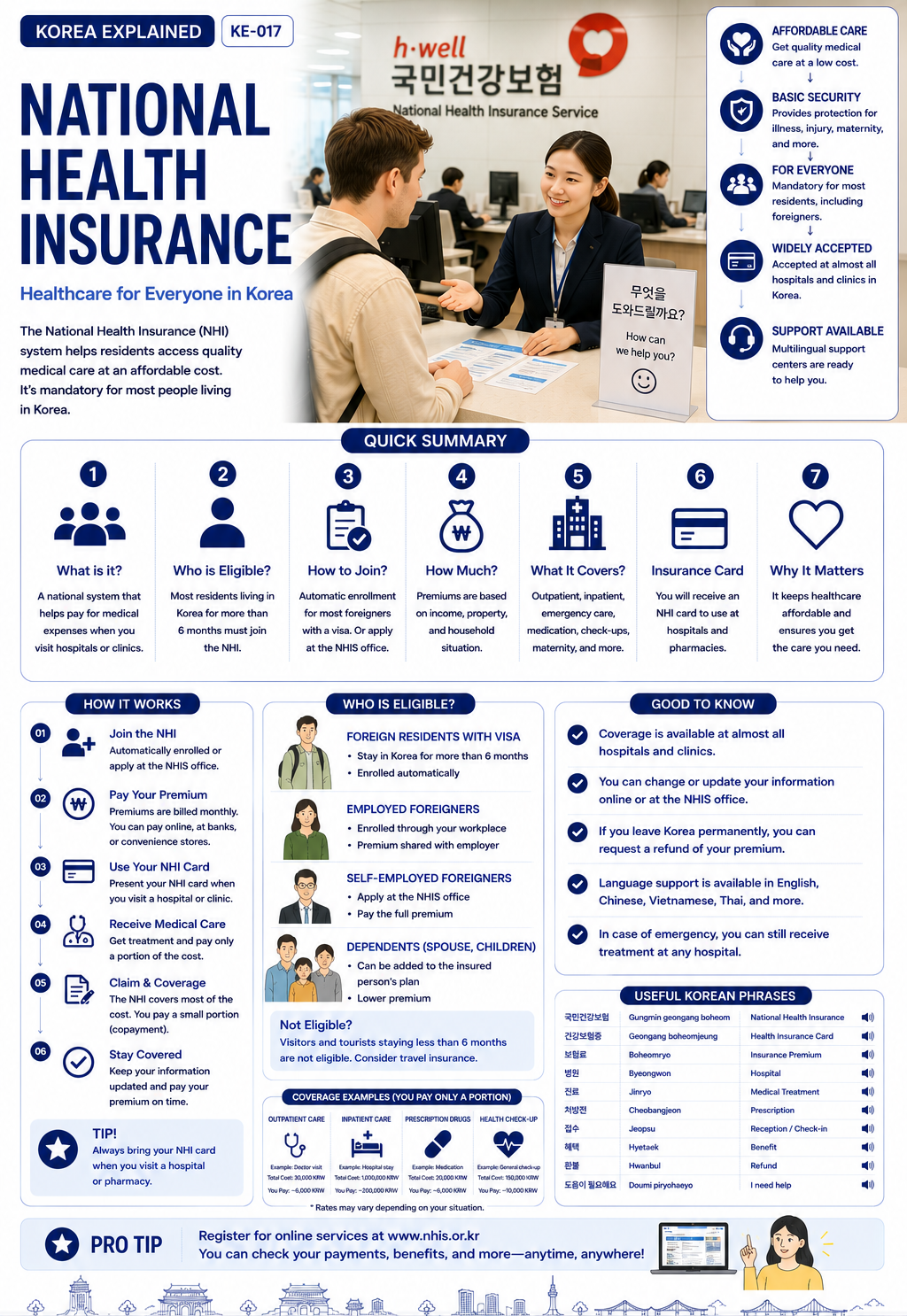
National health insurance in Korea — ASK KOREA infographic
01 — Overview

Quick Summary

Korea's public services are dense, digital and unusually well maintained, from transport to healthcare to neighbourhood libraries. Most services are open to residents; some are open to everyone, and a few require registration and a Korean identity number.

Key takeaways

  • National Health Insurance covers residents and is generally mandatory for long stays.
  • Public transport is state-supported, cheap and integrated across cities.
  • District libraries, sports centres and community classes are open to local residents at low cost.
  • Visitors should carry travel insurance, since they are not covered by national insurance.
  • Emergency care is available to everyone regardless of status.
02 — Full Guide

The Complete Guide

Healthcare

Korea's National Health Insurance Service covers a large share of medical costs for enrolled residents. Enrolment is generally required once you are staying long term, and contributions are calculated from income or a standard rate. Clinics are plentiful, waiting times are short, and standards are high.

  • Residents enrol through the National Health Insurance Service
  • Contributions are usually deducted or billed monthly
  • Pharmacies are separate from clinics and sit close by
  • Visitors should rely on travel insurance instead

Transport and city infrastructure

Public transport is the clearest example of Korean public service quality. Subways, buses and intercity rail are frequent, affordable and integrated with a single transport card. Stations are accessible, well signposted in English and consistently clean.

  • One transport card works across subway, bus and taxi in most cities
  • Transfers between bus and subway are discounted
  • Intercity rail connects most of the country within a few hours

Neighbourhood services

Beyond the headline services, districts run libraries, sports centres, cultural classes and welfare programmes. These are among the best value services in Korea and are usually available to anyone registered in the district.

  • Public libraries with study rooms and free Wi-Fi
  • Low-cost swimming pools and gyms
  • Language, cooking and craft classes run by district centres
  • Support programmes for foreign residents in many districts

Frequently asked questions

  • Is healthcare free? No — insurance covers a large portion and you pay the rest at the counter.
  • Can tourists use public libraries? Reading rooms are usually open; borrowing normally requires registration.
  • Do I need Korean to use these services? Basic Korean helps, but signage and apps are increasingly bilingual.
  • What if I have an emergency? Call 119; emergency treatment does not depend on insurance status.

Official resources

  • National Health Insurance Service (nhis.or.kr) — enrolment and coverage
  • Government24 (gov.kr) — public service directory
  • Korea Tourism Organization 1330 — traveller support in English
  • Your district office website for local facilities and classes
Pro Tips

Pro Tips

  • Register for health insurance as soon as you are eligible; gaps can create back-payments.
  • Ask your district office what foreign resident programmes exist — most people never find out.
  • Keep receipts from clinics; some are reimbursable through private or travel insurance.
Ask AI

Ask AI About This Topic

AI Assistant

Have a question about Public Services in Korea?

Get instant, locally-checked answers from the ASK KOREA AI. Ask anything from specific edge cases to itinerary decisions.

Ask this question
Suggested prompt

"Explain the main public services available in Korea and which ones a foreign resident can use."

ASK KOREA Transit