Government & Administration · Guide 02

National vs Local Government

Who does what between ministries, metropolitan cities, provinces and the district office on your street.

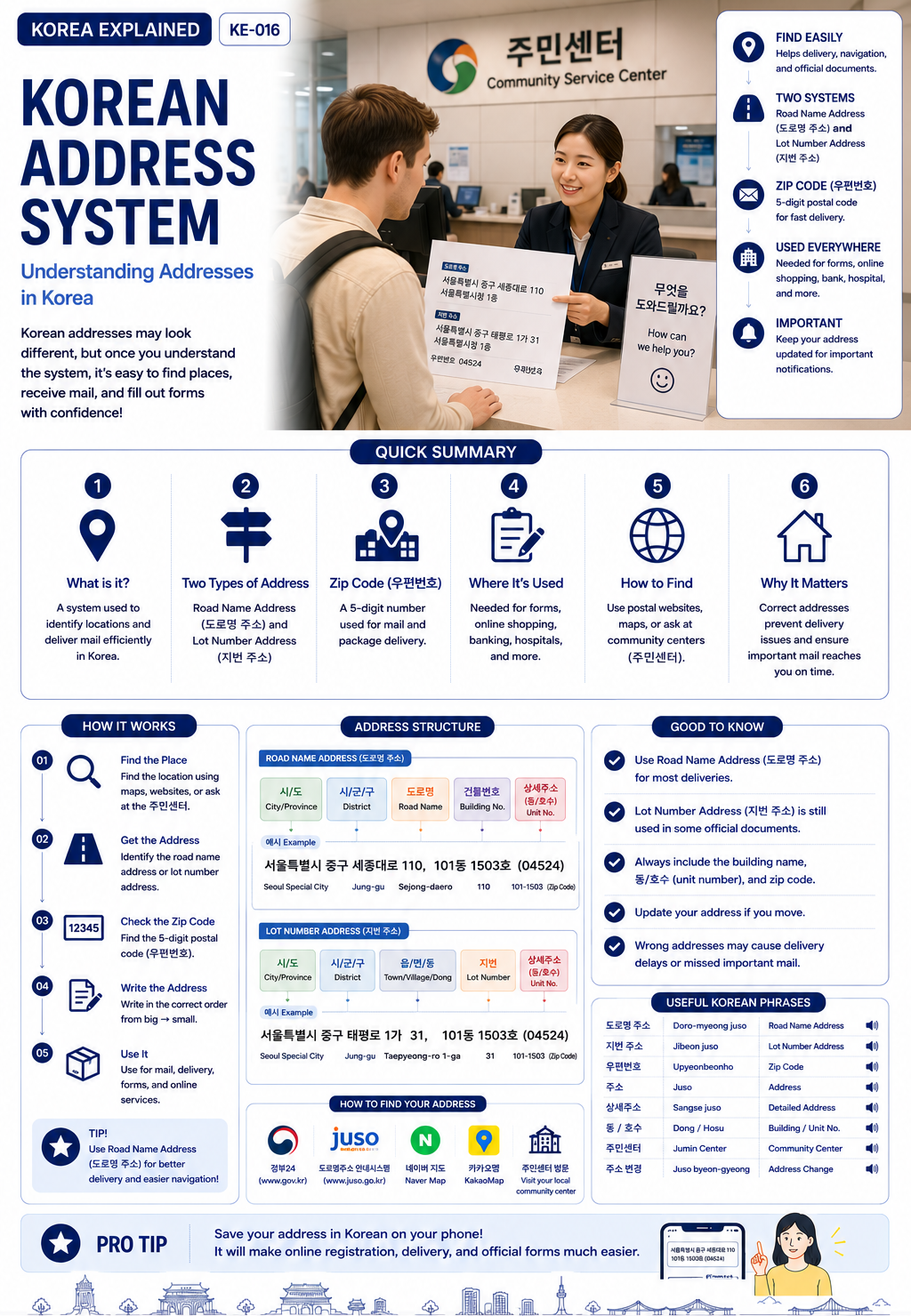
Korean address system — ASK KOREA infographic
01 — Overview

Quick Summary

National government sets policy and law; local government delivers most of the services you will actually use. Korea is divided into metropolitan cities and provinces, then into districts (gu), cities (si), counties (gun) and neighbourhoods (dong) — the same hierarchy you see inside a Korean address.

Key takeaways

  • Seoul, Busan and other metropolitan cities have their own mayors and budgets.
  • Provinces (do) cover wider regions and contain smaller cities and counties.
  • Districts (gu) and neighbourhoods (dong) run the offices closest to residents.
  • Local governments handle waste, parking, welfare, local health centres and residence paperwork.
  • A Korean address reads from the largest unit down to the building — the same logic as the administrative map.
02 — Full Guide

The Complete Guide

The administrative map in one paragraph

Above everything sits the national government. Below it are metropolitan cities such as Seoul and Busan, special self-governing units such as Jeju and Sejong, and provinces such as Gyeonggi or Gangwon. Each of those is divided again into districts, cities or counties, and finally into neighbourhoods.

  • National — ministries and national agencies
  • Metropolitan city / province — mayors and governors
  • District (gu), city (si), county (gun) — local administration
  • Neighbourhood (dong / eup / myeon) — community service centres

Who handles what

As a rule of thumb: anything about your legal status in the country is national, and anything about your daily life in a place is local. Visas are national. Recycling rules, local health centres and residence certificates are local.

  • National: visas, immigration, tax law, health insurance rules
  • Local: waste and recycling, parking, community centres, local welfare
  • Local: residence registration and many certificates
  • Shared: public health campaigns and disaster response

Why addresses matter

Korea uses road-name addresses today, but the older lot-number system still appears on documents and older signage. Both encode the administrative hierarchy, which is why staff will often ask which gu or dong you live in before telling you which office to visit.

  • Road-name address: city → district → road name → building number
  • Lot-number address: city → district → neighbourhood → lot number
  • Your dong determines your community service centre

Frequently asked questions

  • Which office should I go to first? The community service centre of the dong where you live, unless the matter is immigration.
  • Do rules differ between cities? Details such as waste bag colours, parking and some subsidies do differ by district.
  • Do I need my Korean address in Korean? It helps enormously — save it in Korean text on your phone.
  • Can I use any district office? For many national certificates yes, but residence matters usually belong to your own district.

Official resources

  • Government24 (gov.kr) — find your local office and available services
  • Juso (juso.go.kr) — official Korean address lookup
  • Seoul Metropolitan Government (english.seoul.go.kr) — city-level information
  • Your district office website, usually linked from the city portal
Pro Tips

Pro Tips

  • Store your address in both Korean and English — couriers, taxis and offices all ask.
  • Photograph the road-name plate outside your building the day you arrive.
  • If an office says you are in the wrong place, ask them to write the correct office name in Korean.
Ask AI

Ask AI About This Topic

AI Assistant

Have a question about National vs Local Government?

Get instant, locally-checked answers from the ASK KOREA AI. Ask anything from specific edge cases to itinerary decisions.

Ask this question
Suggested prompt

"Explain the difference between national and local government in Korea and which one handles the services a foreign resident needs."

ASK KOREA Transit