Government & Administration · Guide 03

Resident & District Offices

What happens inside a Korean community service centre and how to prepare before you walk in.

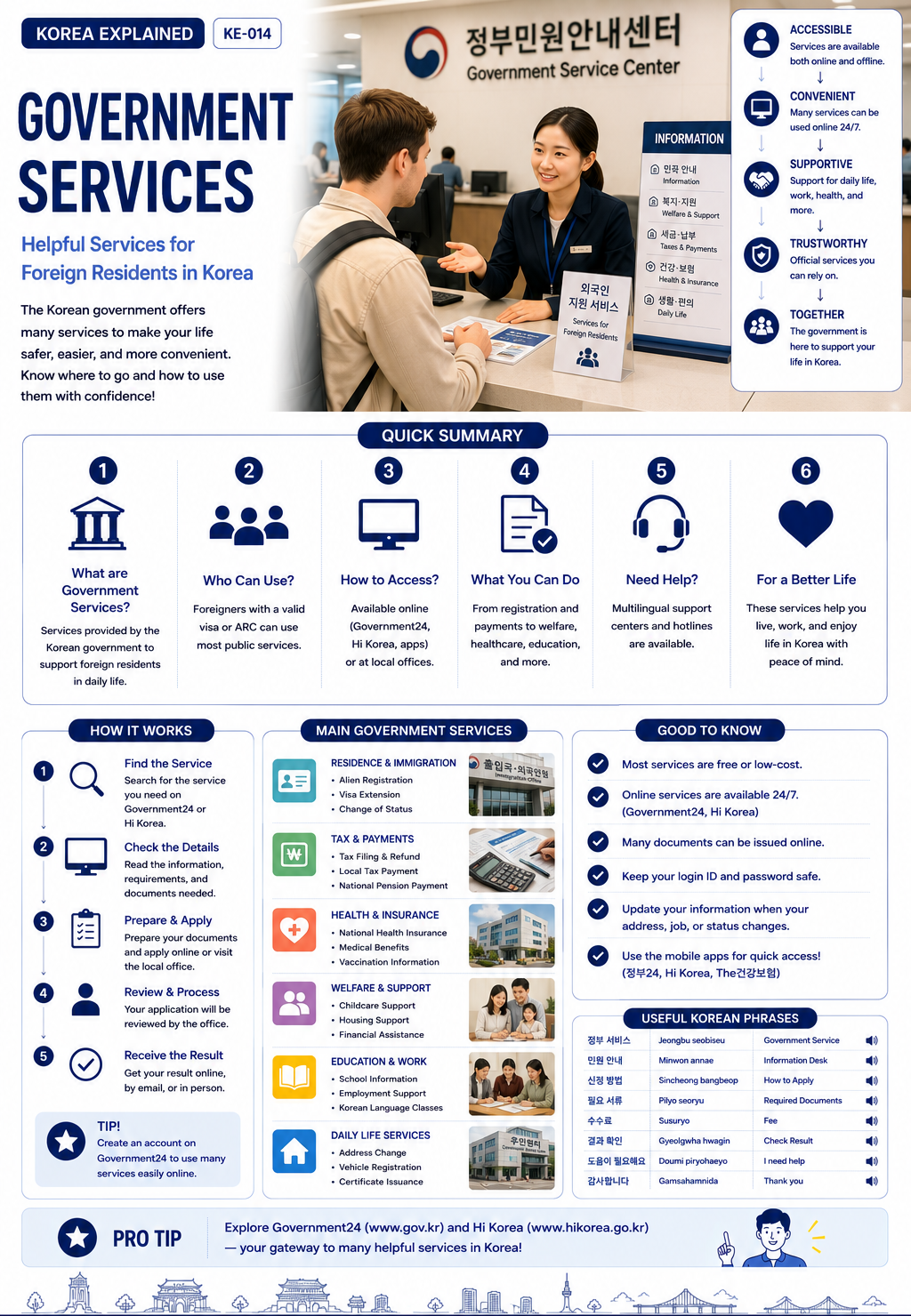
Government services — ASK KOREA infographic
01 — Overview

Quick Summary

The community service centre of your neighbourhood is the single most useful public building for anyone living in Korea. They handle residence paperwork, certificates, local welfare programmes and a surprising number of small everyday services.

Key takeaways

  • Every dong has a community service centre, usually within walking distance.
  • District (gu) offices handle larger matters and sit above the dong offices.
  • Bring your passport and residence card for anything involving your identity.
  • Ticket machines manage the queue; take a number as soon as you enter.
  • Many services are also available online through Government24.
02 — Full Guide

The Complete Guide

What these offices do

A community service centre issues certificates, records address changes for registered residents, processes some welfare and childcare applications, and answers general administrative questions. District offices handle business registration, larger permits and matters that cover several neighbourhoods.

  • Residence and address records
  • Official certificates and document copies
  • Local welfare, childcare and senior programmes
  • Community classes, libraries and facility bookings in many districts

How a visit actually goes

Offices are calm, clean and efficient. You take a numbered ticket, wait a short time, and are called to a desk. Staff will usually try English or use a translation app, and larger districts often have a dedicated foreign resident helpdesk.

  • Typical hours are weekdays, roughly 09:00 to 18:00, closed on public holidays
  • Take a queue ticket for the correct category on arrival
  • Bring original documents — photocopies are often not accepted
  • Card payment is normal for small certificate fees

Preparing before you go

The most common reason for a wasted trip is a missing document. Confirm the required list on the official portal or by phone before travelling, and take more identification than you think you need.

  • Passport and, if you have one, your residence card
  • Proof of address such as a lease, when relevant
  • Any reference number you were given by another office
  • A translation app on your phone

Frequently asked questions

  • Can tourists use these offices? Mostly no — they serve registered residents, though some tourist information is available.
  • Is English available? Often at some level, and larger districts have foreign resident support desks.
  • Do I need an appointment? Usually not, but going mid-morning on a weekday avoids the longest waits.
  • Can I do it online instead? Many certificates are available through Government24 if you have Korean online identity verification.

Official resources

  • Government24 (gov.kr) — service list, required documents and online issuance
  • Hi Korea (hikorea.go.kr) — for anything immigration-related
  • Your district office website for local programmes
  • 120 Dasan Call Center in Seoul for local administrative questions
Pro Tips

Pro Tips

  • Go early in the morning or shortly after lunch; the last hour of the day is often busiest.
  • Keep a photo of every document you submit anywhere in Korea.
  • Ask staff to write the name of the next office or document in Korean before you leave.
Ask AI

Ask AI About This Topic

AI Assistant

Have a question about Resident & District Offices?

Get instant, locally-checked answers from the ASK KOREA AI. Ask anything from specific edge cases to itinerary decisions.

Ask this question
Suggested prompt

"Explain what a Korean community service centre does and how a foreign resident should prepare for a visit."

ASK KOREA Transit