Korean Society · Guide 08

Low Birth Rate

Korea's fertility rate is the world's lowest — the causes, the government response and what it means for daily life.

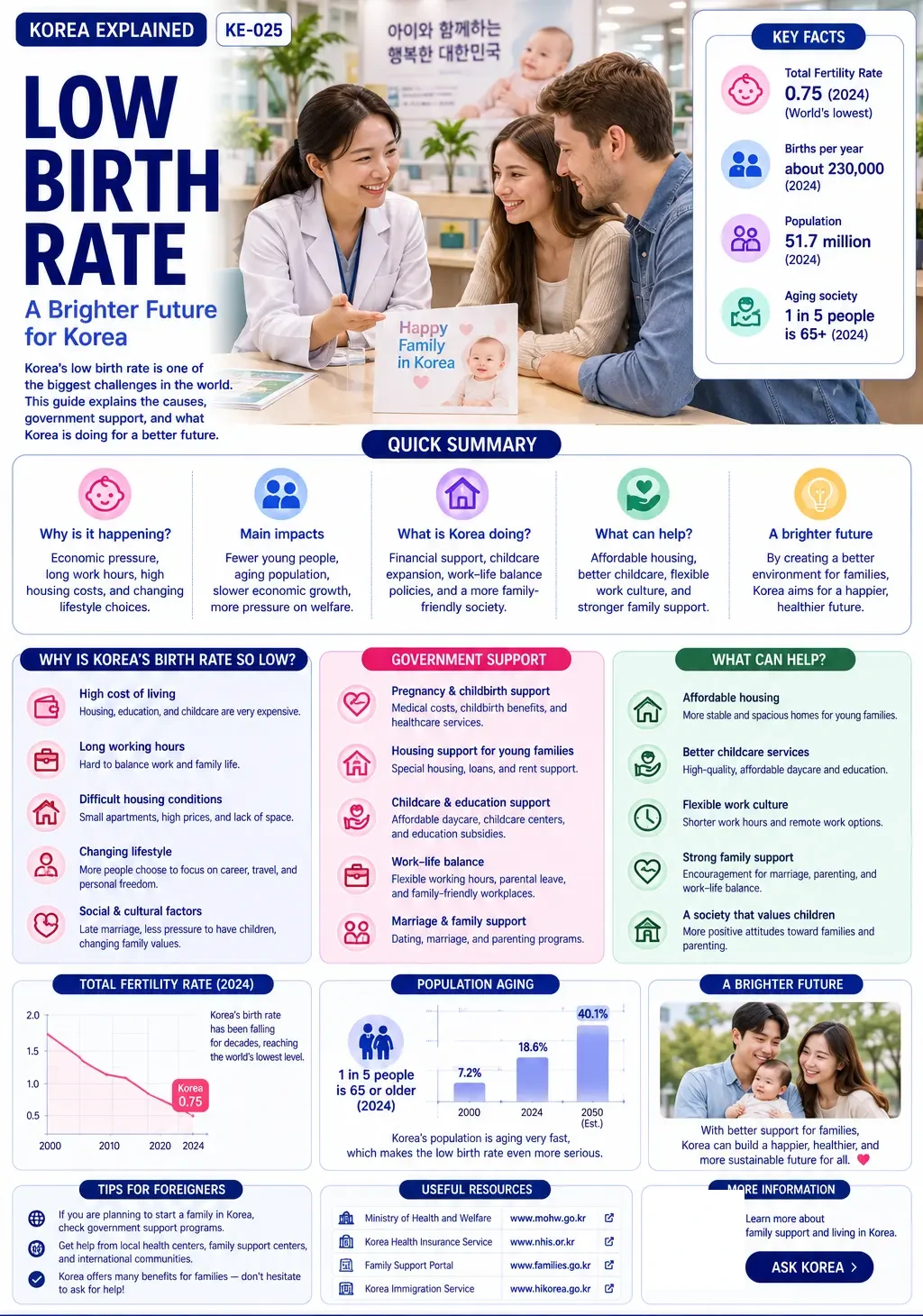
Korea's low birth rate — ASK KOREA infographic
01 — Overview

Quick Summary

Korea's total fertility rate was around 0.75 in 2024, the lowest in the world, with roughly 230,000 births that year. The causes are economic and cultural, and the government has responded with financial, housing and childcare support.

Key takeaways

  • Total fertility rate: about 0.75 in 2024; population about 51.7 million.
  • One in five people in Korea is aged 65 or older.
  • High living costs, long working hours and housing pressure are the main drivers.
  • Government support covers pregnancy, childbirth, housing and childcare.
  • Affordable housing, better childcare and flexible work culture are seen as the key fixes.
02 — Full Guide

The Complete Guide

Why the birth rate is so low

The reasons are practical more than ideological. Raising a child in Korea is expensive, work hours are long, and housing in major cities is small and costly.

  • High cost of living — housing, education and childcare
  • Long working hours make work-family balance difficult
  • Difficult housing conditions in big cities
  • Changing lifestyles — more focus on career, travel and personal freedom
  • Social and cultural shifts — later marriage, changing family values

What it means for Korea

Fewer births mean a shrinking young population, an ageing society, slower economic growth and greater pressure on welfare systems.

  • Fewer young people entering the workforce
  • Rapidly ageing population
  • Slower long-term economic growth
  • More pressure on pensions and welfare

Government support

  • Pregnancy and childbirth — medical costs, childbirth benefits, healthcare
  • Housing support for young families — special housing, loans and rent support
  • Childcare and education support — affordable daycare and subsidies
  • Work-life balance — flexible hours, parental leave, family-friendly workplaces
  • Marriage and family support programmes

What could help

  • Affordable, more spacious housing for young families
  • High-quality, affordable childcare
  • Shorter working hours and remote work options
  • Stronger family and community support
  • A society that values children and parenting

Useful resources

  • Ministry of Health and Welfare (mohw.go.kr)
  • National Health Insurance Service (nhis.or.kr)
  • Family Support Portal (familynet.or.kr)
  • Korea Immigration Service (hikorea.go.kr)
Pro Tips

Pro Tips

  • If you plan to start a family in Korea, check government support programmes first.
  • Local health centres and family support centres help foreign residents too.
  • Many benefits are not automatic — you usually need to apply.
Ask AI

Ask AI About This Topic

AI Assistant

Have a question about Low Birth Rate?

Get instant, locally-checked answers from the ASK KOREA AI. Ask anything from specific edge cases to itinerary decisions.

Ask this question
Suggested prompt

"Explain why Korea's birth rate is so low and what support exists for families."

ASK KOREA Transit