Korean Society · Guide 09

Aging Society

Korea is ageing faster than any other country — what a super-aged society means and how Korea is responding.

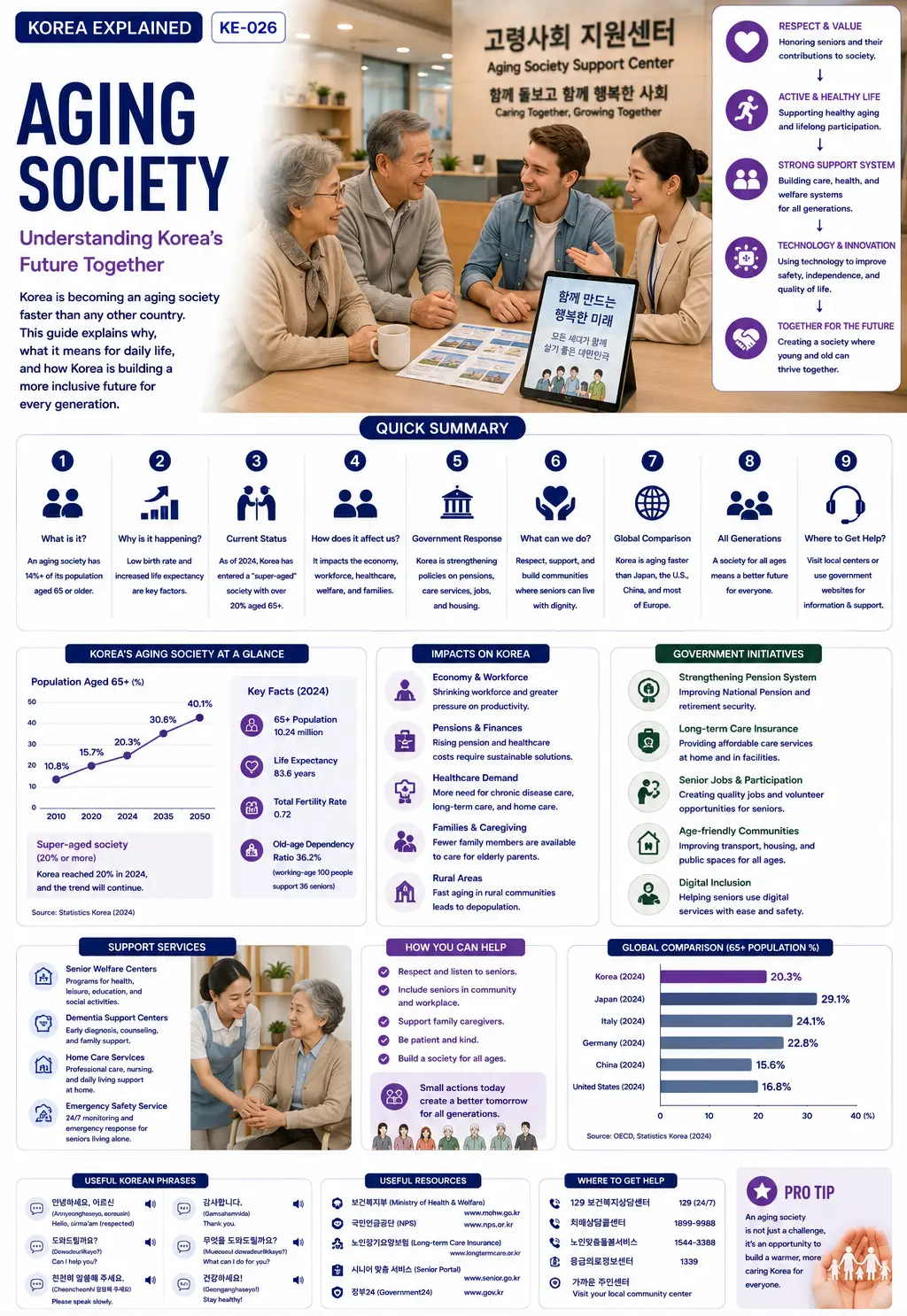
Korea's aging society — ASK KOREA infographic
01 — Overview

Quick Summary

As of 2024 Korea has entered a super-aged society, with more than twenty percent of the population aged 65 or older. Low birth rates and rising life expectancy are the drivers, and the response spans pensions, care services, jobs and age-friendly cities.

Key takeaways

  • An aged society means 14 percent or more of the population is 65+; Korea passed 20 percent in 2024.
  • 65+ population is around 10.24 million; life expectancy is about 83.6 years.
  • Korea is ageing faster than Japan, the United States, China and most of Europe.
  • Impacts reach the workforce, pensions, healthcare and rural communities.
  • Support includes senior welfare centres, dementia centres, home care and emergency safety services.
02 — Full Guide

The Complete Guide

Where Korea stands

The share of Koreans aged 65 and over has climbed from 10.8 percent in 2010 to 20.3 percent in 2024, and is projected to approach 40 percent by 2050.

  • 2010 — 10.8 percent aged 65+
  • 2020 — 15.7 percent
  • 2024 — 20.3 percent, a super-aged society
  • 2050 — projected around 40 percent
  • Old-age dependency ratio: 36.2 percent in 2024

Impacts on Korea

  • Economy and workforce — a shrinking labour pool and productivity pressure
  • Pensions and finances — rising costs require sustainable solutions
  • Healthcare demand — more chronic disease, long-term and home care
  • Families and caregiving — fewer family members available to care for elderly parents
  • Rural areas — fast ageing leads to depopulation

Government initiatives

  • Strengthening the National Pension and retirement security
  • Long-term care insurance for affordable home and facility care
  • Senior jobs and volunteer participation programmes
  • Age-friendly communities — transport, housing and public spaces
  • Digital inclusion so seniors can use digital services safely

Support services

  • Senior welfare centres — health, leisure, education and social activities
  • Dementia support centres — early diagnosis, counselling and family support
  • Home care services — professional care, nursing and daily living support
  • Emergency safety service — 24/7 monitoring for seniors living alone

Where to get help

  • 129 — Health and Welfare Call Center, 24/7
  • 1899-9988 — dementia counselling centre
  • 1544-3388 — senior care service
  • 1339 — emergency medical information centre
  • Ministry of Health and Welfare (mohw.go.kr), National Pension Service (nps.or.kr), Senior Portal (senior.go.kr)
Pro Tips

Pro Tips

  • Local community centres run programmes for older residents, including foreign residents.
  • Long-term care insurance is separate from health insurance — check eligibility early.
  • Small everyday courtesies towards seniors matter a great deal in Korea.
Ask AI

Ask AI About This Topic

AI Assistant

Have a question about Aging Society?

Get instant, locally-checked answers from the ASK KOREA AI. Ask anything from specific edge cases to itinerary decisions.

Ask this question
Suggested prompt

"Explain what Korea's super-aged society means and what support exists for older people."

ASK KOREA Transit