Korean Society · Guide 01

Education System

How Korean schooling works from kindergarten to university — school levels, the academic year and support for foreign students.

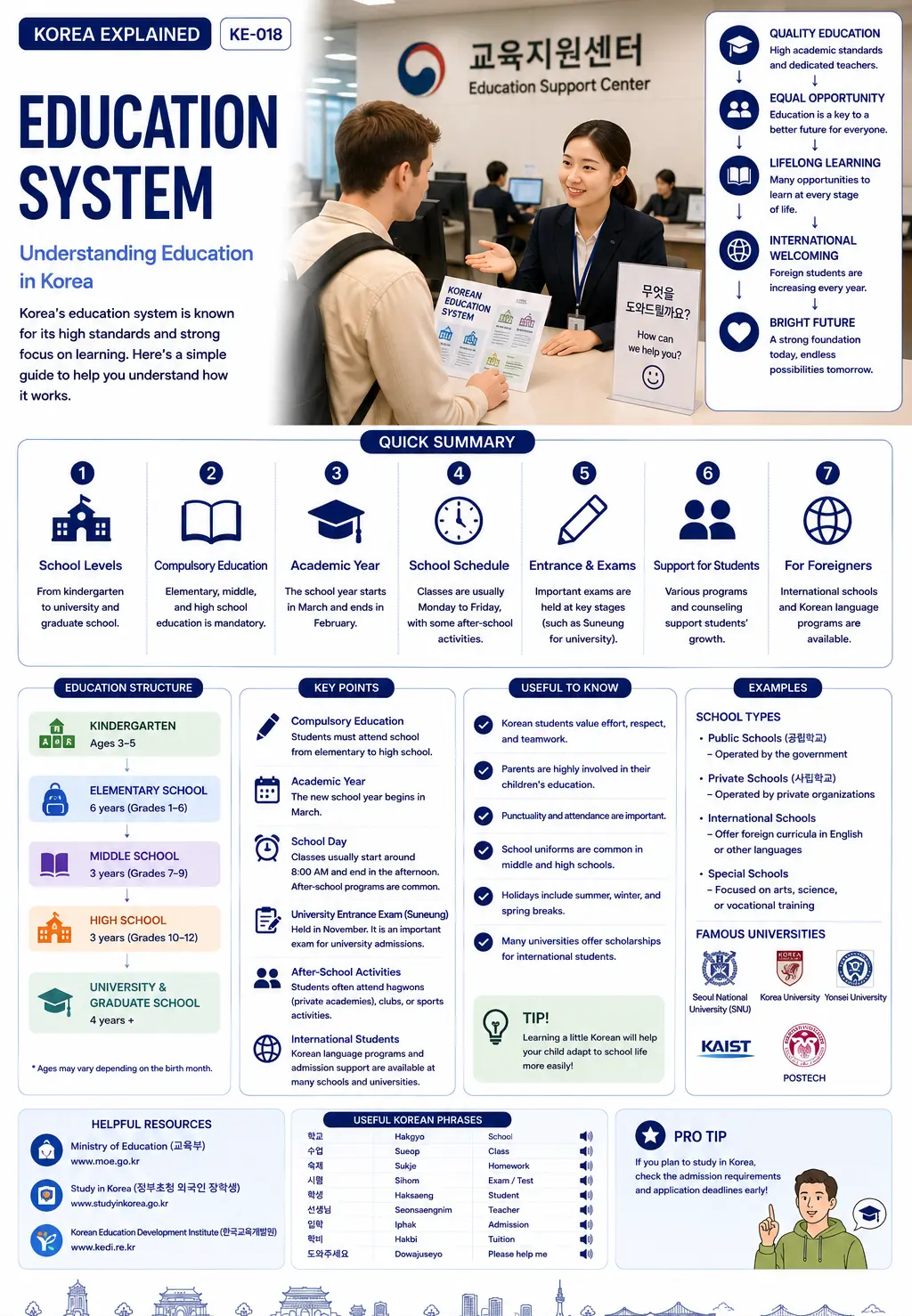
Education System in Korea — ASK KOREA infographic
01 — Overview

Quick Summary

Korea's education system is known for high academic standards, strong parental involvement and a school year that begins in March. Elementary through high school covers twelve years, and international schools plus Korean language programmes give foreign families several routes.

Key takeaways

  • Kindergarten runs from ages three to five, followed by six years of elementary school.
  • Middle school is three years and high school is three years; the academic year starts in March and ends in February.
  • Elementary through middle school education is compulsory.
  • Suneung, the university entrance exam, is held each November and dominates the senior year.
  • Public, private, international and special schools all exist, and many universities offer scholarships for international students.
02 — Full Guide

The Complete Guide

The structure at a glance

Korean schooling follows a 6-3-3-4 pattern: six years of elementary school, three of middle school, three of high school and four or more years of university or graduate study. Ages can shift slightly depending on the birth month.

  • Kindergarten — ages 3 to 5
  • Elementary school — 6 years, grades 1 to 6
  • Middle school — 3 years, grades 7 to 9
  • High school — 3 years, grades 10 to 12
  • University and graduate school — 4 years and up

The school year and daily rhythm

The new academic year begins in March, not September. Classes usually run Monday to Friday from around 8:00 AM into the afternoon, and after-school programmes are common. Holidays fall in summer, winter and a short spring break.

  • School day typically starts near 8:00 AM
  • After-school clubs, sports and hagwon classes fill the evening
  • School uniforms are standard in middle and high school
  • Punctuality and attendance are taken seriously

Exams and university entrance

The Suneung (CSAT) is held in November and is the single most important exam for university admission. The whole country adjusts around it — offices open later and flights are paused during the listening section.

  • Suneung determines most university placements
  • Many students also use school records and essay-based admissions
  • Competition is highest for Seoul-based universities

Options for foreign families

Foreign residents can enrol children in public schools, private schools or international schools. International schools offer foreign curricula in English or other languages, while public schools often provide Korean language support.

  • Public schools (공립학교) — operated by the government
  • Private schools (사립학교) — run by private organisations
  • International schools — foreign curricula, taught in English or another language
  • Special schools — arts, science or vocational focus

Official resources

  • Ministry of Education (moe.go.kr)
  • Study in Korea (studyinkorea.go.kr) — government scholarships for foreign students
  • Korean Educational Development Institute (kedi.re.kr)
Pro Tips

Pro Tips

  • Check admission requirements and deadlines early if you plan to study in Korea.
  • Learning a little Korean helps children settle into school life far more quickly.
  • Ask the local education support centre about language classes for newly arrived students.
Ask AI

Ask AI About This Topic

AI Assistant

Have a question about Education System?

Get instant, locally-checked answers from the ASK KOREA AI. Ask anything from specific edge cases to itinerary decisions.

Ask this question
Suggested prompt

"Explain how the Korean school system is structured and what options foreign families have."

ASK KOREA Transit