Korean Society · Guide 03

Healthcare System

Quality care at reasonable cost — how hospitals, clinics and National Health Insurance work in Korea.

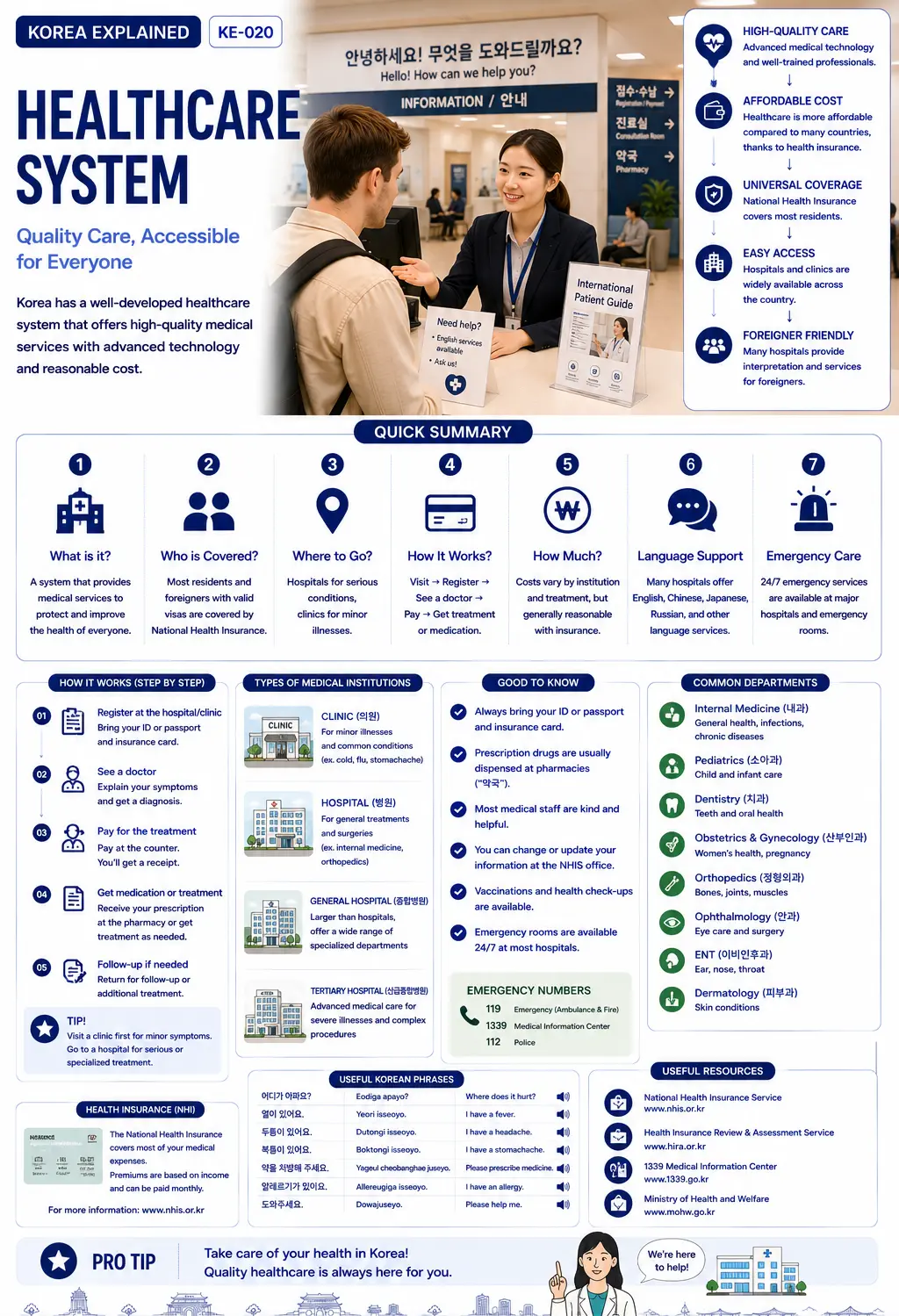
Healthcare system in Korea — ASK KOREA infographic
01 — Overview

Quick Summary

Korea has a well-developed healthcare system offering advanced technology at reasonable cost, underpinned by National Health Insurance. Most residents and foreigners with valid visas are covered, and many hospitals provide interpretation for international patients.

Key takeaways

  • National Health Insurance covers most residents, including many foreign residents.
  • Visit a clinic for minor illnesses and a hospital for serious or specialised care.
  • The flow is simple: register, see a doctor, pay, then collect medication at a pharmacy.
  • Emergency rooms operate 24/7 at most hospitals; 119 is the ambulance and fire number.
  • Bring your ID or passport and your insurance card to every visit.
02 — Full Guide

The Complete Guide

How a visit works

Korean medical visits are fast and follow a predictable sequence. Most clinics accept walk-ins and the whole visit often takes under an hour.

  • Register at the reception desk with your ID and insurance card
  • See the doctor, explain your symptoms and get a diagnosis
  • Pay at the counter and receive your receipt
  • Collect medication at a nearby pharmacy (약국) with your prescription
  • Return for follow-up if the doctor asks you to

Types of medical institutions

Choosing the right level of institution saves both time and money. Starting at a clinic for minor symptoms is usually the fastest route.

  • Clinic (의원) — minor illnesses such as colds, flu or stomach aches
  • Hospital (병원) — general treatments and surgeries
  • General hospital (종합병원) — wide range of specialised departments
  • Tertiary hospital (상급종합병원) — advanced care for severe or complex conditions

National Health Insurance

The National Health Insurance Service (NHIS) covers most medical expenses. Premiums are based on income and can be paid monthly. Coverage brings the cost of routine care down sharply.

  • Most residents and foreigners with valid visas are enrolled
  • Vaccinations and regular health check-ups are available
  • You can change or update your information at an NHIS office

Emergencies and language support

Emergency rooms are available around the clock at most hospitals, and many large hospitals offer English, Chinese, Japanese and Russian interpretation.

  • 119 — emergency ambulance and fire
  • 1339 — medical information centre
  • 112 — police

Official resources

  • National Health Insurance Service (nhis.or.kr)
  • Health Insurance Review & Assessment Service (hira.or.kr)
  • 1339 Medical Information Center (1339.go.kr)
  • Ministry of Health and Welfare (mohw.go.kr)
Pro Tips

Pro Tips

  • Save 119 and 1339 in your phone before you need them.
  • Keep your insurance card with your ID — you will be asked for both at reception.
  • For minor symptoms, a neighbourhood clinic is far faster than a large hospital.
Ask AI

Ask AI About This Topic

AI Assistant

Have a question about Healthcare System?

Get instant, locally-checked answers from the ASK KOREA AI. Ask anything from specific edge cases to itinerary decisions.

Ask this question
Suggested prompt

"Explain how to see a doctor in Korea and what National Health Insurance covers."

ASK KOREA Transit