Korean Society · Guide 02

Hagwon Culture

Private academies are a huge part of Korean learning — what hagwons are, who attends and how to choose one.

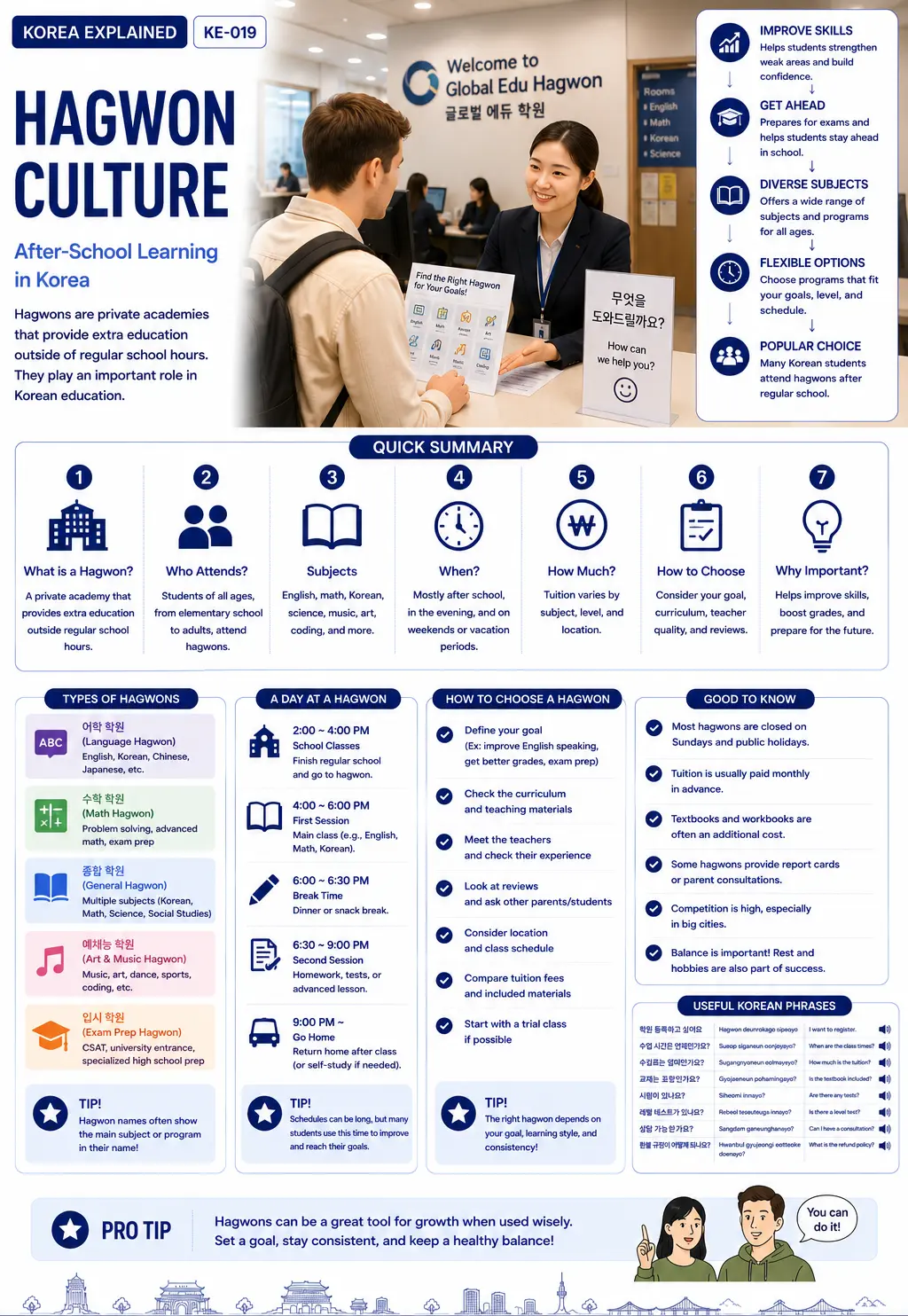
Hagwon culture in Korea — ASK KOREA infographic
01 — Overview

Quick Summary

Hagwons are private academies that provide extra education outside regular school hours, and they play a central role in Korean education. They serve everyone from elementary students to working adults, covering languages, maths, arts, coding and exam preparation.

Key takeaways

  • A hagwon is a private academy offering lessons after school, in the evening or at weekends.
  • Students of all ages attend, from elementary school children to adults.
  • Tuition varies by subject, level and location, and is usually paid monthly in advance.
  • Choose based on your goal, the curriculum, teacher experience and reviews.
  • Balance matters — rest and hobbies are part of success too.
02 — Full Guide

The Complete Guide

What a hagwon is

A hagwon (학원) is a private academy that supplements regular schooling. Some focus on a single subject, others cover several. Their names usually reveal their speciality.

  • Language academies (어학 학원) — English, Korean, Chinese, Japanese
  • Maths academies (수학 학원) — problem solving and exam preparation
  • General academies (종합 학원) — covering several subjects
  • Arts and sports academies (예체능 학원) — art, music, dance, sports and coding
  • Exam-prep academies (입시 학원) — CSAT and university entrance preparation

A typical hagwon day

For school-age students, hagwon time begins where school ends. Sessions run in blocks with a dinner or snack break between them, and students often head home around 9:00 PM.

  • 2:00–4:00 PM — regular school finishes, students travel to the hagwon
  • 4:00–6:00 PM — first session, usually the main subject
  • 6:00–6:30 PM — dinner or snack break
  • 6:30–9:00 PM — second session, homework or advanced lessons
  • 9:00 PM — return home, sometimes after self-study

How to choose one

The right hagwon depends on your goal and learning style far more than on brand name. Trial classes are common and worth asking for.

  • Define your goal — speaking, grades or exam preparation
  • Check the curriculum and teaching materials
  • Meet the teachers and ask about their experience
  • Read reviews and ask other parents or students
  • Compare tuition fees and what is included
  • Start with a trial class if one is offered

Good to know

  • Most hagwons close on Sundays and public holidays.
  • Tuition is usually paid monthly in advance.
  • Textbooks and workbooks are often an additional cost.
  • Some hagwons provide report cards or parent consultations.
  • Competition is high, especially in big cities.
Pro Tips

Pro Tips

  • Ask about the refund policy before paying the first month's tuition.
  • Consistency beats intensity — a schedule you can keep is the one that works.
  • Location and class timing matter as much as teaching quality for long-term attendance.
Ask AI

Ask AI About This Topic

AI Assistant

Have a question about Hagwon Culture?

Get instant, locally-checked answers from the ASK KOREA AI. Ask anything from specific edge cases to itinerary decisions.

Ask this question
Suggested prompt

"Explain what a hagwon is in Korea and how to choose the right one for my goals."

ASK KOREA Transit