Korean Work Life · Guide 09

Workplace Communication

How Koreans communicate at work — channels, tone, feedback, honorifics and choosing the right message for the moment.

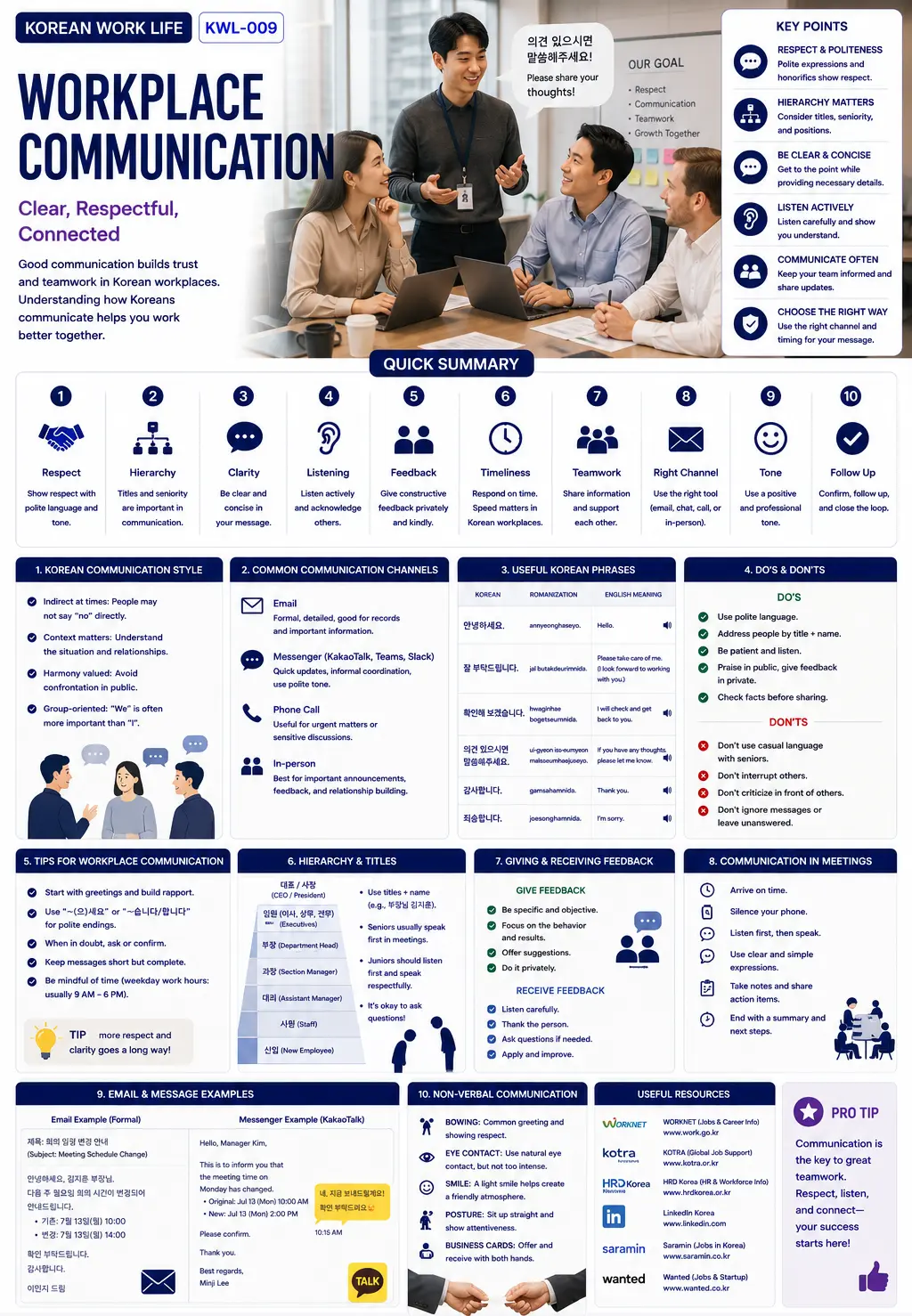
Korean workplace communication — ASK KOREA infographic
01 — Overview

Quick Summary

Good communication builds trust and teamwork in Korean workplaces. Knowing which channel to use, and how to phrase things politely, prevents most misunderstandings.

Key takeaways

  • Polite expressions and honorifics show respect.
  • Titles, seniority and position shape how you speak.
  • Be clear and concise while giving the necessary details.
  • Give constructive feedback privately and kindly.
  • Confirm, follow up and close the loop.
02 — Full Guide

The Complete Guide

Korean communication style

Communication can be indirect: people may not say 'no' directly, and context matters. Harmony is valued, so public confrontation is avoided and the group perspective often comes before the individual.

  • Indirect at times — 'no' is often implied
  • Context and relationships matter
  • Avoid confrontation in public
  • 'We' is often more important than 'I'

Common channels

Different channels carry different expectations. Choosing the right one is part of communicating well.

  • Email — formal, detailed, good for records
  • Messenger (KakaoTalk, Teams, Slack) — quick updates in a polite tone
  • Phone call — urgent or sensitive matters
  • In-person — important announcements, feedback and relationship building

Giving and receiving feedback

Feedback is most effective when it is specific, focused on behaviour and results, and delivered privately. When receiving feedback, listen carefully, thank the person and ask questions if needed.

  • Be specific and objective
  • Focus on behaviour and results, not personality
  • Offer suggestions, and do it privately
  • Praise in public, correct in private

Useful Korean phrases

A handful of expressions cover most daily exchanges.

  • 안녕하세요 (annyeonghaseyo) — Hello
  • 잘 부탁드립니다 (jal butakdeurimnida) — I look forward to working with you
  • 확인해 보겠습니다 (hwaginhae bogetseumnida) — I will check and get back to you
  • 감사합니다 (gamsahamnida) — Thank you
  • 죄송합니다 (joesonghamnida) — I'm sorry
Pro Tips

Pro Tips

  • Use titles plus names, for example 팀장님 김지훈.
  • When in doubt, ask or confirm rather than assume.
  • Be mindful of timing — weekday work hours are usually 9 AM to 6 PM.
Ask AI

Ask AI About This Topic

AI Assistant

Have a question about Workplace Communication?

Get instant, locally-checked answers from the ASK KOREA AI. Ask anything from specific edge cases to itinerary decisions.

Ask this question
Suggested prompt

"How do I communicate politely and effectively with Korean colleagues?"

ASK KOREA Transit