Korean Work Life · Guide 01

Office Culture

Shared values, daily customs and unwritten rules that shape how people work together in Korean offices.

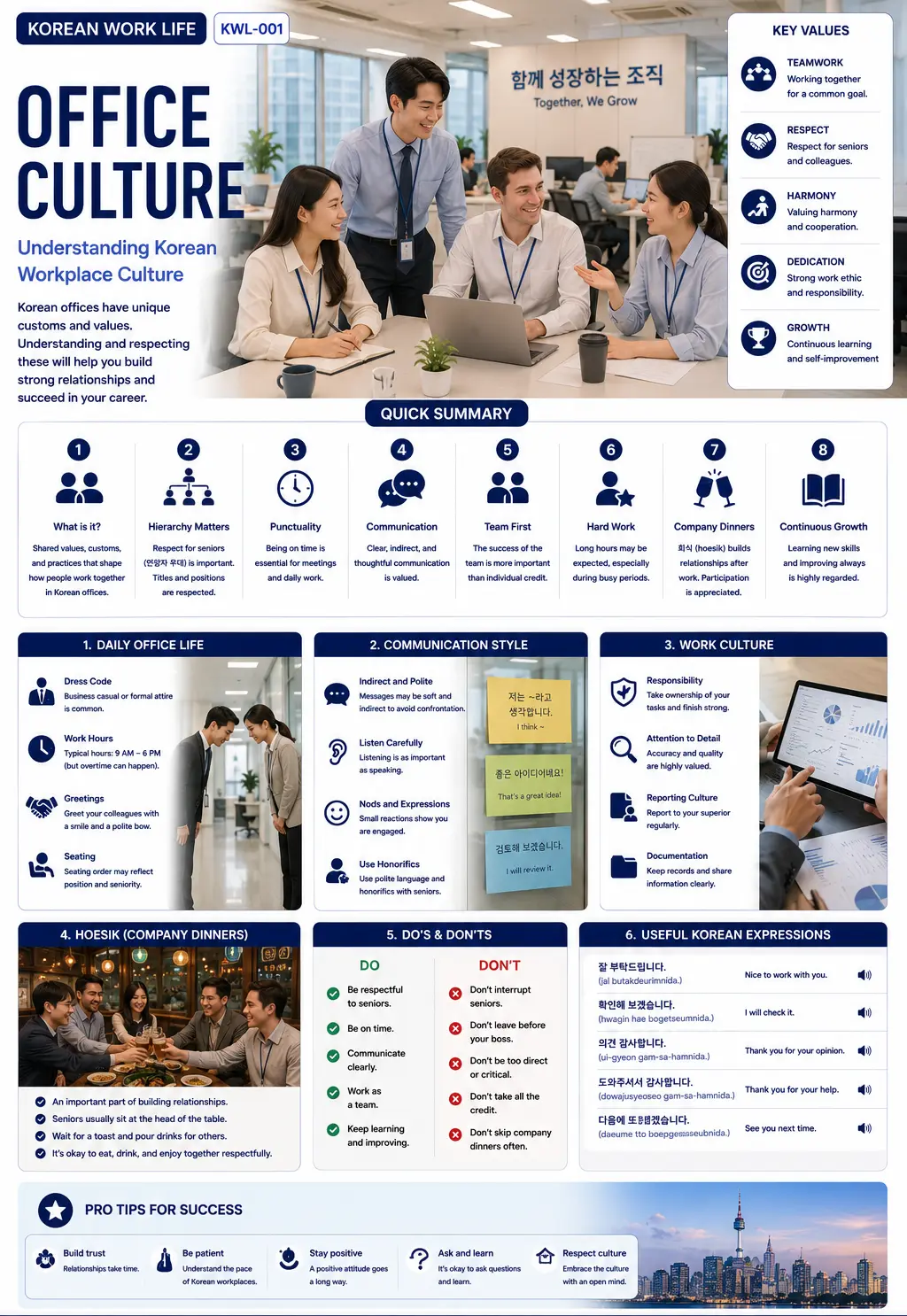
Korean office culture — ASK KOREA infographic
01 — Overview

Quick Summary

Korean offices run on teamwork, respect for seniors, punctuality and a strong sense of shared responsibility. Understanding these everyday customs helps you build trust quickly and settle into a Korean workplace with confidence.

Key takeaways

  • Hierarchy matters: seniority, titles and positions shape how people speak and work together.
  • Punctuality is expected for meetings and daily work.
  • Communication tends to be polite and indirect rather than blunt.
  • Team success is usually valued above individual credit.
  • Hoesik (회식), or company dinners, help build relationships after work.
02 — Full Guide

The Complete Guide

Daily office life

Most offices follow a predictable rhythm. Business casual or formal attire is common, typical hours run from around 9:00 AM to 6:00 PM, and greetings at the start of the day matter more than many newcomers expect.

  • Dress code — business casual or formal attire is common
  • Work hours — typically 9:00 AM to 6:00 PM, though overtime can happen
  • Greetings — greet colleagues with a smile and a polite bow
  • Seating — seating order often reflects position and seniority

Communication style

Messages are often softened to avoid confrontation. Listening carefully is considered as important as speaking, and small reactions show that you are engaged.

  • Indirect and polite phrasing is the norm
  • Listen carefully — listening is as valued as speaking
  • Nods and small expressions show attentiveness
  • Use honorifics and polite language with seniors

Work culture and expectations

Taking ownership of your tasks and reporting progress regularly are the two habits that build the fastest trust. Accuracy and clear documentation are highly valued.

  • Responsibility — take ownership and finish what you start
  • Attention to detail — accuracy and quality are highly valued
  • Reporting culture — update your superior regularly
  • Documentation — keep records and share information clearly

Useful Korean expressions

A few polite phrases go a long way, especially in your first weeks.

  • 잘 부탁드립니다 (jal butakdeurimnida) — Nice to work with you
  • 확인해 보겠습니다 (hwagin hae bogetseumnida) — I will check it
  • 의견 감사합니다 (ui-gyeon gamsahamnida) — Thank you for your opinion
  • 도와주셔서 감사합니다 (dowajusyeoseo gamsahamnida) — Thank you for your help
Pro Tips

Pro Tips

  • Build trust slowly — relationships take time in Korean offices.
  • Be patient and observe the pace before changing how a team works.
  • Ask questions openly; a willingness to learn is respected.
  • Stay positive — attitude counts as much as output.
Ask AI

Ask AI About This Topic

AI Assistant

Have a question about Office Culture?

Get instant, locally-checked answers from the ASK KOREA AI. Ask anything from specific edge cases to itinerary decisions.

Ask this question
Suggested prompt

"Explain Korean office culture for a foreigner starting a new job in Seoul."

ASK KOREA Transit