Korean Work Life · Guide 02

Company Hierarchy

Korean organisational structure explained — job titles, honorifics, reporting lines and how decisions flow.

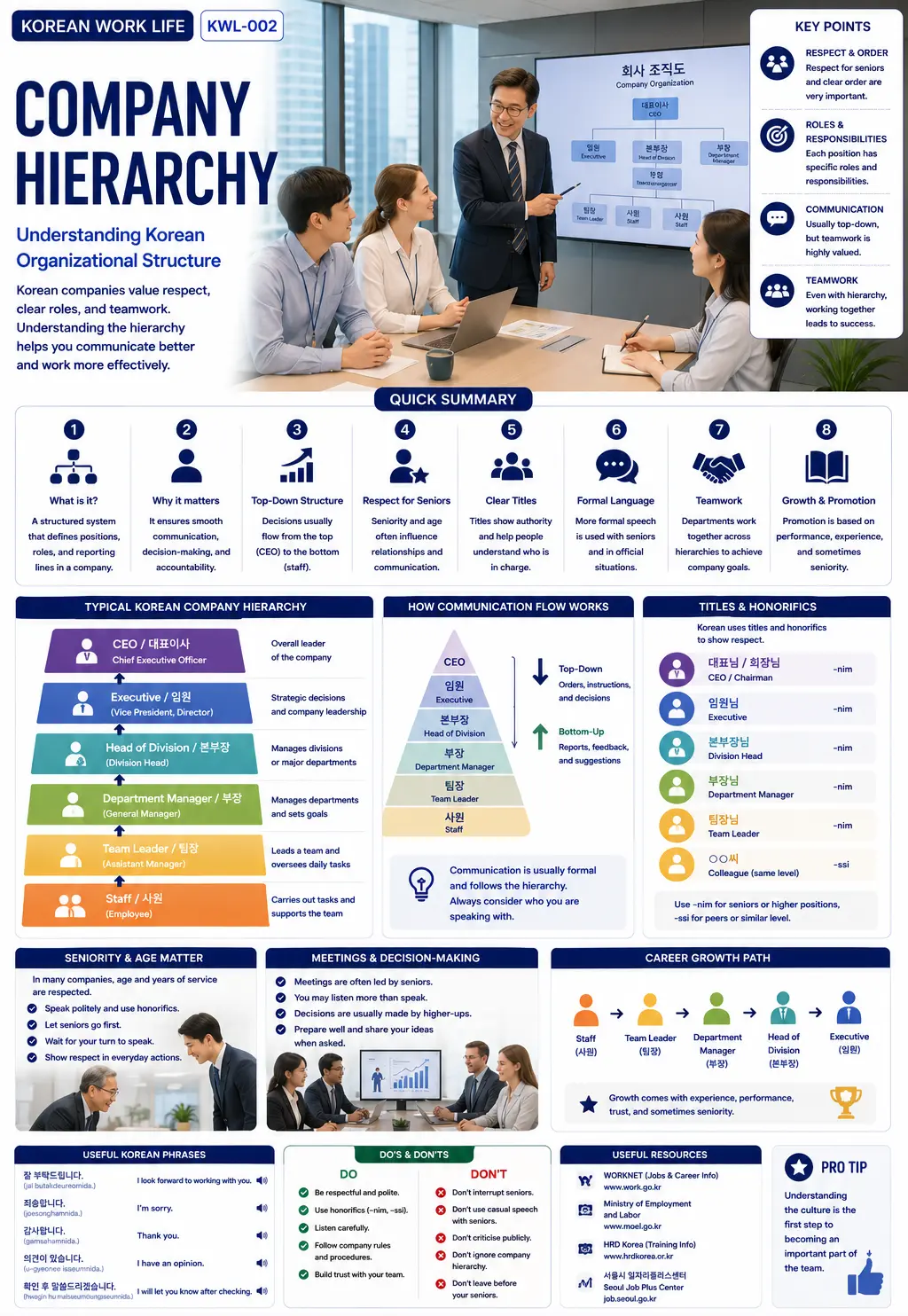
Korean company hierarchy — ASK KOREA infographic
01 — Overview

Quick Summary

Korean companies use a clear structure of positions that defines roles, responsibilities and reporting lines. Knowing the titles and the honorifics that go with them makes daily communication far easier.

Key takeaways

  • Structure is typically top-down, from CEO (대표이사) to staff (사원).
  • Seniority and age often influence relationships and speech.
  • Titles show authority and help everyone understand who is in charge.
  • More formal language is used with seniors and in official situations.
  • Promotion is based on performance, experience and sometimes seniority.
02 — Full Guide

The Complete Guide

A typical Korean company hierarchy

Most companies use a recognisable ladder of positions. Titles vary slightly between firms, but the order is broadly consistent.

  • CEO / 대표이사 — overall leader of the company
  • Executive / 임원 — strategic decisions and company leadership
  • Head of Division / 본부장 — manages divisions or major departments
  • Department Manager / 부장 — manages departments and sets goals
  • Team Leader / 팀장 — leads a team and oversees daily tasks
  • Staff / 사원 — carries out tasks and supports the team

How communication flows

Instructions and decisions usually travel top-down, while reports, feedback and suggestions travel bottom-up. Communication is generally formal and follows the hierarchy, so it helps to consider who you are speaking with before you speak.

  • Top-down — orders, instructions and decisions
  • Bottom-up — reports, feedback and suggestions
  • Escalate through your team leader rather than skipping levels

Titles and honorifics

Korean adds honorific suffixes to titles to show respect. Using the right one is a simple way to show cultural awareness.

  • -님 (nim) — for seniors or higher positions, e.g. 부장님, 팀장님
  • -씨 (ssi) — for peers or colleagues at a similar level
  • CEO or Chairman — 대표님 / 회장님
  • Division Head — 본부장님

Meetings, decisions and career growth

Meetings are often led by seniors, and decisions usually come from higher up after discussion. Careers typically progress from staff to team leader, department manager, head of division and executive.

  • Let seniors speak first and wait for your turn
  • Prepare well and share ideas when asked
  • Growth comes with experience, performance and trust
Pro Tips

Pro Tips

  • Learn your team's titles in your first week — it prevents awkward moments.
  • Use honorifics consistently, even in messenger chats.
  • When unsure of someone's rank, use the more polite form.
Ask AI

Ask AI About This Topic

AI Assistant

Have a question about Company Hierarchy?

Get instant, locally-checked answers from the ASK KOREA AI. Ask anything from specific edge cases to itinerary decisions.

Ask this question
Suggested prompt

"Explain Korean company job titles and honorifics for a new foreign employee."

ASK KOREA Transit