Korean Work Life · Guide 06

Working Hours

Korea's legal workweek, overtime rules, break times and annual leave — plus how real company culture varies.

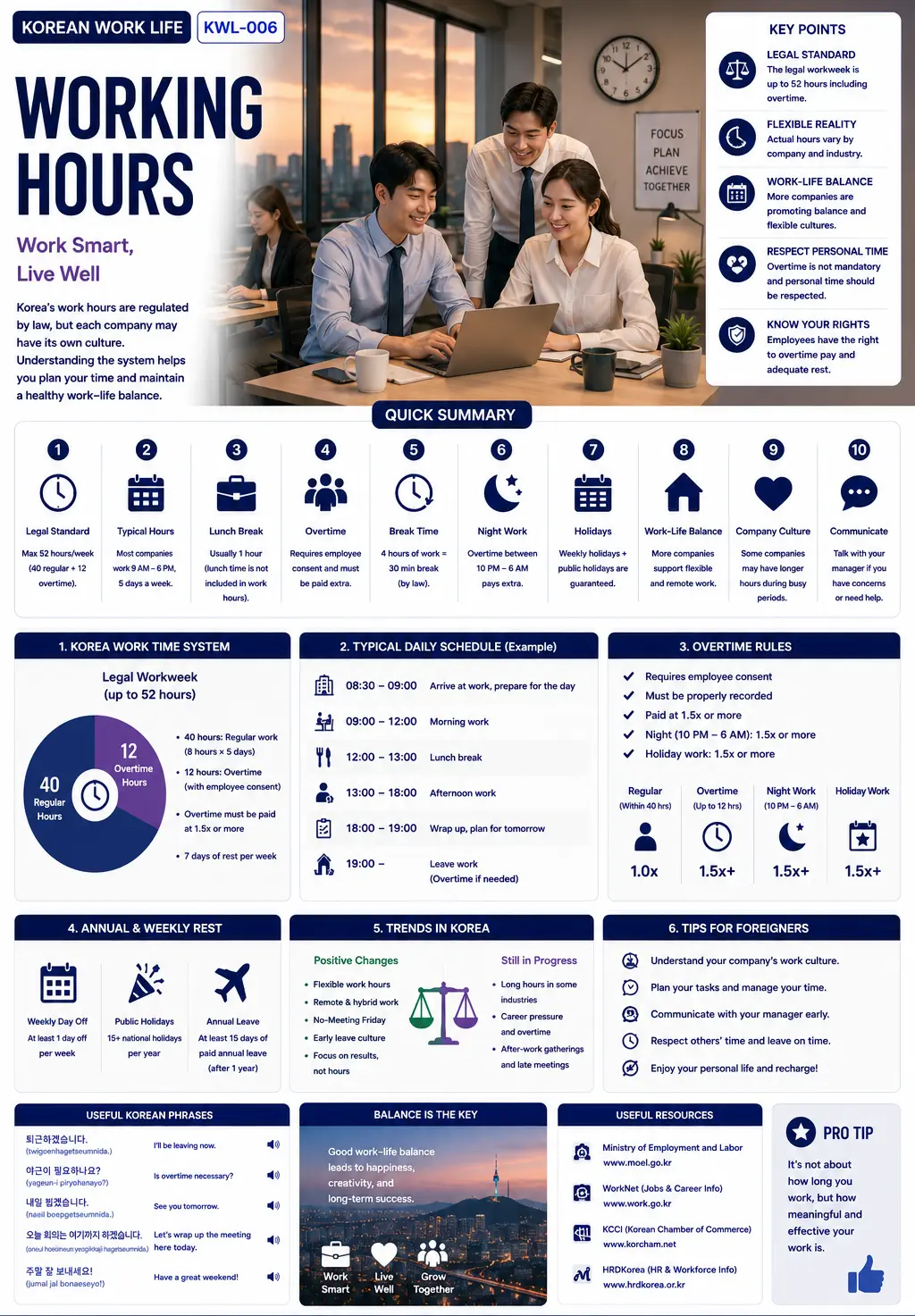
Korean working hours and overtime — ASK KOREA infographic
01 — Overview

Quick Summary

Korea's working hours are regulated by law, but each company also has its own culture. Understanding the system helps you plan your time and protect a healthy work-life balance.

Key takeaways

  • The legal workweek is up to 52 hours — 40 regular hours plus up to 12 hours of overtime.
  • Most companies work roughly 9:00 AM to 6:00 PM, five days a week.
  • Lunch is usually one hour and is not counted as working time.
  • Overtime requires employee consent and must be paid extra.
  • Employees are guaranteed weekly rest and paid annual leave.
02 — Full Guide

The Complete Guide

The Korean work time system

The legal standard is a maximum of 52 hours per week: 40 regular hours across five 8-hour days, plus up to 12 hours of overtime with employee consent. At least one day of rest per week is required.

  • 40 hours regular work (8 hours × 5 days)
  • Up to 12 hours overtime, with consent
  • Overtime must be paid at 1.5× or more
  • At least one weekly day off

A typical daily schedule

Schedules vary by company, but a common pattern looks like the one below.

  • 08:30–09:00 — arrive and prepare for the day
  • 09:00–12:00 — morning work
  • 12:00–13:00 — lunch break
  • 13:00–18:00 — afternoon work
  • 18:00 — wrap up, plan for tomorrow

Overtime and break rules

Overtime must be agreed and properly recorded. Break time is also protected by law: four hours of work requires at least a 30-minute break.

  • Overtime — 1.5× or more
  • Night work (10 PM–6 AM) — 1.5× or more
  • Holiday work — 1.5× or more
  • 4 hours of work = at least a 30-minute break

Rest, leave and current trends

Employees receive weekly rest days, public holidays and paid annual leave — generally at least 15 days after one year of service. Many companies are moving towards flexible hours, hybrid work and a stronger focus on results.

  • At least one day off per week
  • 15+ national public holidays per year
  • At least 15 days of paid annual leave after one year
  • Growing trends: flexible hours, remote and hybrid work
Pro Tips

Pro Tips

  • Talk to your manager early if hours or workload become a concern.
  • Useful phrases: 퇴근하겠습니다 (I'll be leaving now), 야근이 필요한가요? (Is overtime necessary?).
  • Check your contract for how overtime is recorded and paid.
Ask AI

Ask AI About This Topic

AI Assistant

Have a question about Working Hours?

Get instant, locally-checked answers from the ASK KOREA AI. Ask anything from specific edge cases to itinerary decisions.

Ask this question
Suggested prompt

"Explain Korea's 52-hour workweek and overtime pay rules in simple terms."

ASK KOREA Transit