Korean Society · Guide 04

Housing System

Jeonse, wolse, officetels and one-rooms — how renting and finding a home in Korea actually works.

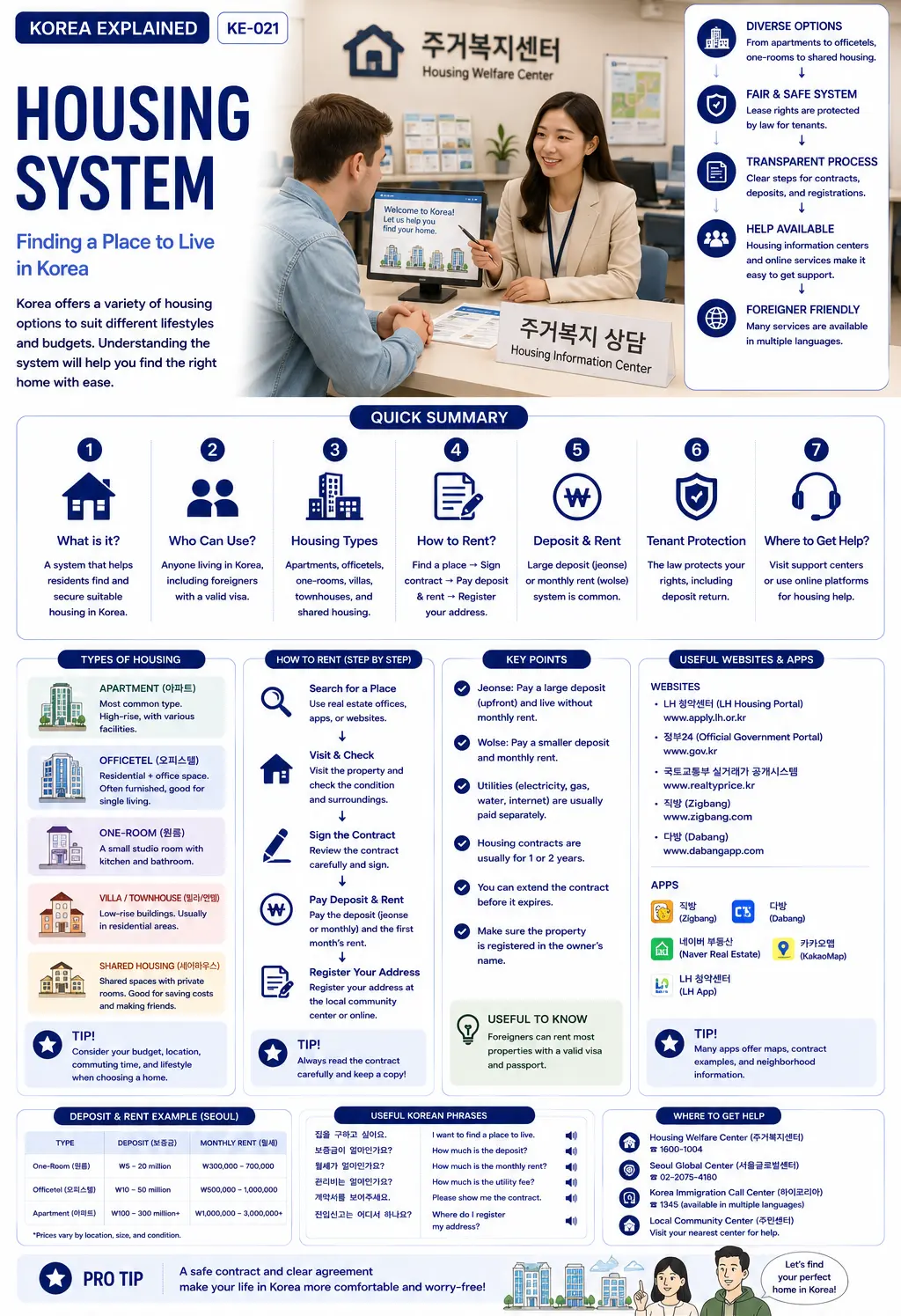
Housing system in Korea — ASK KOREA infographic
01 — Overview

Quick Summary

Korea offers apartments, officetels, one-rooms, villas and shared housing to suit different budgets and lifestyles. The rental system is transparent and legally protected, and foreigners with a valid visa can rent most properties.

Key takeaways

  • Jeonse means a large upfront deposit with no monthly rent; wolse means a smaller deposit plus monthly rent.
  • Contracts usually run for one or two years and can be extended.
  • Utilities are normally paid separately from rent.
  • Tenant rights, including deposit return, are protected by law.
  • Register your address at the local community centre after moving in.
02 — Full Guide

The Complete Guide

Types of housing

Housing types differ in size, facilities and price. Choosing between them is mostly a question of budget, commute and how much space you need.

  • Apartment (아파트) — the most common type, high-rise with shared facilities
  • Officetel (오피스텔) — residential and office space combined, often furnished
  • One-room studio (원룸) — a studio with kitchen and bathroom
  • Villa or townhouse (빌라/연립) — low-rise buildings in residential areas
  • Shared housing (셰어하우스) — private rooms with shared common space

How to rent, step by step

Most people search through real estate offices or apps, then view several properties before signing. Take your time on the contract stage.

  • Search using real estate offices, apps or websites
  • Visit and check the property condition and surroundings
  • Review and sign the contract carefully
  • Pay the deposit (jeonse or monthly) and the first month's rent
  • Register your address at the local community centre or online

Deposits and monthly rent

Jeonse requires a large deposit and no monthly payment; wolse combines a smaller deposit with monthly rent. Seoul figures vary widely by district, size and condition.

  • One-room — deposit around ₩5–20 million, rent ₩300,000–700,000
  • Officetel — deposit around ₩10–50 million, rent ₩500,000–1,000,000
  • Apartment — deposit ₩100–300 million+, rent ₩1,000,000–3,000,000+

Useful websites and apps

  • LH 청약센터 (apply.lh.or.kr) — public housing portal
  • Government24 (정부24, gov.kr) — official government portal
  • Real Transaction Price System (실거래가 공개시스템, realtyprice.kr) — actual sale and rent prices
  • Listing apps — Zigbang (직방), Dabang (다방), Naver Real Estate (네이버 부동산) and KakaoMap (카카오맵)

Where to get help

  • Housing Welfare Center (주거복지센터) — 1600-1004
  • Seoul Global Center (서울글로벌센터) — 02-2075-4180
  • Korea Immigration Call Center (하이코리아) — 1345, multiple languages
  • Your local community centre (주민센터)
Pro Tips

Pro Tips

  • Make sure the property is registered in the owner's name before paying a deposit.
  • Always read the contract carefully and keep your own signed copy.
  • Budget for utilities — electricity, gas, water and internet are usually separate.
Ask AI

Ask AI About This Topic

AI Assistant

Have a question about Housing System?

Get instant, locally-checked answers from the ASK KOREA AI. Ask anything from specific edge cases to itinerary decisions.

Ask this question
Suggested prompt

"Explain the difference between jeonse and wolse and what I should check before signing a Korean lease."

ASK KOREA Transit