History of Korean Heritage
Korea's cultural heritage has evolved continuously over thousands of years, shaped by ancient kingdoms, royal dynasties, Buddhism, Confucian philosophy and the traditions of everyday life.
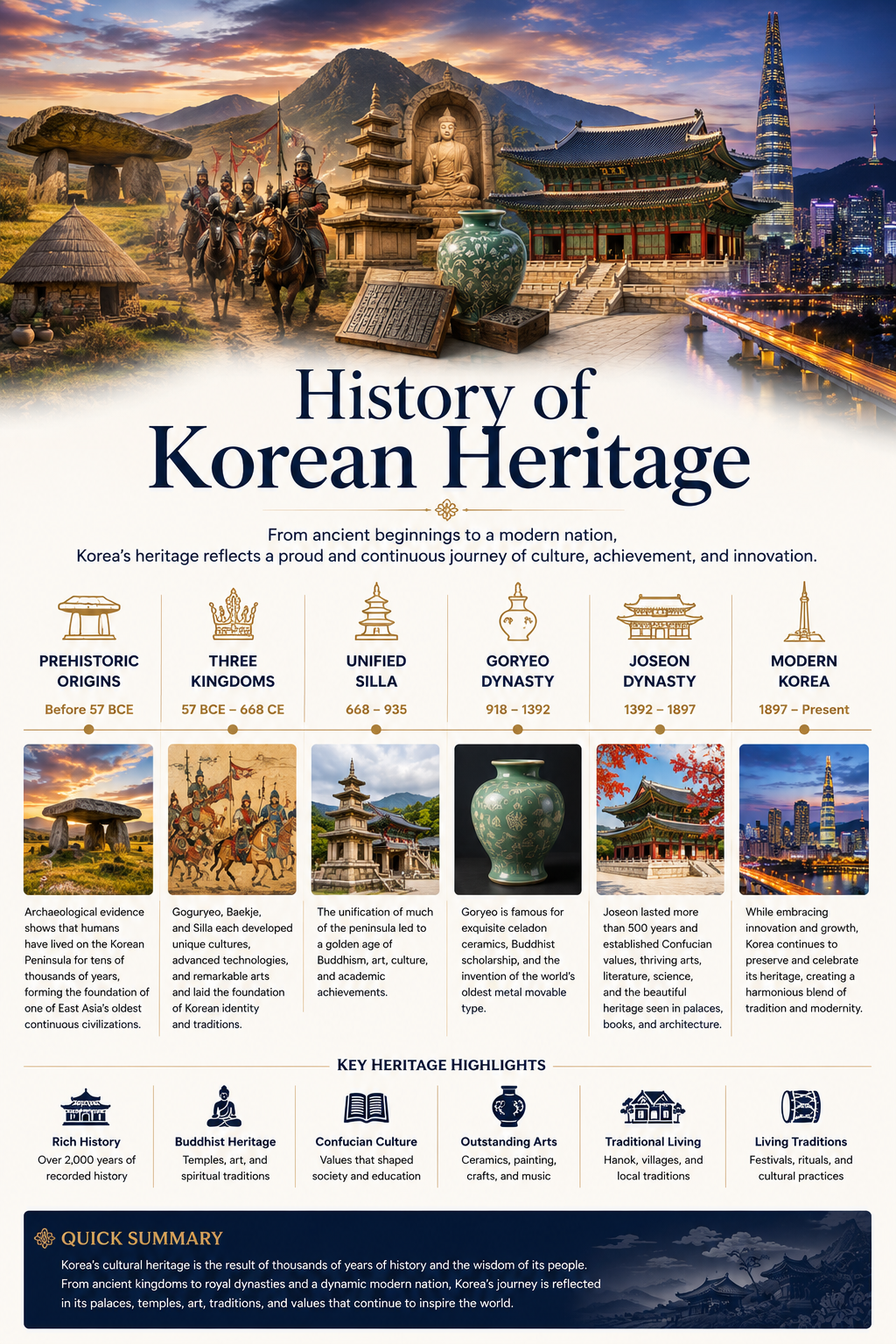
Quick Summary
Key takeaways
- Korea's cultural heritage reflects thousands of years of continuous development, preserving the achievements of ancient kingdoms, Buddhist traditions, and royal dynasties while remaining an important part of modern Korean society.
The Complete Guide
Korea's cultural heritage has evolved continuously over thousands of years, shaped by ancient kingdoms, royal dynasties, religious traditions, and the resilience of its people. Throughout history, Korea has preserved its identity while adapting to social and technological change, creating a rich cultural legacy that remains visible today.
The foundations of Korean civilization date back to prehistoric settlements and the Bronze Age, followed by the rise of the Three Kingdoms of Goguryeo, Baekje, and Silla. These kingdoms established distinctive architecture, art, religion, and cultural traditions that continue to influence modern Korea.
During the Unified Silla Period, Buddhism flourished, leading to the construction of magnificent temples, pagodas, and stone monuments. The Goryeo Dynasty became famous for its celadon ceramics, Buddhist scholarship, and the creation of the Tripitaka Koreana, one of the world's greatest collections of Buddhist scriptures.
The Joseon Dynasty, which lasted for more than five centuries, profoundly shaped Korean society through Confucian philosophy, education, literature, architecture, and royal traditions. Many of Korea's royal palaces, Hanok villages, and traditional customs originated during this period.
Today, Korea carefully protects its historic sites while preserving traditional ceremonies, festivals, craftsmanship, and cultural practices for future generations.
Major Historical Periods
Prehistoric Korea
Early settlements, dolmens, and archaeological remains reveal the origins of Korean civilization.
Three Kingdoms Period
Goguryeo, Baekje, and Silla developed unique cultures, architecture, and artistic traditions.
Unified Silla
Buddhism became the dominant cultural influence, inspiring remarkable temples and monuments.
Goryeo Dynasty
Known for celadon ceramics, Buddhist culture, and advanced printing technology.
Joseon Dynasty
Confucian philosophy shaped Korean society, education, architecture, and daily life for over 500 years.
Highlights
Ask AI About This Topic
Have a question about History of Korean Heritage?
Get instant, locally-checked answers from the ASK KOREA AI. Ask anything from specific edge cases to itinerary decisions.
"Give me a simple timeline of Korean history and the heritage each period left behind."
ASK KOREA Transit