Korean Holidays · Guide 01

Seollal (Lunar New Year)

Korea's most important family holiday — ancestral rites, sebae bowing, tteokguk and what to expect when the country travels home.

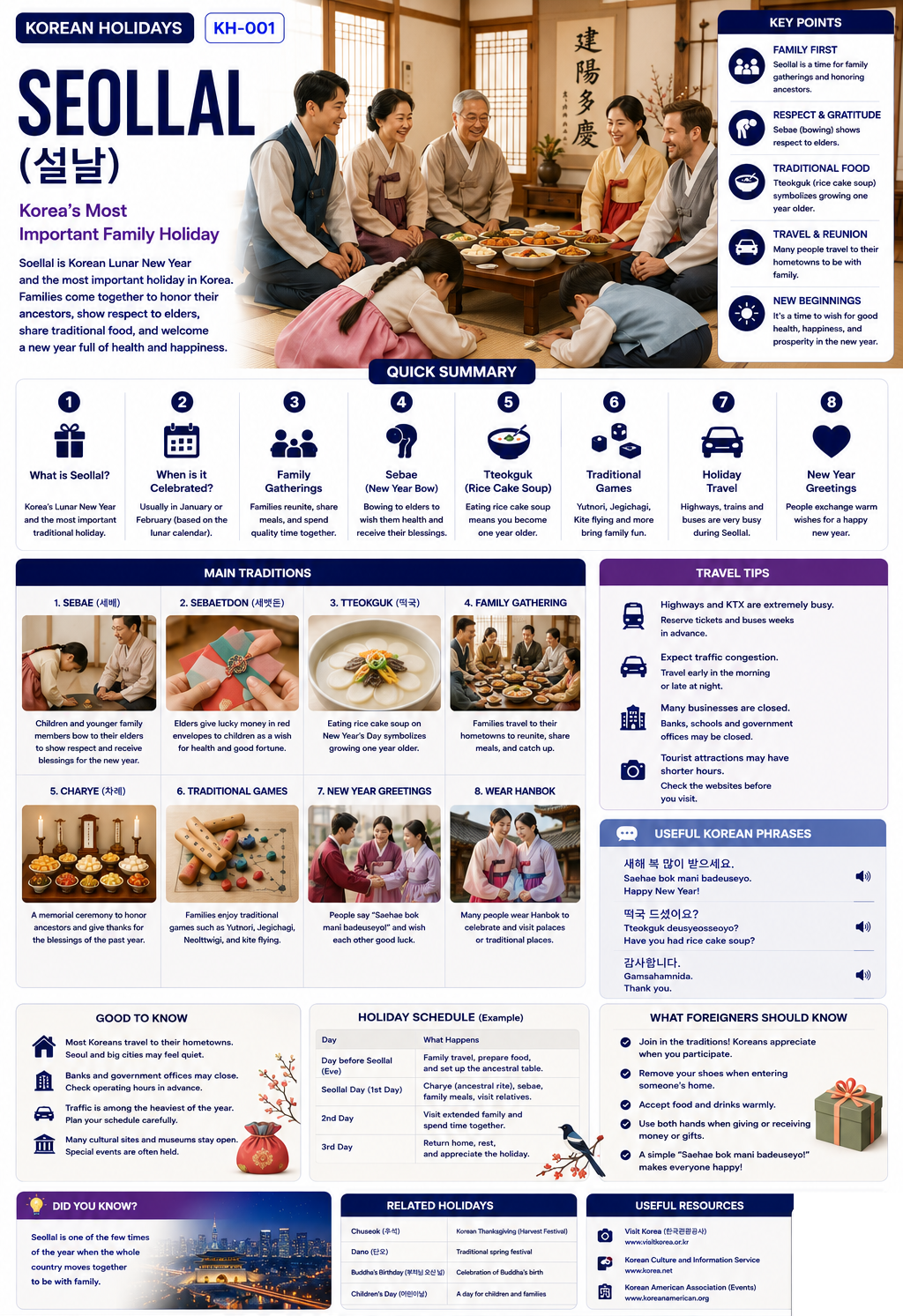
Seollal, Korean Lunar New Year — ASK KOREA infographic
01 — Overview

Quick Summary

Seollal is Korean Lunar New Year and the most important traditional holiday in Korea. Families come together to honour their ancestors, show respect to elders, share traditional food and wish each other health and happiness for the new year.

Key takeaways

  • Seollal falls in January or February, following the lunar calendar, so the date changes each year.
  • Sebae (세배), the New Year bow to elders, is answered with blessings and sebaetdon (lucky money).
  • Eating tteokguk (rice cake soup) traditionally means becoming one year older.
  • Many people travel to their hometowns, so highways, trains and buses are extremely busy.
  • Banks, government offices and many businesses close during the holiday.
02 — Full Guide

The Complete Guide

Main traditions

Seollal blends ceremony, food and play. Families gather the day before, prepare food together, and hold their observances on the morning of the first day.

  • Sebae (세배) — children and younger family members bow to elders to show respect and receive blessings
  • Sebaetdon (세뱃돈) — elders give lucky money in decorated envelopes
  • Charye (차례) — a memorial ceremony honouring ancestors and giving thanks for the past year
  • Tteokguk (떡국) — rice cake soup eaten on New Year's Day
  • Traditional games such as yutnori, jegichagi, neolttwigi and kite flying
  • Many people wear hanbok to celebrate or to visit palaces and traditional sites

A typical holiday schedule

Seollal is officially a three-day holiday centred on Lunar New Year's Day. A common pattern looks like this.

  • Day before (eve) — travel, prepare food, set up the ancestral table
  • Seollal Day (first day) — charye, sebae and family meals, visiting relatives
  • Second day — visiting extended family and spending time together
  • Third day — returning home and resting

Travelling during Seollal

This is one of the heaviest travel periods of the year. Trains and express buses sell out well in advance, and highway journeys can take far longer than usual.

  • Reserve KTX tickets and buses weeks in advance
  • Expect congestion — travel early in the morning or late at night
  • Banks, government offices and many shops close
  • Tourist attractions may have shorter hours; check before you visit

What foreign visitors should know

Seoul and other big cities can feel unusually quiet while families travel to their hometowns. Many cultural sites stay open and hold special events, which makes it a rewarding time to visit palaces and museums.

  • Remove your shoes when entering someone's home
  • Accept food and drinks warmly
  • Use both hands when giving or receiving money or gifts
  • A simple 새해 복 많이 받으세요 (saehae bok mani badeuseyo) is always appreciated
Pro Tips

Pro Tips

  • Useful phrases: 새해 복 많이 받으세요 (Happy New Year), 떡국 드셨어요? (Have you had rice cake soup?), 감사합니다 (thank you).
  • Check operating hours for banks and offices in advance.
  • Plan your city travel carefully — traffic is among the heaviest of the year.
  • Official resources: Visit Korea (visitkorea.or.kr) and Korea.net for holiday events.
Ask AI

Ask AI About This Topic

AI Assistant

Have a question about Seollal (Lunar New Year)?

Get instant, locally-checked answers from the ASK KOREA AI. Ask anything from specific edge cases to itinerary decisions.

Ask this question
Suggested prompt

"Explain Seollal traditions and what to expect if I'm visiting Korea during Lunar New Year."

ASK KOREA Transit