Korean Holidays · Guide 03

National Holidays

Korea's public holidays across the year — what each one commemorates, which dates move and how to plan around them.

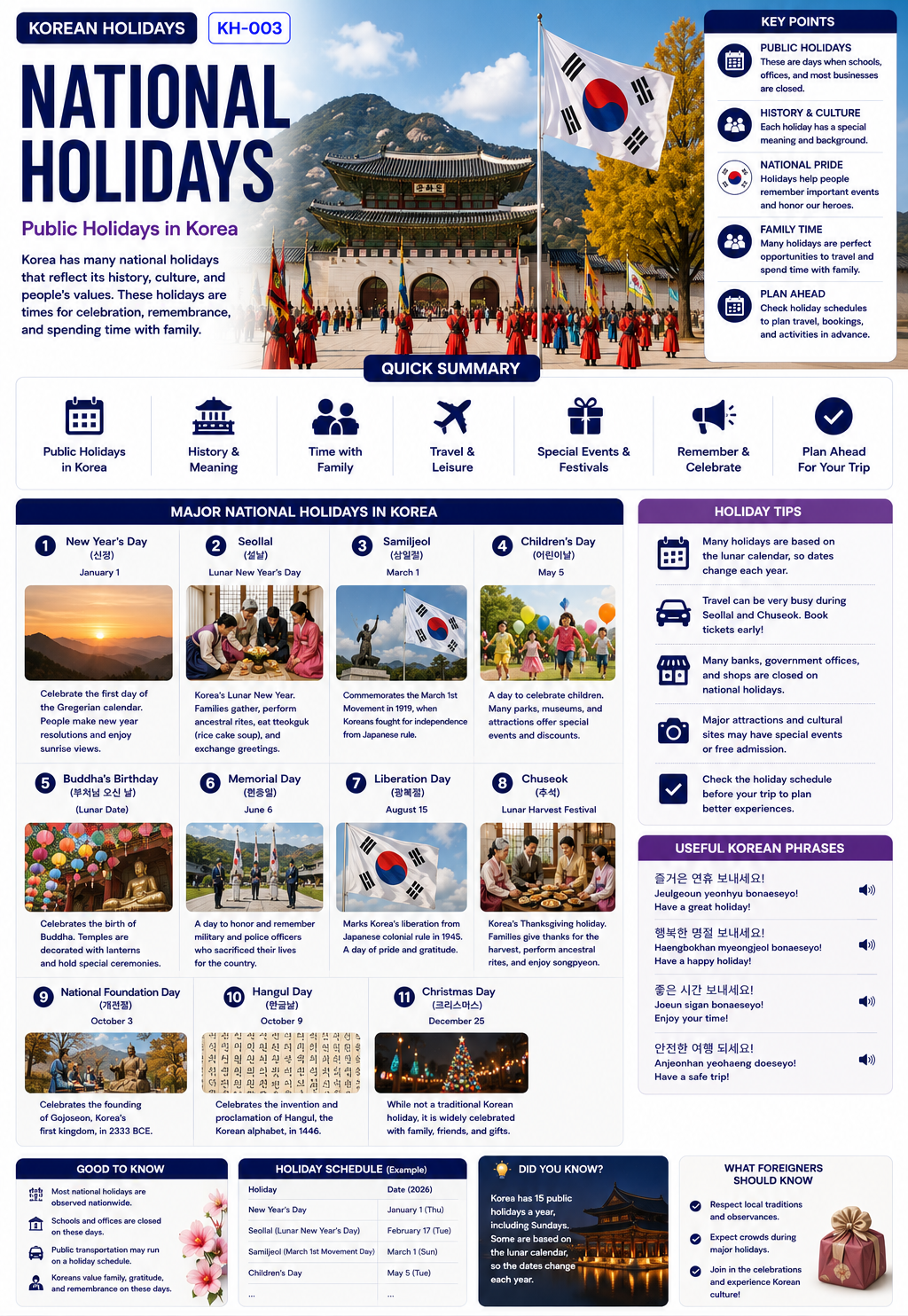
Korean national and public holidays — ASK KOREA infographic
01 — Overview

Quick Summary

Korea has a full calendar of national holidays that reflect its history, culture and values. Some follow the solar calendar and fall on the same date every year, while others follow the lunar calendar and move.

Key takeaways

  • On public holidays, schools, government offices and most businesses close.
  • Each holiday has its own historical or cultural meaning.
  • Lunar-calendar holidays such as Seollal, Buddha's Birthday and Chuseok change date each year.
  • Travel is busiest around Seollal and Chuseok — book early.
  • Major attractions and cultural sites often hold special events or offer free admission.
02 — Full Guide

The Complete Guide

Fixed-date national holidays

These holidays fall on the same calendar date every year, which makes them easy to plan around.

  • New Year's Day (신정) — January 1, the first day of the Gregorian calendar
  • Samiljeol (삼일절) — March 1, commemorating the 1919 independence movement
  • Children's Day (어린이날) — May 5, a day for children with events at parks and museums
  • Memorial Day (현충일) — June 6, honouring those who died serving the country
  • Liberation Day (광복절) — August 15, marking Korea's liberation in 1945
  • National Foundation Day (개천절) — October 3, celebrating the founding of Gojoseon
  • Hangul Day (한글날) — October 9, celebrating the Korean alphabet proclaimed in 1446
  • Christmas Day (크리스마스) — December 25, widely celebrated with family and friends

Holidays that follow the lunar calendar

Because these dates are set by the lunar calendar, they shift from year to year. Always check the current year's calendar before booking travel.

  • Seollal (설날) — Lunar New Year, usually January or February
  • Buddha's Birthday (부처님 오신 날) — temples are decorated with lanterns
  • Chuseok (추석) — the lunar harvest festival, usually September or October

What closes and what stays open

Most national holidays are observed nationwide. Schools and offices close, and public transport often runs on a holiday schedule.

  • Banks, government offices and many shops close
  • Public transport may follow a Sunday or holiday timetable
  • Convenience stores, large supermarkets and hospitals generally stay open
  • Museums and cultural sites often run special programmes

Planning your trip around holidays

Holidays can be the most rewarding time to experience Korean culture, as long as you plan transport and accommodation ahead.

  • Check the current year's holiday calendar before booking
  • Reserve KTX and intercity buses early for Seollal and Chuseok
  • Expect crowds at major attractions
  • Look out for festivals and free admission days
Pro Tips

Pro Tips

  • Useful phrases: 즐거운 연휴 보내세요 (have a great holiday), 행복한 명절 보내세요 (have a happy holiday).
  • Confirm exact dates each year — lunar holidays move.
  • Respect local traditions and observances, especially on Memorial Day.
  • Official resources: Visit Korea (visitkorea.or.kr), Korea.net.
Ask AI

Ask AI About This Topic

AI Assistant

Have a question about National Holidays?

Get instant, locally-checked answers from the ASK KOREA AI. Ask anything from specific edge cases to itinerary decisions.

Ask this question
Suggested prompt

"List Korea's public holidays and tell me which ones affect travel the most."

ASK KOREA Transit