Korean Holidays · Guide 02

Chuseok (Harvest Festival)

Korea's Thanksgiving — ancestral rites, songpyeon rice cakes, grave visits and the full moon that symbolises abundance.

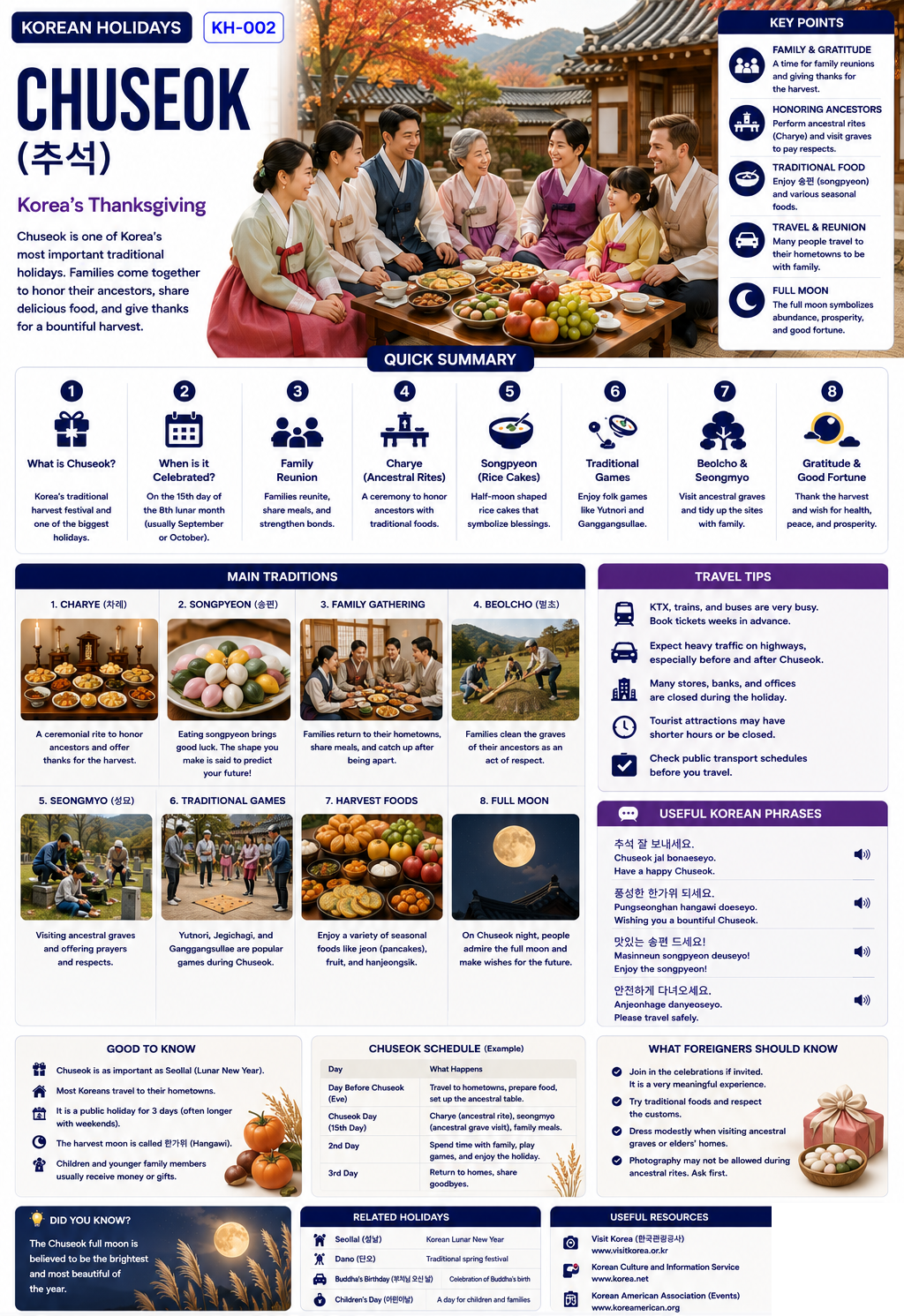
Chuseok, Korean harvest festival — ASK KOREA infographic
01 — Overview

Quick Summary

Chuseok is one of Korea's most important traditional holidays and is often called Korean Thanksgiving. Families come together to honour their ancestors, share seasonal food and give thanks for a bountiful harvest.

Key takeaways

  • Chuseok falls on the 15th day of the 8th lunar month, usually in September or October.
  • It is a public holiday for three days, and can be longer when it lands beside a weekend.
  • Charye (차례) is the ancestral rite; seongmyo (성묘) and beolcho (벌초) involve visiting and tidying family graves.
  • Songpyeon (송편), half-moon shaped rice cakes, are the signature food.
  • The Chuseok full moon, called Hangawi (한가위), symbolises abundance and good fortune.
02 — Full Guide

The Complete Guide

Main traditions

Chuseok centres on gratitude — to ancestors, and for the harvest. Families return to their hometowns, cook together and spend several days catching up.

  • Charye (차례) — a ceremonial rite honouring ancestors and offering thanks for the harvest
  • Songpyeon (송편) — half-moon rice cakes made together by the family
  • Beolcho (벌초) — cleaning ancestral grave sites as an act of respect
  • Seongmyo (성묘) — visiting graves to offer prayers and respects
  • Folk games such as yutnori, jegichagi and ganggangsullae
  • Harvest foods including jeon (savoury pancakes), fruit and hanjeongsik spreads

A typical Chuseok schedule

The holiday runs across three days, with the main observances on Chuseok Day itself.

  • Day before (eve) — travel to hometowns, prepare food, set up the ancestral table
  • Chuseok Day (15th day) — charye, seongmyo and family meals
  • Second day — time with family, games and rest
  • Third day — returning home and saying goodbyes

Travel and closures

Like Seollal, Chuseok produces heavy nationwide travel. Book transport as early as you can and expect the roads to be busiest the day before and the day after the holiday.

  • KTX, trains and buses are very busy — book tickets weeks in advance
  • Expect heavy highway traffic before and after Chuseok
  • Many stores, banks and offices close during the holiday
  • Tourist attractions may have shorter hours or close; check public transport schedules

What foreign visitors should know

If you are invited to a Chuseok gathering, accepting is a meaningful experience. A little care with dress and photography goes a long way.

  • Join in the celebrations if invited
  • Try the traditional foods and respect the customs
  • Dress modestly when visiting graves or elders' homes
  • Photography may not be allowed during ancestral rites — ask first
Pro Tips

Pro Tips

  • Useful phrases: 추석 잘 보내세요 (have a happy Chuseok), 맛있는 송편 드세요 (enjoy the songpyeon), 안전하게 다녀오세요 (travel safely).
  • Children and younger family members often receive money or gifts.
  • Convenience stores and large supermarkets usually stay open when smaller shops close.
  • Official resources: Visit Korea (visitkorea.or.kr) and Korea.net for Chuseok programmes.
Ask AI

Ask AI About This Topic

AI Assistant

Have a question about Chuseok (Harvest Festival)?

Get instant, locally-checked answers from the ASK KOREA AI. Ask anything from specific edge cases to itinerary decisions.

Ask this question
Suggested prompt

"Explain Chuseok traditions and how to plan travel in Korea during the holiday."

ASK KOREA Transit