Quick Summary
You do not need perfect Korean to use transportation in Korea. Even simple words help a lot, and most Koreans will try to help once they understand your destination. Do not be afraid to speak simple Korean.
Key takeaways
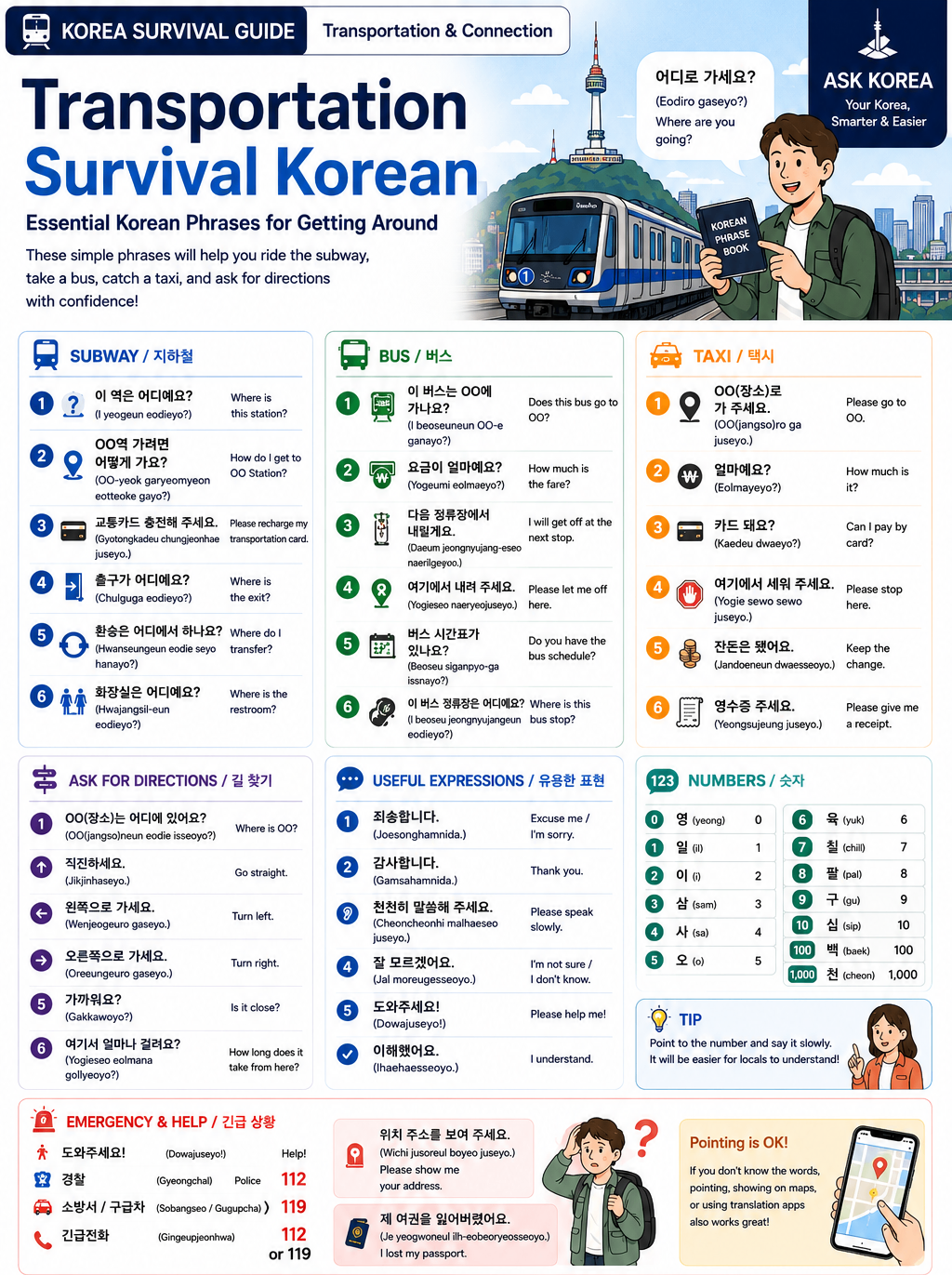
- Destination template: 저는 [장소]에 가요. — "I'm going to [place]." (e.g. 저는 강남역에 가요. — I'm going to Gangnam Station.)
- Asking directions template: [장소]은/는 어디예요? — "Where is [place]?" (e.g. 강남역은 어디예요?)
- Subway phrases: 이거 강남 가나요? (Does this go to Gangnam?) · 몇 호선이에요? (What line is this?) · 어디서 갈아타요? (Where do I transfer?)
- Use polite speech with strangers: 어디예요? ✅ rather than 어디야? ❌ — polite Korean feels safer.
- Imperfect pronunciation is fine — Koreans usually understand simple place names like 강남 or 홍대.
- Watch hand gestures and pointing: many Koreans give directions visually.
- Showing your destination on your phone screen (KakaoMap, translation apps) instead of speaking a long sentence is very common and completely acceptable.
- Universal survival phrase: 죄송하지만 영어 가능하세요? — "Excuse me, do you speak English?"
Official resources
- Visit Korea — Official travel information and Korean travel help for foreign visitors.
Why It Matters
You do NOT need perfect Korean to use transportation in Korea. Even simple Korean words can be very helpful. Most Koreans will try to help if they understand your destination, so do not be afraid to speak simple Korean.
Simple Korean is enough
Even imperfect Korean is usually okay. Koreans usually understand simple destination names like 강남 (Gangnam) or 홍대 (Hongdae).
Politeness matters with strangers
Polite speech is preferred when asking strangers for help — use 어디예요? rather than 어디야?, which feels safer and more appropriate.
Gestures help a lot
Many Koreans use hand pointing, finger directions, and visual gestures when giving directions. Watching gestures carefully helps a lot.
Your phone is a valid tool
Many foreigners show their destination on their phone, show a KakaoMap screen, or use translation apps instead of speaking long Korean sentences — this is very common in Korea.
Step-by-Step Guide
- 01
1. Basic destination phrases
저는 강남역에 가요. (I'm going to Gangnam Station.) 저는 홍대에 가요. (I'm going to Hongdae.) 저는 명동에 가요. (I'm going to Myeongdong.) 저는 부산역에 가요. (I'm going to Busan Station.) Template: 저는 [장소]에 가요. — I'm going to [place]. Example places: 강남역, 홍대, 명동, 잠실, 성수, 서울역, 부산역.
- 02
2. Asking directions
강남역은 어디예요? (Where is Gangnam Station?) 홍대는 어디예요? (Where is Hongdae?) 서울역은 어디예요? (Where is Seoul Station?) Template: [장소]은/는 어디예요? — Where is [place]? Many Koreans use hand pointing and gestures when giving directions, so watch carefully.
- 03
3. Subway usage phrases
이거 강남 가나요? (Does this go to Gangnam?) 이 지하철 홍대 가나요? (Does this subway go to Hongdae?) 몇 호선이에요? (What line is this?) 2호선 어디예요? (Where is Line 2?) 어디서 갈아타요? (Where do I transfer?) 환승 어디예요? (Where is the transfer?) 반대 방향이에요? (Is this the opposite direction?) 급행이에요? (Is this an express train?) Template: [숫자]호선 어디예요? — Where is Line [number]? Examples: 1호선, 2호선, 3호선, 9호선.
- 04
4. Bus usage phrases
이 버스 강남 가나요? (Does this bus go to Gangnam?) 여기서 내려주세요. (Please let me off here.) 몇 번째 정류장이에요? (How many stops away is it?) 이 버스 맞아요? (Is this the correct bus?) Template: 이 버스 [장소] 가나요? — Does this bus go to [place]?
- 05
5. Taxi phrases
여기 가주세요. (Please go here.) 강남역 가주세요. (Please go to Gangnam Station.) 카드 돼요? (Can I pay by card?) 여기서 내려주세요. (Please stop here.) 얼마나 걸려요? (How long does it take?) Template: [장소] 가주세요. — Please go to [place].
- 06
6. KTX / train phrases
이 KTX 부산 가나요? (Does this KTX go to Busan?) 몇 시에 출발해요? (What time does it leave?) 몇 번 승강장이에요? (What platform is it?) 제 좌석 어디예요? (Where is my seat?) Template: 이 KTX [장소] 가나요? — Does this KTX go to [place]?
- 07
7. Airport transportation phrases
서울역 가려면 어디로 가야 해요? (Where should I go to get to Seoul Station?) 공항버스 어디예요? (Where is the airport bus?) 직통열차 어디예요? (Where is the express train?) 택시 타는 곳 어디예요? (Where is the taxi area?) Template: [장소] 가려면 어디로 가야 해요? — Where should I go to get to [place]?
- 08
8. Exit & transfer phrases
3번 출구 어디예요? (Where is Exit 3?) 환승 어디예요? (Where is the transfer?) 반대편 어디예요? (Where is the opposite side?) Template: [숫자]번 출구 어디예요? — Where is Exit [number]? Examples: 1번 출구, 3번 출구, 10번 출구.
- 09
9. Emergency / confused situations
길을 잃었어요. (I'm lost.) 도와주세요. (Please help me.) 여기 맞아요? (Is this correct?) 잘 모르겠어요. (I'm not sure.) 영어 가능하세요? (Do you speak English?) Sometimes Koreans answer very quickly, with fast speaking, hand gestures, and complex directions — it is okay to ask again slowly. If you are completely lost, go to a convenience store, subway station office, or information desk — staff often try to help foreigners.
- 10
10. Universal survival phrase
죄송하지만 영어 가능하세요? — "Excuse me, do you speak English?" This is one of the most useful phrases for foreigners. Many Koreans may understand simple English.
- 11
11. Survival mini words
출구 (Exit), 환승 (Transfer), 방향 (Direction), 급행 (Express), 일반 (General), 정류장 (Bus stop), 승강장 (Platform), 택시 (Taxi), 카드 (Card), 현금 (Cash).
Top 5 transportation survival sentences
| Korean | English |
|---|---|
| 여기 가주세요. | Please go here. |
| 이 버스 강남 가나요? | Does this bus go to Gangnam? |
| 환승 어디예요? | Where is the transfer? |
| 3번 출구 어디예요? | Where is Exit 3? |
| 길을 잃었어요. | I'm lost. |
Important Tips
Use the destination template
저는 [장소]에 가요. works for taxis, buses, and telling anyone where you're headed.
Watch for hand gestures
Many Koreans point or gesture when giving directions — watching carefully helps a lot.
Use polite speech with strangers
어디예요? is safer and more appropriate than 어디야? when asking someone you don't know.
Show your phone screen
Showing a KakaoMap screen or translation app is a completely normal alternative to speaking a full sentence.
Learn line and platform phrases
몇 호선이에요? and 몇 번 승강장이에요? are essential for navigating subway and KTX transfers.
It's okay to ask again slowly
If a Korean speaker answers too fast, it's fine to ask them to repeat or slow down.
Head to staffed locations when lost
Convenience stores, subway station offices, and information desks are reliable places to get help.
Common Mistakes
Don't
Using casual Korean with strangers.
Do
Use polite phrasing like 어디예요? instead of the casual 어디야?
Don't
Trying to speak a full complex sentence.
Do
Use short templates like 저는 [장소]에 가요. or show your destination on your phone screen.
Don't
Panicking when someone answers quickly with gestures.
Do
It's okay to ask again slowly — most Koreans are happy to repeat or simplify.
Don't
Giving up when completely lost.
Do
Go to a convenience store, subway station office, or information desk — staff often help foreigners.
Don't
Assuming no one will understand any English.
Do
Try 죄송하지만 영어 가능하세요? (Excuse me, do you speak English?) — many Koreans understand basic English.
Frequently Asked Questions
Do I need to speak fluent Korean to use transportation?+
No. Even simple Korean words help a lot, and most Koreans will try to help once they understand your destination.
What's the most useful transportation phrase?+
여기 가주세요. (Please go here.) for taxis, and 죄송하지만 영어 가능하세요? (Do you speak English?) as a universal fallback.
Is it rude to use casual Korean with strangers?+
It can feel less appropriate. Polite forms like 어디예요? are preferred over casual forms like 어디야?
What if I don't understand the answer?+
It's okay to ask again slowly. Many Koreans speak quickly or use gestures, so don't hesitate to ask for clarification.
What should I do if I'm completely lost?+
Go to a convenience store, subway station office, or information desk — staff often try to help foreigners.
Official Resources
Ask AI About This Topic
Have a question about Transportation Survival Korean — Real Phrases Foreigners Actually Use.?
Get instant, locally-checked answers from the ASK KOREA AI. Ask anything from specific edge cases to itinerary decisions.
"Give me 5 short Korean phrases I can use to ask a taxi driver to take me to Myeongdong and to check if he accepts card payment."