Quick Summary
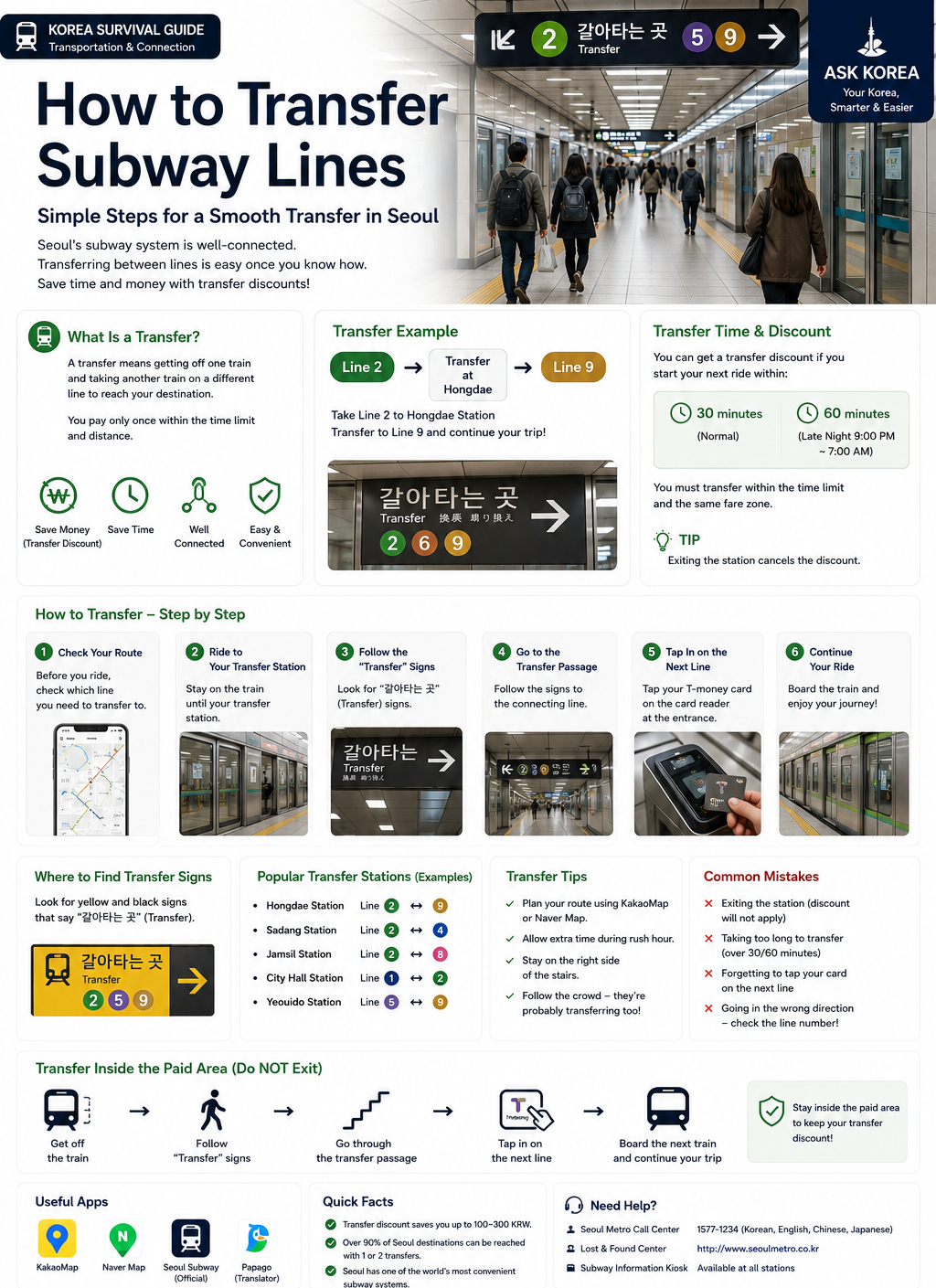
A subway transfer means changing from one line to another. Transfers are very common in Korea — one trip in Seoul often includes one to three transfers, so transferring is a core survival skill.
Key takeaways
- Transfers are usually free when you pay with T-money.
- Never leave the station gates during a transfer — follow the indoor transfer signs instead.
- Transfer stations show multiple line colours, transfer signs and direction arrows; some transfers happen on the same platform.
- Read transfer signs as line number + colour + direction, e.g. "Line 4 (Blue) → Sadang Direction".
- Walking 5–15 minutes with several escalators and long underground hallways is normal at large stations such as Seoul Station, Express Bus Terminal and Jongno 3-ga.
- Line 2 runs clockwise and counterclockwise — check the direction, not just the line.
- Watch out for express trains: they can skip your station.
- If you ride the wrong way, get off and move to the opposite platform.
- Screenshot your transfer route, exit number, final destination and station name before you travel.
- Check the last train time — the final transfer connection can end earlier than you expect.
Official resources
- Seoul Metro — Official Website — Seoul subway operator: lines, fares and service notices.
- T-money — Official Transport Card — Official transport card issuance, top-up and usage rules.
- Official Seoul Metro English Map — English subway map and route planner for Seoul.
- Official Seoul Metro Website — Subway information, schedules and service updates.
Why It Matters
Without understanding transfers, you may ride the wrong train, accidentally leave the station, or waste a lot of time. Transfers are a core survival skill in Korea.
Transfers are everywhere
In Seoul especially, one trip often includes one to three transfers. Transfer stations usually have multiple line colors, "Transfer" signs, long underground hallways, escalators and stairs, and large maps.
Some transfers are surprisingly easy
In some stations you can transfer by simply crossing the platform — a same-platform transfer. This surprises many foreigners.
Others are surprisingly hard
Major transfer stations like Seoul Station, Gangnam Station and Jamsil Station can feel confusing and very large, sometimes requiring 5–15 minutes of walking.
Korean reality
Many foreigners expect transfers to work exactly like their home country. However, Seoul has one of the largest subway systems in the world. Long walks, multiple line changes, and complex stations are normal — don't worry if your first transfer feels confusing.
Step-by-Step Guide
- 01
1. What is a subway transfer?
A subway transfer means changing from one subway line to another line. In Korea, transfers are very common — especially in Seoul, where one trip often includes 1–3 transfers.
- 02
2. Why is transfer important?
Without understanding transfers, you may ride the wrong train, leave the station accidentally, or waste time. Transfers are a core survival skill in Korea.
- 03
3. What does a transfer station look like?
Transfer stations usually have multiple line colors, "Transfer" signs, long underground hallways, escalators and stairs, and large maps. Major transfer stations — like Seoul Station, Gangnam Station and Jamsil Station — can feel confusing.
- 04
4. Same Platform Transfer
Some transfers are very easy: in some stations you can transfer by simply crossing the platform. This surprises many foreigners.
- 05
5. How to transfer subway lines
Step by step: get off the subway, follow "Transfer" signs, check the line number and color, check the final destination, move to the correct platform, and ride the next subway.
- 06
6. The most important rule
Do NOT follow only the line number. You must also check the final destination and direction. For example, Line 2 can go clockwise or counterclockwise — riding the wrong direction is a big mistake.
- 07
7. Clockwise & Counterclockwise System
Line 2 in Seoul operates in two directions: clockwise and counterclockwise. You must check the destination carefully, since the wrong direction can waste a lot of time.
- 08
8. How to read transfer signs
Korean transfer signs usually show the line number, color, final destination and arrow direction. Example: "→ Line 4 (Blue) → Sadang Direction."
- 09
9. How long does a transfer take?
Some transfers are short, but some are very long — 5–15 minutes of walking is common, especially in Seoul. Foreigners are often surprised by this.
- 10
10. Long Walking Transfer
Some Seoul subway transfers are extremely long, involving 5–15 minutes of walking, multiple escalators, and underground hallways. Foreigners are often shocked by this.
- 11
11. Why are transfers so long?
Some transfer stations in Seoul are extremely large. As a result, walking 5–15 minutes is normal, multiple escalators may be required, and long underground hallways are common. Examples: Seoul Station, Express Bus Terminal Station, and Jongno 3-ga Station. Do not panic if a transfer takes longer than expected.
- 12
12. Express vs Normal Train
Some subway lines have express and normal trains. Express trains skip stations, and foreigners often take the wrong express train by mistake.
- 13
13. Express Train Warning
Many foreigners accidentally board express trains. Before entering the train, check whether it is Express or Local/General. If you are unsure, choose the local train.
- 14
14. How to avoid getting lost
Use KakaoMap or Naver Map, check the station name repeatedly, follow color signs, check exit numbers, and take screenshots of your route.
- 15
15. Screenshot Survival Tip
Many foreigners take screenshots before riding. Recommended screenshots: the transfer route, exit number, final destination, and station name. This helps reduce confusion underground.
- 16
16. Last Train Transfer System
Missing the last transfer train can become a serious problem in Korea. Always check the last train time and the final transfer connection, especially late at night.
- 17
17. Survival Situations
"Why am I going the wrong way?" — you did not check the destination direction. "Why did this train skip my station?" — you boarded an express train. "Why am I outside the station?" — you took the wrong exit during a transfer.
Transfer troubleshooting
| Problem | Likely cause | Fix |
|---|---|---|
| Going the wrong way | Did not check the final destination direction | Get off and switch to the opposite platform |
| Train skipped your station | You boarded an express train | Check Express vs. Local before boarding; take the local train if unsure |
| Ended up outside the station | Took the wrong exit during transfer | Follow the indoor "Transfer" signs and don't exit the gates mid-transfer |
Important Tips
Seoul transfers can be huge
Some transfer stations require 5–15 minutes of walking with multiple escalators.
Follow arrows carefully
Transfer signs show line number, color, final destination, and arrow direction.
Don't panic if confused
Long walks, multiple line changes, and complex stations are completely normal in Seoul.
Double-check before entering the train
Confirm Express vs. Local, and the final destination direction, before boarding.
Use station numbers if possible
Station numbers can be easier to follow than names when you're unsure.
Screenshot your route
Save the transfer route, exit number, final destination, and station name before you travel.
Watch the last transfer connection
The last train time for your transfer line may be earlier than you expect — check both legs of the trip.
Common Mistakes
Don't
Following only the line number.
Do
Always check the final destination and direction as well — Line 2, for example, runs both clockwise and counterclockwise.
Don't
Accidentally taking an express train.
Do
Check Express vs. Local/General before boarding; choose local if you're unsure.
Don't
Leaving the station during a transfer.
Do
Follow the indoor "Transfer" signs — you usually do not need to exit the gates.
Don't
Confusing line colors.
Do
Confirm the line number and color together before moving to a platform.
Don't
Not checking the final station.
Do
Always verify the final destination shown on the train and platform signs before boarding.
Frequently Asked Questions
Are subway transfers free?+
Usually yes, with T-money.
Can transfers take 10 minutes?+
Yes, especially in Seoul.
What happens if I ride the wrong direction?+
Get off and change to the opposite side/platform.
Why does a transfer take so long?+
Some transfer stations in Seoul are extremely large. Walking 5–15 minutes can be normal — this does not mean you are lost.
Official Resources
Ask AI About This Topic
Have a question about Subway Transfer — How to Change Lines Without Getting Lost.?
Get instant, locally-checked answers from the ASK KOREA AI. Ask anything from specific edge cases to itinerary decisions.
"How do I know if a Seoul subway transfer requires leaving the gates, and how do I read the transfer signs correctly?"