Quick Summary
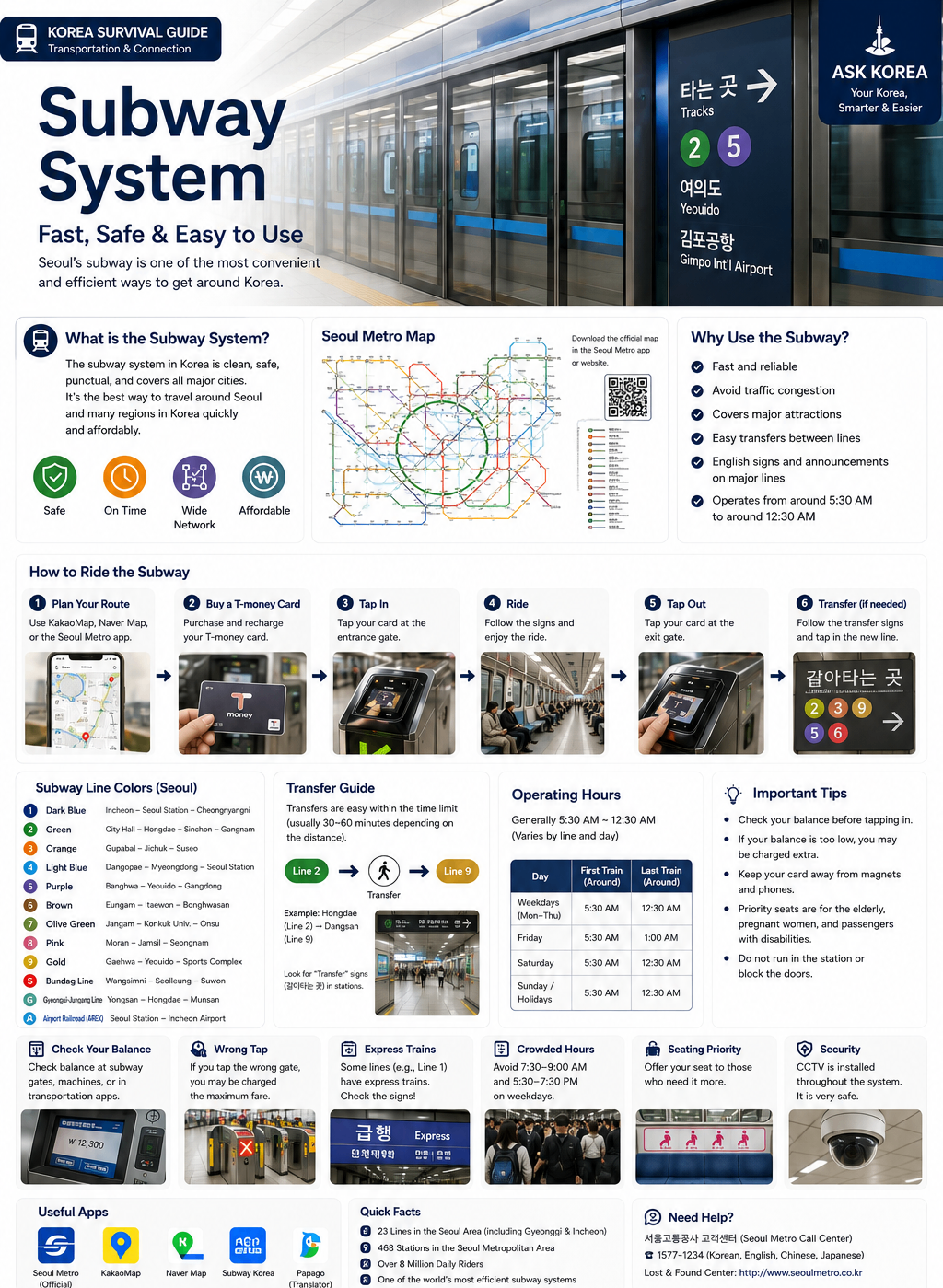
Korea has one of the fastest and most connected subway systems in the world. Most foreigners mainly use the Seoul subway system, and for many it becomes the main survival transportation system.
Key takeaways
- The subway is fast, cheap, safe, easy to transfer and connected almost everywhere.
- Stations use colour-coded lines, platform screen doors, large maps, exit numbers, transfer signs and English signage.
- Each line has a number, a colour and a final destination shown on signs; each station also has a station number (e.g. Gangnam = 222, Hongdae = 239).
- Always check the direction (final destination station) before boarding — riding the wrong way is the most common mistake.
- Express and local trains share some lines (Line 1, Line 9, AREX); express trains skip stations, so check the train type before boarding.
- Exit numbers matter — Koreans give directions like "Meet at Exit 3," and the wrong exit can mean a lot of extra walking.
- Pay with a T-money card, a cash ticket, or a mobile transportation app.
- Rush hour (7–9AM and 6–8PM) gets very crowded, especially in Seoul, and most lines stop running around midnight, so check the last train time.
Official resources
- Seoul Metro — Official Website — Seoul subway operator: lines, fares and service notices.
- Busan Transportation Corporation — Official Website — Busan subway and urban rail operator.
- T-money — Official Transport Card — Official transport card issuance, top-up and usage rules.
- Official Seoul Metro English Map — English subway map and route planner for Seoul.
- Official Seoul Metro Website — Subway information, schedules and service updates.
Why It Matters
The subway is fast, cheap, safe, easy to transfer between lines, and connected almost everywhere in major Korean cities. For many foreigners, it becomes the main survival transportation system.
It's more than just a train system
Korean subway stations include color-coded lines, platform screen doors, large subway maps, exit numbers, transfer signs and English signs. Each subway line also has a number, a color, and a final destination shown on signage.
Directions matter more than line numbers
Many foreigners think they only need to know the subway line number. However, in Korea, the final destination direction is often more important — Line 2, for example, can go in two different directions.
Foreigners are often confused by
Direction, transfer, exit numbers, express vs. normal trains, and large stations are the top things that confuse foreign visitors underground.
Station numbers can help
Many foreigners focus only on station names, but station numbers can sometimes be easier to follow and reduce confusion — for example Gangnam Station = 222, Hongdae Station = 239.
Step-by-Step Guide
- 01
1. What is the Subway System?
Korea has one of the fastest and most connected subway systems in the world. The subway is the main transportation method in major cities: Seoul, Busan, Daegu, Daejeon and Gwangju. Most foreigners mainly use the Seoul subway system.
- 02
2. Why do you need it?
The subway is fast, cheap, safe, easy to transfer, and connected almost everywhere. For many foreigners, the subway becomes the main survival transportation system.
- 03
3. What does it look like?
Korean subway stations usually include color-coded lines, platform screen doors, large subway maps, exit numbers, transfer signs, and English signs. Each subway line has a number, a color, and a final destination.
- 04
4. English Subway Map
Most foreigners use the English subway map first. The Seoul subway system is organized by line colors, line numbers, transfer stations, and final destinations.
- 05
5. Color-Coded Subway Lines
Examples: Line 1 → Dark Blue, Line 2 → Green, Line 3 → Orange, Line 4 → Light Blue, Line 5 → Purple, AREX → Airport Blue. Foreigners often remember subway lines by color first.
- 06
6. English Signs in Korean Subway
Most major subway stations include English signs, English maps, and English announcements. This helps foreigners navigate more easily.
- 07
7. Station Number System
Many foreigners focus only on station names, but station numbers can sometimes be easier to follow. For example, Gangnam Station = 222 and Hongdae Station = 239. Station numbers can help reduce confusion.
- 08
8. Recommended Highlight Stations
Gangnam Station: business district, shopping area, Line 2. Hongdae Station: youth culture, nightlife, Airport Railroad connection. Myeongdong Station: tourist shopping area, foreign visitors. Seoul Station: KTX connection, Airport Railroad connection. Jamsil Station: Lotte World, shopping mall. Itaewon Station: international district, foreign-friendly area.
- 09
9. Airport Railroad Connection (AREX)
AREX connects Incheon Airport, Hongdae, and Seoul Station. Foreigners use AREX very frequently.
- 10
10. Exit Number System
Korean subway stations often have many exits — for example Exit 1, Exit 3, or Exit 10. The correct exit can save a lot of walking time.
- 11
11. How to enter the subway
Step by step: find the subway entrance, follow line color/color signs, tap your T-money card, wait for the gate to open, and enter the station.
- 12
12. How to find the correct direction
This is one of the biggest foreigner problems. Korean subway directions are based on the final destination station, e.g. "Line 2 → Hongdae." You must check the final station and direction, NOT just the line number.
- 13
13. Express vs Local Train
Some subway lines operate both express and local trains. Express trains skip some stations; local trains stop at every station. Always check the train type before boarding. Common examples: Line 1, Line 9, and Airport Railroad (AREX).
- 14
14. How to ride the subway
Step by step: wait behind the safety line, let people exit first, enter the train, check station screens, listen to announcements, and exit at your station.
- 15
15. How to transfer subway lines
Transfers are very common in Korea. Step by step: follow "Transfer" signs, walk to another line, check the line color, check the destination direction, and ride the next subway. Important: you usually do NOT exit the station gates during a transfer.
- 16
16. How to exit the subway
Step by step: follow exit signs, check the exit number, tap your card at the gate, and leave the station. Exit numbers are VERY important in Korea — for example, "Meet at Exit 3." Taking the wrong exit may cause long walking time or getting lost.
- 17
17. How to pay
Main methods: T-money card, cash ticket, or a mobile transportation app. Most foreigners use T-money.
- 18
18. Korean reality: destination matters more than line number
Many foreigners think they only need to know the subway line number. However, in Korea, the final destination is often more important — for example, Line 2 can go in two different directions. Always check the final destination before boarding.
- 19
19. Rush Hour System
Korean subway becomes very crowded during 7AM–9AM and 6PM–8PM, especially in Seoul. Foreigners may feel shocked, confused, or overwhelmed the first time.
- 20
20. Last Train System
Many foreigners forget to check the last subway. Most subway lines stop operating around midnight. If you miss the last train, you may need to take a taxi, and transportation costs can increase significantly. Always check the last train time before traveling late at night.
- 21
21. Safety & Etiquette
Important etiquette: let people exit first, do not talk loudly, do not block doors, and remember that priority seats are reserved for those who need them.
Important Tips
Use KakaoMap or Naver Map
Recommended over Google Maps for accurate Korean subway routes.
Always check the exit number
The correct exit can save a lot of walking time — Koreans often say "Meet at Exit 3."
Avoid rush hour if possible
7AM–9AM and 6PM–8PM get very crowded, especially in Seoul.
Stand on the correct side of the escalator
Follow local escalator etiquette to avoid blocking foot traffic.
Last train time is important
Most lines stop operating around midnight — check before heading out late.
Use station numbers when confused
Station numbers (e.g. Gangnam = 222) can be easier to follow than names.
Common Mistakes
Don't
Riding the wrong direction.
Do
Always check the final destination station, not just the line number, before boarding.
Don't
Confusing express and local trains.
Do
Check whether the train is express or local before boarding — express trains skip stations.
Don't
Exiting through the wrong gate.
Do
Check the exit number before leaving — the wrong exit can mean long extra walking.
Don't
Missing transfer signs.
Do
Follow the "Transfer" signs carefully and check the line color and destination direction.
Don't
Blocking subway doors.
Do
Let people exit first, then board, and avoid standing in the doorway.
Don't
Not checking the last train.
Do
Most lines stop around midnight — check the last train time before traveling late.
Frequently Asked Questions
Is the Korean subway safe?+
Very safe.
Can foreigners use the subway easily?+
Yes, but directions may be confusing at first.
Does Google Maps work well for the subway?+
Not perfectly in Korea. KakaoMap and Naver Map are better.
What is the most common subway mistake?+
Taking the subway in the wrong direction. Always check the final destination.
Are subway stations easy to find?+
Yes — most stations have good English signage. Look for the subway symbol and station name signs.
How late does the subway run?+
Most lines operate until around midnight. Last train times vary by line and station.
Official Resources
Ask AI About This Topic
Have a question about Subway System — Korea's Fastest, Most Connected Way to Travel.?
Get instant, locally-checked answers from the ASK KOREA AI. Ask anything from specific edge cases to itinerary decisions.
"How do I find the correct direction and exit number when riding the Seoul subway for the first time?"