Quick Summary
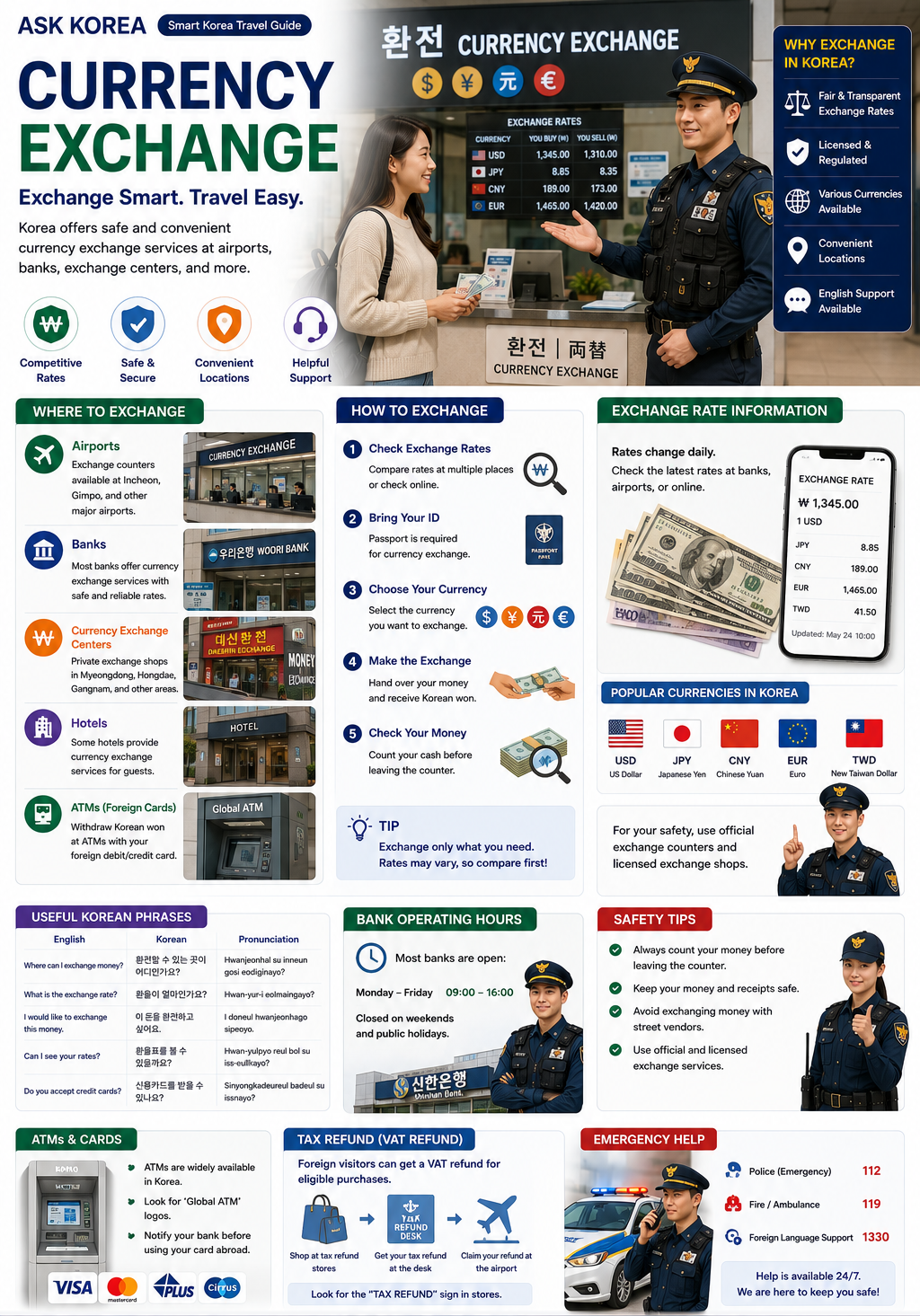
Korea's currency is the Korean Won (KRW), and Korea offers safe and convenient currency exchange for foreign visitors. Rates change daily and vary by location, so compare before you commit.
Key takeaways
- Exchange at the airport, banks, exchange offices, and tourist areas.
- Popular exchange areas: Myeongdong, Hongdae and the Seoul Station area, which often have banks or currency exchange offices nearby.
- Exchange rates may vary by location — compare rates before exchanging money if possible.
- Korean bills come in ₩1,000, ₩5,000, ₩10,000 and ₩50,000 denominations.
- Korea is largely card-based, so you usually don't need much cash — but a small amount is useful for street vendors, traditional markets and emergencies.
- One of the most common foreigner mistakes is exchanging money at bad rates, so check and compare before you exchange.
Official resources
- Korea Customs Service — Official Website — Customs declarations, duty-free allowances and prohibited items.
Why It Matters
Banking & Payment covers credit cards, debit cards, cash, ATMs, currency exchange and mobile payments. Without a working payment method, transportation, shopping and restaurants all become difficult — so getting Korean won into your wallet the right way matters from day one.
Korea is card-based, but not card-only
Most places accept Visa, Mastercard and Korean cards, but small street vendors, traditional markets and emergencies still call for cash.
Rates vary by location
Airport counters are convenient but usually less favorable than banks or licensed exchange offices in areas like Myeongdong, Hongdae and Seoul Station.
A bad exchange is a common mistake
Exchanging money at bad rates is one of the most common mistakes foreigners make — comparing rates first avoids losing value on the exchange.
Step-by-Step Guide
- 01
1. Decide how much cash you actually need
Korea is largely card-based, so plan to carry only a small amount of cash for street vendors, traditional markets and emergencies.
- 02
2. Choose where to exchange
You can exchange money at the airport, at banks, at dedicated exchange offices, or in tourist areas.
- 03
3. Head to a popular exchange area if possible
Myeongdong, Hongdae and the Seoul Station area often have several banks or currency exchange offices close together, making it easy to compare.
- 04
4. Compare rates before committing
Exchange rates vary by location, so check a couple of nearby options before exchanging money if you can.
- 05
5. Bring your passport
ID is required for currency exchange in Korea, so carry your passport when you go.
- 06
6. Complete the exchange and count your money
Ask for a receipt and count your cash before leaving the counter.
Important Tips
Try Myeongdong, Hongdae or Seoul Station
These areas often cluster banks and licensed exchange offices, so it's easy to compare rates on the spot.
Bank hours are limited
Banks generally keep standard weekday hours and are closed on weekends and public holidays.
Airport exchange is convenient, not cheap
Change only what you need to get into the city, then exchange the rest at a better rate downtown.
Always ask for a receipt
Keep it in case you need to prove the transaction or exchange leftover won back later.
Count your cash at the counter
Count your money before leaving so any error can be corrected immediately.
Compare before you commit
Rates vary by location — a quick comparison can save real money on a large exchange.
Use only official, licensed services
Stick to banks, airport counters and licensed exchange offices rather than informal money changers.
Common Mistakes
Don't
Exchanging all your money at the airport.
Do
Exchange only what you need for transport into the city, then compare rates downtown for the rest.
Don't
Exchanging money without comparing rates.
Do
Rates vary by location — compare a couple of options, especially in areas like Myeongdong or Hongdae, before exchanging.
Don't
Forgetting your passport.
Do
Bring your passport — ID is required for currency exchange in Korea.
Don't
Carrying no cash at all because Korea is card-based.
Do
Keep a small amount of cash for street vendors, traditional markets and emergencies.
Don't
Walking away without checking your cash.
Do
Count your money before leaving the counter and ask for a receipt.
Frequently Asked Questions
Where can I exchange money in Korea?+
At the airport, banks, exchange offices and tourist areas — popular exchange areas include Myeongdong, Hongdae and the Seoul Station area.
Do exchange rates differ by location?+
Yes, exchange rates may vary by location, so it's recommended to compare rates before exchanging money if possible.
Do I need cash in Korea?+
Not much — Korea is largely card-based, but a small amount of cash is useful for street vendors, traditional markets and emergencies.
What do I need to bring to exchange money?+
Your passport — ID is required for currency exchange in Korea.
How do I ask where to exchange money in Korean?+
You can ask '환전 어디서 해요?' (Where can I exchange money?). You can also ask '수수료 있어요?' (Is there a fee?).
Official Resources
Ask AI About This Topic
Have a question about Currency Exchange — Get Korean Won at a Fair Rate.?
Get instant, locally-checked answers from the ASK KOREA AI. Ask anything from specific edge cases to itinerary decisions.
"Where should I exchange USD to KRW in Seoul for the best rate — the airport, a bank, or a Myeongdong exchange shop?"