Quick Summary
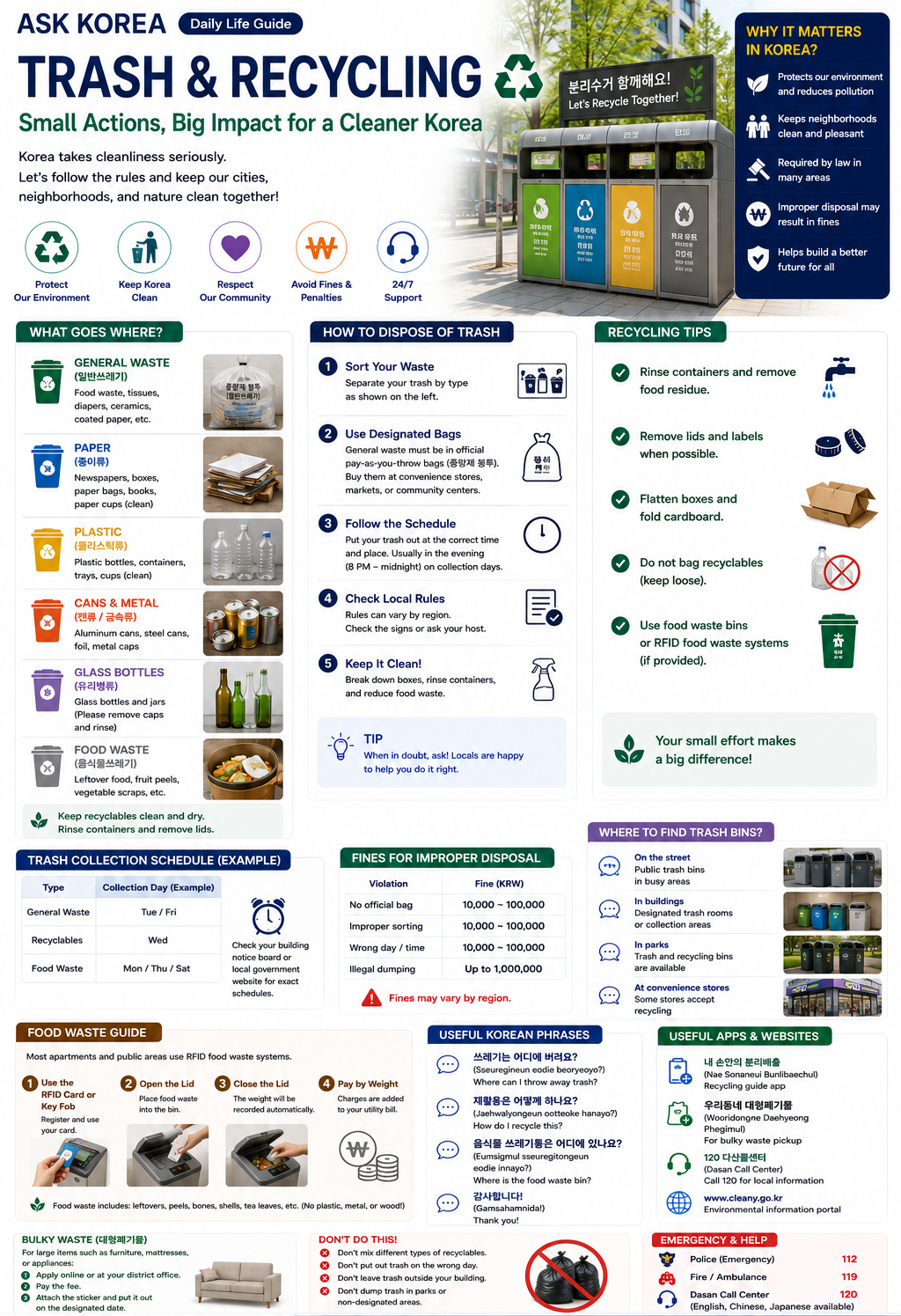
Korea has a recycling system that separates waste into categories: general trash, plastic, cans, glass bottles, paper, and food waste. Many foreigners notice there are very few street trash cans — this is completely normal in Korea.
Key takeaways
- Very few street trash cans exist; people often carry trash and throw it away later, or use convenience store bins.
- Categories: general trash (tissue, dirty paper, non-recyclables), food waste (rice, bread, fruits, vegetables — but NOT bones, shells, or fruit pits), plastic, cans, and glass.
- Most cities require official garbage bags (종량제 봉투), sold at convenience stores and supermarkets. Using regular bags may result in fines.
- Convenience store bins should only be used for items purchased at that store.
- Most apartments have a recycling area, trash collection area, and food waste bins.
- If you can't find a trash can: keep the trash temporarily, dispose of it later, and use proper bins.
Why It Matters
Korea takes recycling seriously, and proper sorting helps protect the environment, reduce waste, and improve recycling outcomes. This is one of the most common culture shocks for foreigners.
Why are there so few trash cans?
Many foreigners notice there are very few trash cans on the street. This is normal in Korea — people often carry trash, throw it away later, or use convenience store bins. Many people carry trash until they return home.
Food waste confusion
Food waste includes rice, bread, fruits, and vegetables. General trash includes bones, shells, and fruit pits. This distinction commonly confuses foreigners.
Official garbage bags
Most cities require official garbage bags (종량제 봉투), available at convenience stores and supermarkets. Using regular bags instead may result in fines.
Public trash disposal culture
If you cannot find a trash can, it is common to keep trash temporarily, dispose of it later, and use proper bins. Tourists are often surprised by this system — it is one of the most common culture shocks in Korea.
Step-by-Step Guide
- 01
1. Common trash categories
General trash, plastic, cans, glass bottles, paper, and food waste.
- 02
2. Why so few trash cans?
Many foreigners notice there are very few street trash cans. This is normal in Korea; people carry trash, throw it away later, or use convenience store bins.
- 03
3. General trash
Examples include tissue, dirty paper, and other non-recyclable items.
- 04
4. Food waste vs. general trash
Food waste: rice, bread, fruits, vegetables, leftover food, fruit peels. General trash: bones, shells, fruit pits. This distinction commonly confuses foreigners.
- 05
5. Plastic
Examples: water bottles and plastic containers.
- 06
6. Cans
Examples: soda cans and coffee cans.
- 07
7. Glass
Examples: beverage bottles.
- 08
8. Convenience store trash system
Many convenience stores provide trash bins and recycling bins. Important: use them only for items purchased there.
- 09
9. Apartment recycling system
Most apartments have a recycling area, a trash collection area, and food waste bins.
- 10
10. Official garbage bags (종량제 봉투)
Most cities require official garbage bags, available at convenience stores and supermarkets. Using regular bags may result in fines.
- 11
11. Food waste culture
Korea separates food waste. Foreigners are often confused by what counts as food waste versus general trash.
- 12
12. Public trash disposal
If you cannot find a trash can: keep trash temporarily, dispose of it later, and use proper bins. This is common in Korea, and tourists are often surprised by this system.
- 13
13. Real survival situation: finished a drink
Finished a drink → cannot find a trash can → keep the bottle → use a convenience store recycling bin later.
- 14
14. Real survival situation: leftovers
Bought food → have leftovers → separate food waste correctly.
Important Tips
Carry a small bag for trash
Since street trash cans are rare, a small bag lets you carry trash until you find proper disposal.
Use convenience store bins properly
Only dispose of items purchased at that specific store.
Learn basic recycling symbols
Recognizing recycling symbols helps you sort correctly.
Ask staff if unsure
If you're not sure how to sort something, ask store or building staff.
Buy official garbage bags
Most cities require official 종량제 봉투 bags, sold at convenience stores and supermarkets.
Separate food waste correctly
Remember: rice, bread, fruits, and vegetables are food waste; bones, shells, and fruit pits are general trash.
Don't leave trash in public places
Keep trash with you and dispose of it properly rather than leaving it behind.
Common Mistakes
Don't
Looking for street trash cans everywhere.
Do
Street trash cans are rare in Korea — carry trash and use convenience store bins or dispose of it at home.
Don't
Mixing all trash together.
Do
Sort trash into categories: general trash, plastic, cans, glass, paper, and food waste.
Don't
Putting bones, shells, or fruit pits in food waste.
Do
These belong in general trash, not food waste, even though they come from food.
Don't
Leaving trash in public places.
Do
Keep trash temporarily and dispose of it later using proper bins.
Don't
Using regular bags instead of official garbage bags.
Do
Most cities require official 종량제 봉투 bags — using regular bags may result in fines.
Frequently Asked Questions
Why are there so few trash cans in Korea?+
This is normal in Korea. People often carry trash and dispose of it later using convenience store bins or at home.
What counts as food waste?+
Rice, bread, fruits, vegetables, leftover food, and fruit peels. Bones, shells, and fruit pits count as general trash instead.
Do I need special garbage bags?+
Most cities require official 종량제 봉투 garbage bags, sold at convenience stores and supermarkets. Using regular bags may result in fines.
Can I use convenience store trash bins for anything?+
Generally, these bins should be used only for items purchased at that specific store.
What do I do if I can't find a trash can?+
Keep the trash temporarily and dispose of it later using proper bins — this is very common in Korea.
Official Resources
Ask AI About This Topic
Have a question about Trash & Recycling — Korea's Waste Sorting System.?
Get instant, locally-checked answers from the ASK KOREA AI. Ask anything from specific edge cases to itinerary decisions.
"Why can't I find a trash can in Korea, and how do I correctly sort my trash and food waste?"