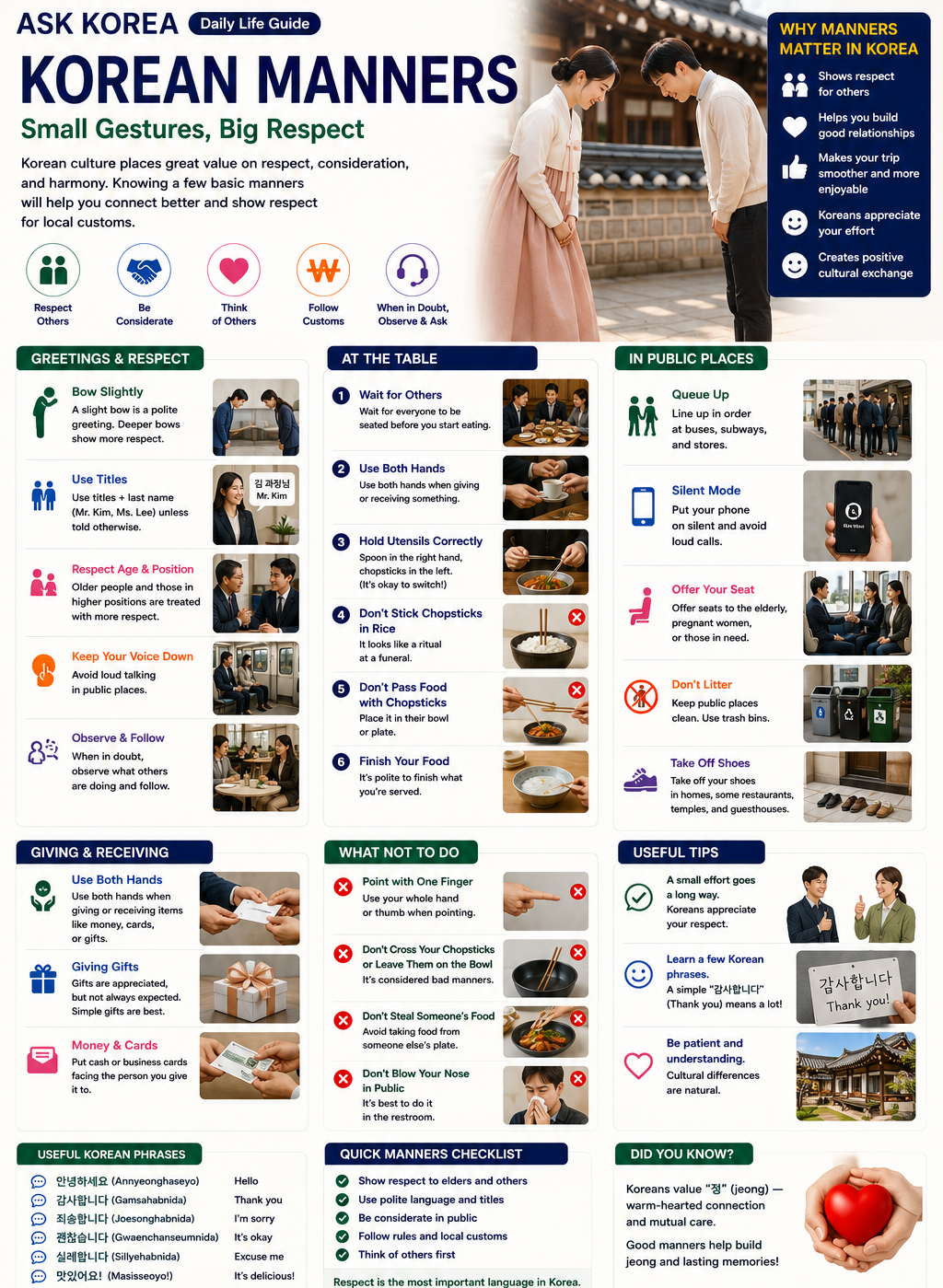
Quick Summary
Korean manners are social rules that help people live together respectfully. Most Koreans appreciate polite behavior, and understanding basic manners helps avoid misunderstandings and make a good impression.
Key takeaways
- On subways and buses: speak quietly, let people exit first, and wait in line. Avoid loud phone calls, blocking doors, and pushing.
- Priority seats are reserved for elderly people, pregnant women, and disabled passengers — many Koreans avoid these seats even when empty.
- In some areas, people stand on one side of escalators and leave the other side open, though this varies by city.
- Restaurant etiquette: wait to be seated if required, return trays when asked, share side dishes respectfully, avoid wasting food, and avoid speaking too loudly.
- Queue culture: Koreans wait in line and respect order — line cutting is considered rude and is common at subway platforms, bus stops, and stores.
- Three essential polite phrases: 감사합니다 (Thank you), 죄송합니다 (Sorry), 실례합니다 (Excuse me).
Why It Matters
Understanding basic manners helps you avoid misunderstandings, make a good impression, and feel more comfortable in Korea. Small gestures of politeness are highly valued.
Public transportation etiquette
Speak quietly, let people exit first, and wait in line. Avoid loud phone calls, blocking doors, and pushing people. Many people use earphones, and keeping noise low is considered polite.
Priority seat culture
Priority seats are reserved for elderly people, pregnant women, and disabled passengers. Even if empty, many Koreans avoid using these seats.
Speaking politely
The phrases 감사합니다 (Thank you), 죄송합니다 (Sorry), and 실례합니다 (Excuse me) help a lot. Using polite language is appreciated even if your Korean is not perfect — most Koreans understand that visitors are still learning.
Home visit culture
If invited to someone's home, remove your shoes and be polite. Small gifts are sometimes appreciated when visiting — not required, but considered thoughtful.
Step-by-Step Guide
- 01
1. What are Korean manners?
Social rules that help people live together respectfully. Most Koreans appreciate polite behavior.
- 02
2. Public transportation etiquette
Speak quietly, let people exit first, and wait in line. Avoid loud phone calls, blocking doors, and pushing people. Many people watch videos or listen to music using earphones, and keeping noise low is considered polite.
- 03
3. Priority seat culture
Priority seats are reserved for elderly people, pregnant women, and disabled passengers. Even if empty, many Koreans avoid using these seats.
- 04
4. Escalator culture
In some areas, people stand on one side of the escalator and leave the other side open. Practices may vary by city.
- 05
5. Restaurant manners
Wait to be seated if required, return trays when asked, and share side dishes respectfully. In formal situations, people wait until everyone is served before starting to eat, especially with older people. Avoid wasting food and speaking too loudly.
- 06
6. Queue culture
Koreans usually wait in line, respect order, and avoid cutting in line. Line cutting is considered rude. Queue lines are common at subway platforms, bus stops, and stores.
- 07
7. Speaking politely
Simple polite words: 감사합니다 (Thank you), 죄송합니다 (Sorry), 실례합니다 (Excuse me). These three phrases help a lot. Using polite language is appreciated even if your Korean is not perfect, and most Koreans understand visitors are still learning.
- 08
8. Personal space
Korea can feel crowded, but people generally respect personal boundaries.
- 09
9. Trash & cleanliness
People are expected to clean up after themselves, use recycling bins correctly, and respect public spaces.
- 10
10. Cafe manners
Studying, working, and staying for a while are generally acceptable, but buying something is expected. Many people study or work for extended periods, though busy cafes may have time limits.
- 11
11. Home visit culture
If invited to someone's home: remove your shoes and be polite. Small gifts are sometimes appreciated — not required, but considered a thoughtful gesture.
- 12
12. Real survival situation: crowded subway
Subway is crowded → wait for people to exit → board calmly → avoid blocking doors.
- 13
13. Real survival situation: restaurant visit
Restaurant visit → order food → eat → return tray if required.
- 14
14. Real survival situation: meeting older people
Meeting older people → use polite expressions → say 감사합니다 → leave a good impression.
- 15
15. Korean culture surprises
Many foreigners notice quiet subways, organized lines, respect for elderly people, and clean public spaces. Many visitors also notice that people often apologize even for small inconveniences, using words like 죄송합니다 and 실례합니다 frequently.
Important Tips
Learn 감사합니다
"Thank you" — one of the most useful phrases in daily interactions.
Learn 죄송합니다
"Sorry" — commonly used even for small inconveniences.
Follow local behavior
Observing how locals act in queues, on transportation, and at restaurants will guide you well.
Observe people around you
Watching others is a reliable way to understand unspoken social norms.
When unsure, be polite
Politeness is always appreciated, even if you're not sure of the exact custom.
Respect priority seats
Avoid sitting in priority seats, even if they appear empty.
Remove shoes when visiting a home
This is expected in most Korean homes and some other settings too.
Don't cut in line
Line cutting is considered rude in Korea — always wait your turn.
Common Mistakes
Don't
Having loud conversations on the subway.
Do
Speak quietly on public transportation — many people are resting or on calls with earphones.
Don't
Sitting in priority seats carelessly.
Do
Avoid priority seats reserved for elderly people, pregnant women, and disabled passengers, even when empty.
Don't
Cutting in line.
Do
Wait your turn — line cutting is considered rude in Korea.
Don't
Not removing your shoes when visiting a home.
Do
Remove your shoes when entering someone's home.
Don't
Blocking escalators.
Do
In some areas, people stand on one side and leave the other open — follow local behavior.
Frequently Asked Questions
What manners should I know in Korea?+
Public transportation etiquette, restaurant manners, queue culture, and a few polite expressions like 감사합니다, 죄송합니다, and 실례합니다.
Are priority seats strictly reserved?+
They are reserved for elderly people, pregnant women, and disabled passengers, and many Koreans avoid using them even when empty.
Do I need to remove my shoes when visiting a Korean home?+
Yes, this is expected when invited to someone's home.
Is it necessary to bring a gift when visiting someone's home?+
Not required, but small gifts are sometimes appreciated and considered thoughtful.
What are the three most useful polite phrases?+
감사합니다 (Thank you), 죄송합니다 (Sorry), and 실례합니다 (Excuse me).
Is line cutting acceptable in Korea?+
No, line cutting is considered rude — Koreans generally wait in line and respect order.
Official Resources
Ask AI About This Topic
Have a question about Korean Manners — Basic Etiquette for Everyday Life.?
Get instant, locally-checked answers from the ASK KOREA AI. Ask anything from specific edge cases to itinerary decisions.
"What are the most important cultural manners I should know as a first-time traveler in Korea?"