Traditional Korean Blacksmithing
Fire, Iron & the Craft of the Korean Blacksmith: inside the traditional daejanggan, the tools it produced and the Korean homi that found gardeners around the world.
Quick Summary
Key takeaways
- Korean: 대장간 (Daejanggan)
- Blacksmith: 대장장이 (Daejangjangi)
- Craft: Traditional Korean blacksmithing and ironworking
- Main Materials: Iron and steel
- Traditional Tools: Forge, bellows, anvil, hammer and tongs
- Traditional Products: Homi, sickles, knives, axes, hoes and other farming and household tools
- Experience: Demonstrations and selected hands-on forging workshops
- Experience Price: Varies by workshop; some current programs are offered from around KRW 30,000
- Best For: Traditional craftsmanship, hands-on culture and unusual Korean experiences
The Complete Guide
What Is a Korean Daejanggan?
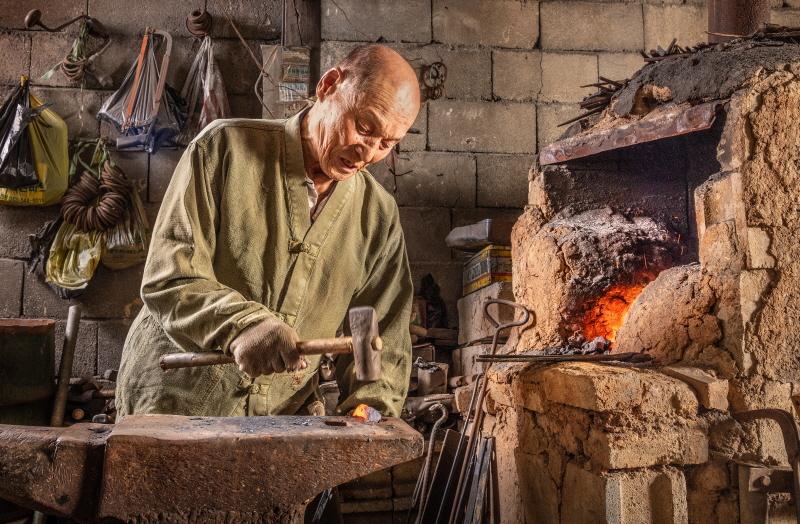
Before factories could produce thousands of identical tools, Korean villages depended on a very different place: the daejanggan (대장간), or traditional blacksmith's forge.
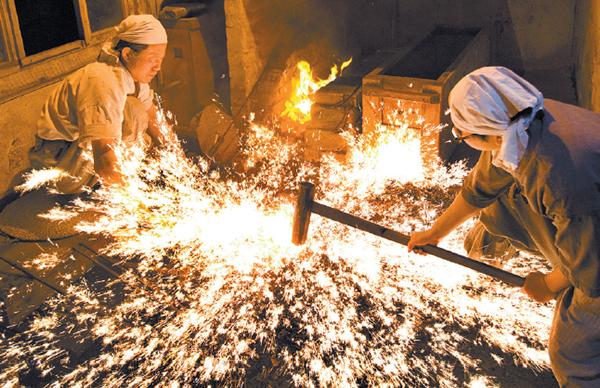
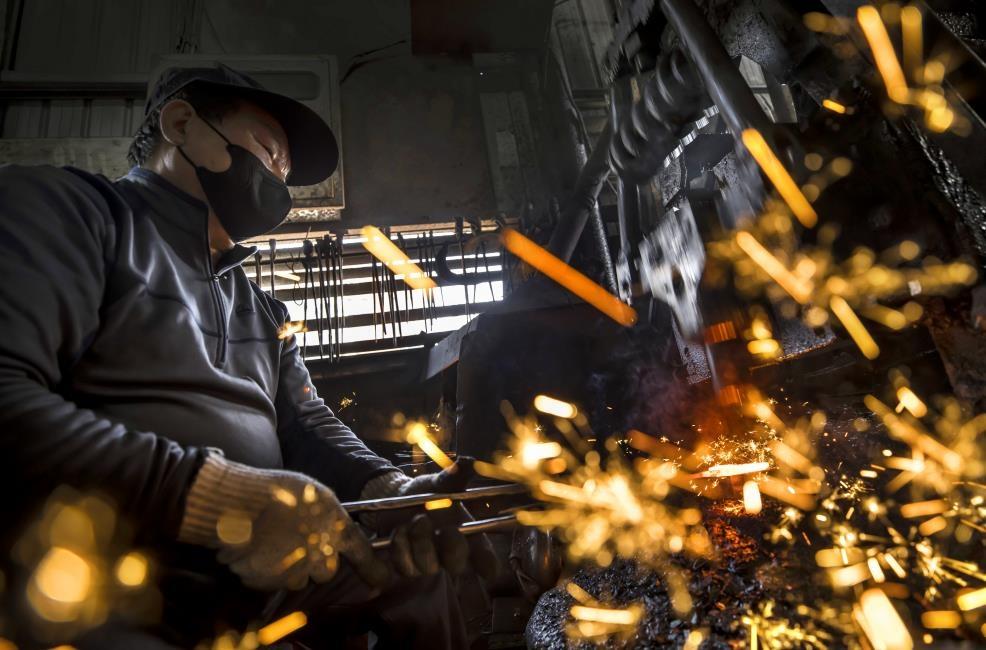
Inside, a blacksmith heated iron until it glowed red or orange, removed it from the fire with long tongs and repeatedly struck it with a heavy hammer.
With heat, force and experience, a simple piece of metal could become a farming tool, kitchen implement or another object needed in everyday life.
The work was loud, hot and physically demanding.
Sparks flew from the anvil. The forge radiated intense heat. Hammers struck metal again and again.
For generations, the village blacksmith was an essential part of everyday Korean life.
The Blacksmith — Daejangjangi
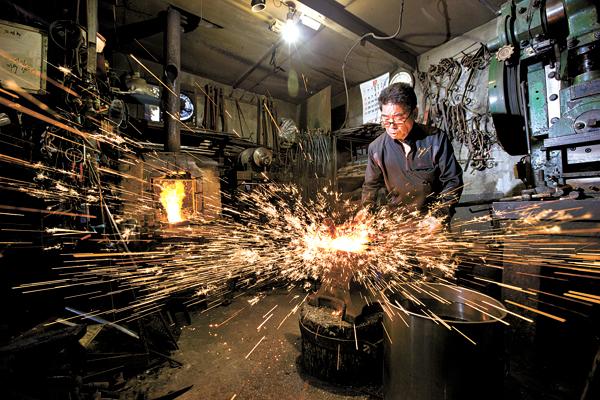
A traditional Korean blacksmith is commonly called a daejangjangi (대장장이).
The job required much more than physical strength.
An experienced blacksmith needed to understand how metal changed as it heated and cooled. The color of heated iron helped indicate whether it was ready to be worked.
Too cold, and the metal became difficult to shape.
Too hot, and the material could be damaged.
The craftsman also had to know where to strike, how hard to strike and when to return the metal to the fire.
Much of this knowledge was acquired through years of observation and practice.
Inside a Traditional Korean Forge
A traditional forge was a working environment rather than a decorative craft studio.
Several basic elements were essential.
The Forge
The fire provides the intense heat necessary to soften metal so that it can be shaped.
Bellows
Air is forced into the fire to increase its temperature.
Anvil
The heated metal is placed on a heavy solid surface for hammering and shaping.
Hammer
Repeated hammer blows gradually transform the metal into the required form.
Tongs
Long metal tongs allow the blacksmith to grip and move extremely hot pieces safely.
Water
Cooling and heat-treatment processes may be used at different stages depending on the object and type of metal.
Together, these relatively simple tools allowed skilled craftsmen to produce remarkably durable and useful objects.
From Iron to Tool
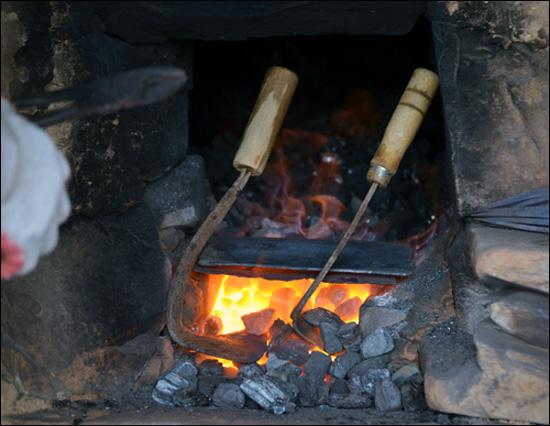
Traditional forging is a repeated process involving fire, hammering and careful control of the metal.
Heating
The metal is placed inside the forge and heated until it becomes hot enough to work.
Hammering
The glowing metal is moved to the anvil and struck repeatedly. Each blow changes its shape.
Reheating
Metal cools quickly outside the forge, so the craftsman repeatedly returns it to the fire.
Shaping
The blacksmith gradually forms the blade, edge, handle connection or other parts of the tool.
Heat Treatment & Cooling
Depending on the material and object, controlled heating and cooling help produce the required characteristics.
Finishing
The completed tool may be sharpened, ground, polished or fitted with a wooden handle.
Watching an ordinary piece of iron slowly become a recognizable tool is one of the most fascinating parts of a traditional blacksmithing demonstration.
What Did Korean Blacksmiths Make?
Traditional Korean blacksmiths primarily produced practical objects for everyday life.
Their products included:
Homi (호미) — Korean Hand Hoe
A distinctive curved hand tool used for digging, planting and weeding.
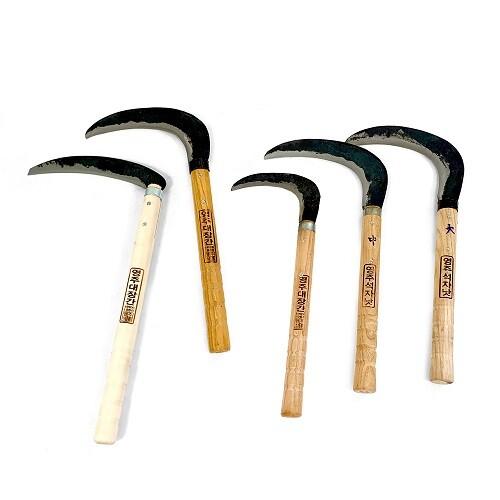
Nat (낫) — Sickle
A curved cutting tool traditionally used for harvesting crops and cutting grass.
Kal (칼) — Knife
Different types of knives and blades used for cooking, farming and general work.
Dokki (도끼) — Axe
Used for cutting and splitting wood.
Gwaeng-i (괭이) — Hoe / Mattock
A heavier agricultural tool for breaking and working soil.
Pickaxes and Agricultural Implements
Tools needed for farming and construction.
Household & Workshop Tools
Blacksmiths also manufactured and repaired many everyday iron objects required by local communities.
These were not originally souvenirs or decorative objects.
They were tools that people genuinely depended on.
The Korean Homi — From a Village Forge to the World
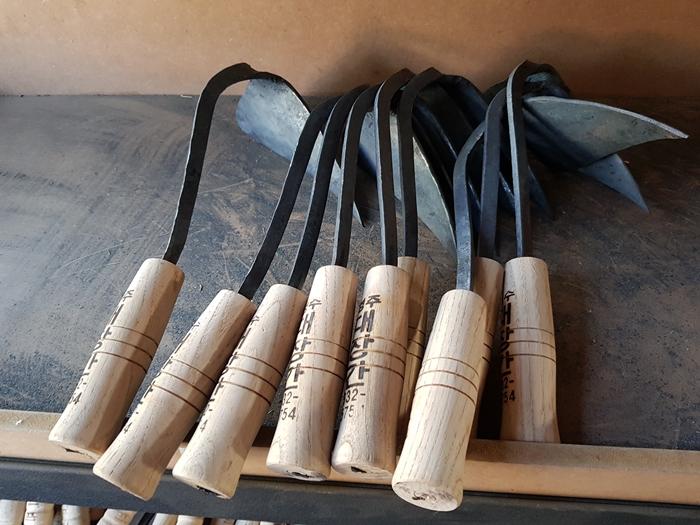
Among all the tools made by Korean blacksmiths, one has developed a particularly interesting international following: the homi (호미).
For generations, the homi was an ordinary farming tool found throughout rural Korea.
Its curved metal blade is designed for working close to the ground and can be used for several different jobs.
A homi can help gardeners:
For many Koreans, the homi was so ordinary that few would have expected it to become known internationally.
But overseas gardeners began discovering the tool.
The “K-Homi” Goes Global
Korean homi began attracting attention among gardeners outside Korea, particularly through online marketplaces, gardening communities and videos.
Its unusual curved shape and versatility distinguished it from many conventional Western hand gardening tools.
One small tool could perform several jobs.
More importantly, the Korean name traveled with the product.
Rather than disappearing under a completely new foreign name, the tool became increasingly known as a “Homi” or “Ho-Mi.”
Today, Korean-style homi can be found in overseas gardening markets and online stores.
It is an unusual example of an everyday Korean object becoming internationally recognized because of its practical design rather than because it was originally created as an export or cultural product.
Yeongju Blacksmith — A Korean Homi Success Story
One of the best-known stories comes from Yeongju in Gyeongsangbuk-do.
Traditional blacksmith Seok No-gi has spent decades making agricultural tools, including handmade homi.
His forged homi eventually began reaching overseas customers through international online sales.
Reports have described thousands of his handmade homi being sold abroad, with the tools reaching markets including the United States, Canada, Australia and New Zealand.
By 2023, Korean media reported that Yeongju Smithy's products were being exported to around 10 countries and that overseas demand had grown beyond domestic sales.
The story is remarkable because the product itself is extremely simple.
A traditional Korean farm tool made in a local forge found a completely new audience among gardeners thousands of kilometers away.
Why Do Foreign Gardeners Like the Homi?
The main reason is practical design.
The pointed part of the blade can penetrate soil.
The wider blade can move earth.
The edge can remove weeds and roots.
The curved shape allows several gardening jobs to be performed with one compact tool.
Traditional handmade homi are especially interesting because the blade is forged and shaped by a blacksmith rather than simply stamped out as an identical industrial product.
Different forms and sizes have historically been used according to agricultural needs and regional practices.
From Farm Tool to Korean Cultural Product
The international popularity of the homi tells an unusual story about Korean culture.
Unlike K-pop, Korean dramas, K-beauty or Korean food, the homi was never designed to introduce Korea to the world.
It was simply a useful agricultural tool.
Foreign gardeners discovered it because it worked.
That makes the homi a particularly interesting object for travelers interested in Korean craftsmanship.
It connects:
A handmade Korean homi is therefore more than a decorative souvenir.
It is a traditional tool that is still genuinely useful today.
Blacksmithing and Korean Agriculture
For much of Korean history, agriculture was central to everyday life.
That made the village blacksmith extremely important.
Farm tools wore down, broke or required sharpening. New tools were constantly needed for planting, cultivating and harvesting crops.
A local forge could manufacture new tools and repair damaged ones without requiring farmers to obtain replacements from far away.
The blacksmith therefore occupied an important position within the traditional local economy.
The rhythm of agricultural life and the work of the forge were closely connected.
More Than Farm Tools
Korean metal craftsmanship extended far beyond the village hoe or sickle.
Specialist Korean artisans developed sophisticated techniques for producing and working metal for architecture, furniture, printing, religious culture and everyday life.
Korea preserves several specialized traditional metal crafts as cultural heritage.
One example is Duseokjang (두석장), the craft of making traditional metal fittings used on objects such as wooden furniture.
Another is Geumsok Hwaljajang (금속활자장), the traditional craft associated with producing metal movable type.
These specialized traditions demonstrate the much broader metalworking knowledge that developed in Korea.
Korea and Metal Movable Type
One particularly important chapter of Korean metal craftsmanship is metal movable type.
Korean artisans developed sophisticated techniques for manufacturing individual metal characters used for printing books.
The surviving Korean Buddhist document Jikji, printed in 1377, is internationally recognized as the oldest extant book printed with movable metal type.
Producing metal movable type required highly specialized metalworking knowledge.
Although this craft is different from ordinary village blacksmithing, it demonstrates the sophisticated level reached by traditional Korean metalworking.
From Village Necessity to Living Heritage
Modern industrial manufacturing dramatically changed the role of Korea's traditional forge.
Mass-produced agricultural and household tools became inexpensive and widely available.
Mechanized agriculture also reduced demand for many handmade implements.
Traditional village blacksmith shops therefore became increasingly rare.
But the craft did not disappear completely.
Traditional forging survives through individual blacksmiths, working workshops, museums, cultural villages, heritage programs and craft experiences.
Today, visiting a working forge provides a glimpse into both Korea's agricultural past and its surviving traditional craftsmanship.
Where Can You See a Korean Blacksmith?
Traditional blacksmithing can still be encountered in Korea, although genuine working forges are much less common than they once were.
Korean Folk Village — Yongin
The Korean Folk Village includes a traditional blacksmith workshop representing the role of the forge in traditional village life.
Visitors can see the types of agricultural and household tools historically produced by Korean blacksmiths, including homi, sickles, picks and knives.
The village also indicates that products produced at the blacksmith workshop may be available for purchase.
For international travelers, this is one of the easiest places to understand blacksmithing within the wider context of traditional Korean life.
Traditional Working Blacksmith Shops
A small number of working blacksmith shops also survive in modern Korean cities and regional communities.
Seoul, for example, has preserved traditional working blacksmith shops as part of its local heritage.
These are particularly interesting because they are not simply reconstructed museum exhibits.
They represent the continuation of a profession that once existed throughout Korea.
Can Foreigners Try Korean Blacksmithing?
Yes, at selected workshops and cultural programs.
Hands-on blacksmithing programs may allow visitors to experience basic forging under the supervision of an experienced instructor.
Depending on the program, participants may make objects such as:
Programs vary significantly between workshops.
Some are designed for complete beginners, while more advanced projects require additional time and instruction.
How Much Does a Blacksmith Experience Cost?
There is no standard nationwide price for Korean blacksmithing experiences.
Prices depend on the workshop, duration, materials and object being made.
As an example, some currently advertised Korean traditional technology workshops have offered approximately 3-hour introductory forging programs for around KRW 30,000 per person.
Projects at this level may include basic forging or making a small hand tool.
More complicated projects, particularly knives or larger forged objects, may cost more and require longer sessions.
Important
Prices, available projects and operating schedules can change.
Always check directly with the workshop before visiting.
Advance reservations may also be required.
What Can You Make?
For travelers, the most interesting blacksmithing experience is one where the participant can take home an object they helped create.
Possible workshop projects may include:
Small Garden Tool
A simple forged gardening implement is closely connected to Korea's agricultural blacksmithing tradition.
Homi
A traditional homi is one of the most characteristic Korean forged products, although making a complete homi may not be offered in beginner workshops.
Knife
Some specialist workshops offer knife-making experiences. These generally require more time and careful supervision.
Bottle Opener or Keyring
Small forged objects are suitable for introductory experiences because visitors can practice heating and hammering metal without attempting a complicated tool.
Tongs & Simple Tools
Some workshops teach basic forging through the production of simple functional objects.
The exact project should always be confirmed before booking.
Buying a Hand-Forged Korean Tool
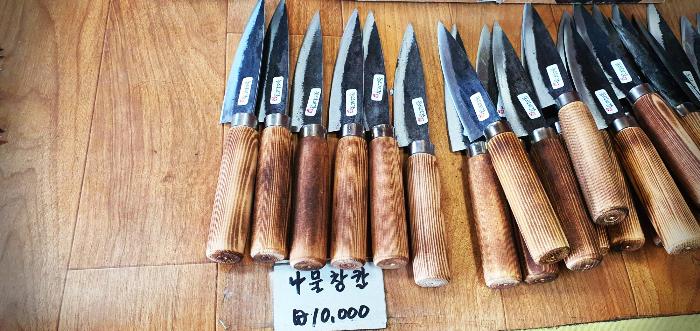
Some surviving Korean blacksmith shops sell handmade products.
For international visitors, a handmade homi is particularly interesting.
Unlike a typical souvenir, it is a functional object based on a traditional Korean design that can actually be used at home.
Hand-forged sickles, knives and other tools may also be available depending on the workshop.
Prices vary according to:
There is no single standard price.
Travel Warning
If purchasing a knife, sickle or other sharp tool, check airline baggage regulations and the import laws of your destination country.
Sharp tools should not be carried in cabin baggage.
Local rules may also restrict the import or possession of particular types of blades.
A homi is generally a much simpler souvenir for an international traveler, but baggage rules should still be checked.
What to Watch During a Blacksmithing Demonstration
If you have an opportunity to watch a Korean blacksmith, do not concentrate only on the sparks.
Watch the Color of the Iron
The appearance of heated metal changes as its temperature rises.
The blacksmith uses experience to judge when the metal is ready to work.
Watch the Hammer Rhythm
An experienced craftsman does not strike randomly. Each blow has a purpose.
Watch the Shape Change
The object may transform surprisingly quickly while the metal is hot.
Watch the Reheating Cycle
Forging involves constant movement between the fire and the anvil.
Look at the Finished Tool
Compare the finished homi, sickle or knife with the plain piece of metal from which it began.
That transformation is the heart of blacksmithing.
If You Try Blacksmithing
Blacksmithing involves real fire, extremely hot metal and heavy tools.
Always follow the instructor's directions.
Iron can remain dangerously hot even when it is no longer glowing red.
Safety requirements differ by workshop.
Useful Korean Words
| Korean | Romanization | Meaning |
| 대장간 | Daejanggan | Blacksmith's forge or workshop. |
| 대장장이 | Daejangjangi | Blacksmith. |
| 호미 | Homi | Traditional Korean hand hoe. |
| 낫 | Nat | Sickle. |
| 칼 | Kal | Knife. |
| 도끼 | Dokki | Axe. |
| 괭이 | Gwaeng-i | Hoe or mattock. |
| 망치 | Mangchi | Hammer. |
| 모루 | Moru | Anvil. |
| 불 | Bul | Fire. |
Why Experience Korean Blacksmithing?
Palaces and museums show visitors the magnificent objects produced by Korean culture. A blacksmith's workshop reveals something different: how ordinary Koreans made the tools that allowed everyday life to function.
Fire, iron, physical strength and generations of accumulated knowledge come together in one small workshop.
And the story continues today.
Perhaps the best example is the humble homi.
A tool once associated with ordinary Korean farmers has crossed borders and found a new generation of users among gardeners around the world.
That journey — from Korean soil, to a village forge, to gardens overseas — makes traditional Korean blacksmithing more than a story about the past.
It is a living example of how practical Korean craftsmanship can remain useful in the modern world.
Travel Tips
See a working forge if possible.
Watching actual forging is much more memorable than simply viewing finished tools.
Look for a handmade homi.
It is one of the most distinctive and practical products associated with Korean blacksmithing.
Check experiences before traveling.
Workshop schedules, projects and prices can change.
Reserve in advance when required.
Hands-on programs may have limited capacity.
Ask before photographing craftsmen at work.
Check baggage rules before buying sharp tools.
Official & Useful Resources
ASK KOREA Tip
If you want one object that represents Korean blacksmithing, look for a hand-forged homi.
It is inexpensive compared with elaborate craftwork, practical enough to use at home, unmistakably Korean and has one of the most unexpected international success stories among Korea's traditional tools.
Ask AI About This Topic
Have a question about Traditional Korean Blacksmithing?
Get instant, locally-checked answers from the ASK KOREA AI. Ask anything from specific edge cases to itinerary decisions.
"Where can I watch or try traditional Korean blacksmithing as a visitor?"
ASK KOREA Transit