What is Formal vs Informal Korean?
Korean has different speech levels depending on the relationship between people.
The two most common styles are:
When to use polite speech and when informal Korean is welcome.
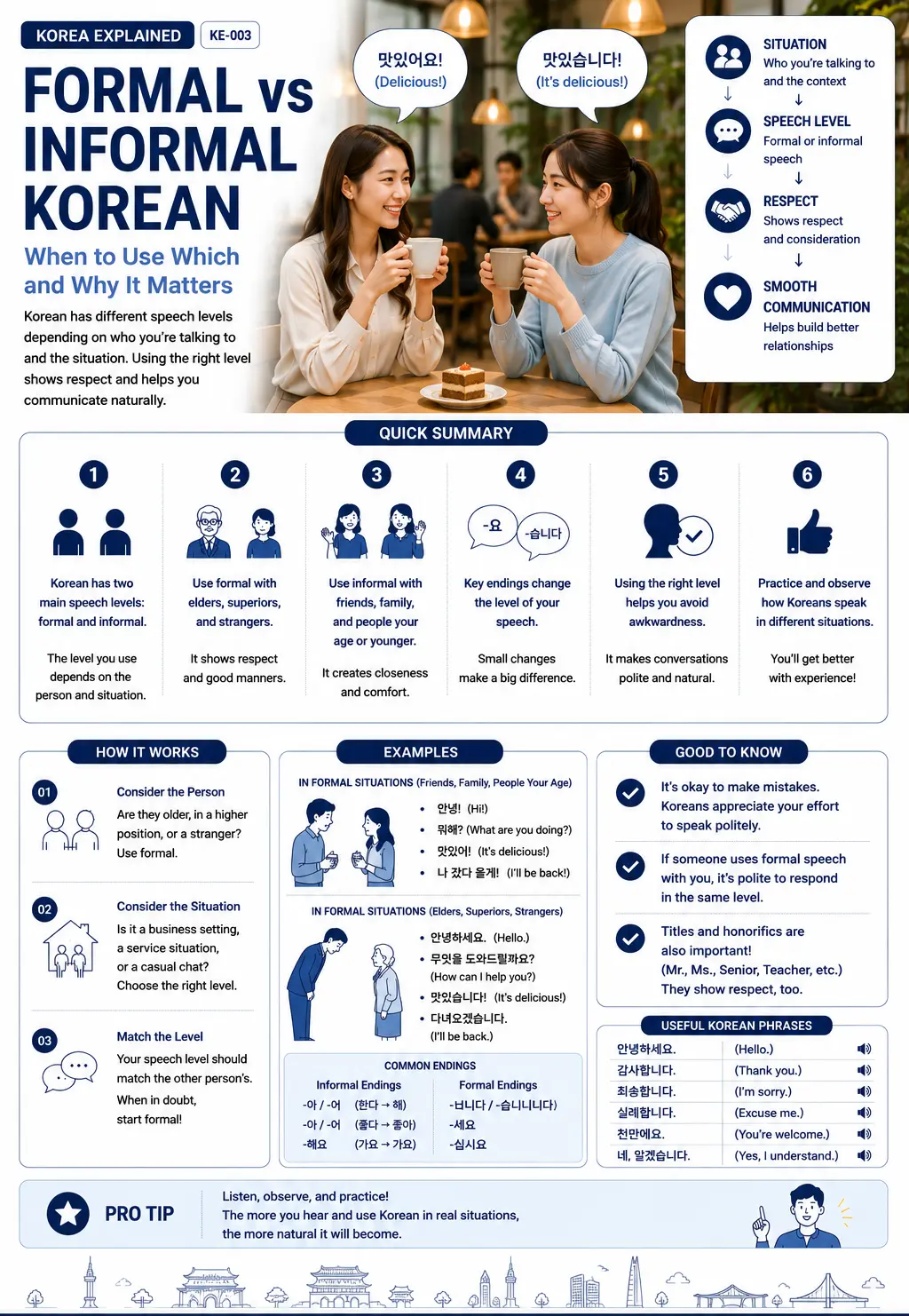
Korean has different speech levels depending on the relationship between people. The two most common styles are:
Key takeaways
Korean has different speech levels depending on the relationship between people.
The two most common styles are:
In many languages:
People speak the same way to everyone.
In Korean:
Speech changes depending on:
Formal Korean shows:
Examples:
Hello.
Thank you.
Sorry.
Where is it?
Informal Korean is used with:
Examples:
Hi.
Thanks.
Sorry.
Where is it?
Because relationships matter.
Speech helps show:
👔 Office
↓
Usually formal
👨🏫 Teacher
↓
Formal
👴 Elderly person
↓
Formal
👫 Close friend
↓
Often informal
Many foreigners learn:
Hi
Then use it everywhere.
This may sound too casual.
Many foreigners learn simple Korean expressions first.
However, using them in the wrong situation can sound awkward.
Examples:
When unsure:
Use formal Korean.
This is usually the safest choice.
Yes.
Most Koreans understand that foreigners are learning.
People usually appreciate the effort.
Usually:
After becoming friends.
Sometimes people ask:
Can we speak informally?
This often means:
Many companies use:
Formal Korean
Even among coworkers.
Families usually use:
Many languages:
One main speaking style.
Korean:
Multiple speech levels.
This is one of the most unique parts of Korean.
Meeting a stranger
↓
↓
Safe and polite
Meeting a close friend
↓
↓
Natural conversation
Get instant, locally-checked answers from the ASK KOREA AI. Ask anything from specific edge cases to itinerary decisions.
"Tell me more about formal vs informal korean in Korea and how I should navigate it as a visitor."
ASK KOREA Transit