What is Age Hierarchy?
Age hierarchy is one of the most important parts of Korean culture.
In Korea:
Age often affects:
- Language
- Relationships
- Social behavior
- Respect
- Workplace interactions
How age shapes conversation, seating and social order in Korea.
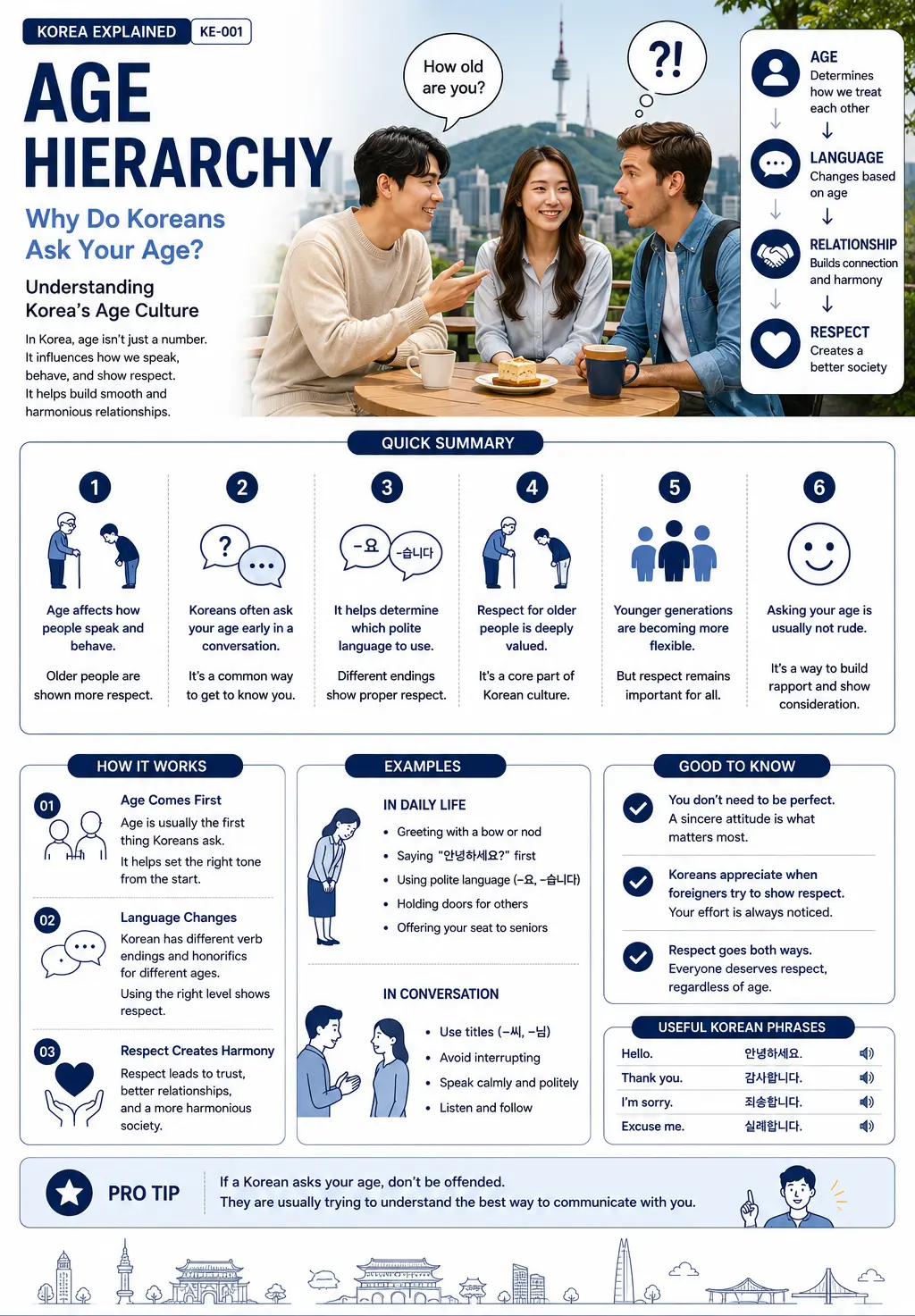
Age hierarchy is one of the most important parts of Korean culture. In Korea: Age often affects:
Key takeaways
Age hierarchy is one of the most important parts of Korean culture.
In Korea:
Age often affects:
Many foreigners are surprised when Koreans ask:
"What year were you born?"
"How old are you?"
These questions are usually not considered rude in Korea.
Koreans often ask age because it helps determine:
Age helps define social roles.
Korean language changes depending on age and relationship.
Example:
Hi
(Informal)
Hello
(Formal)
This is one reason age is important.
Generally:
Older person:
↓
Receives more respect
Younger person:
↓
Uses more polite language
Korean society has traditionally been influenced by:
Korean age hierarchy comes partly from Confucian traditions.
Important values:
Not always.
Among close friends:
↓
Less important
Among coworkers:
↓
Can still be important
Younger generations are becoming more flexible.
However:
Age still plays an important role.
Many foreigners say:
"Why did they ask my age so quickly?"
In Korea:
This is often normal curiosity.
Usually:
They are trying to understand the relationship.
Meeting a Korean friend
↓
They ask your age
↓
Don't be surprised
↓
Answer comfortably
↓
Conversation becomes easier
Meeting coworkers
↓
Age is discussed
↓
Language style becomes clearer
↓
Relationship develops
In many Western countries:
Age is considered private.
In Korea:
Age is often discussed openly.
Get instant, locally-checked answers from the ASK KOREA AI. Ask anything from specific edge cases to itinerary decisions.
"Tell me more about age hierarchy in Korea and how I should navigate it as a visitor."
ASK KOREA Transit