Quick Summary
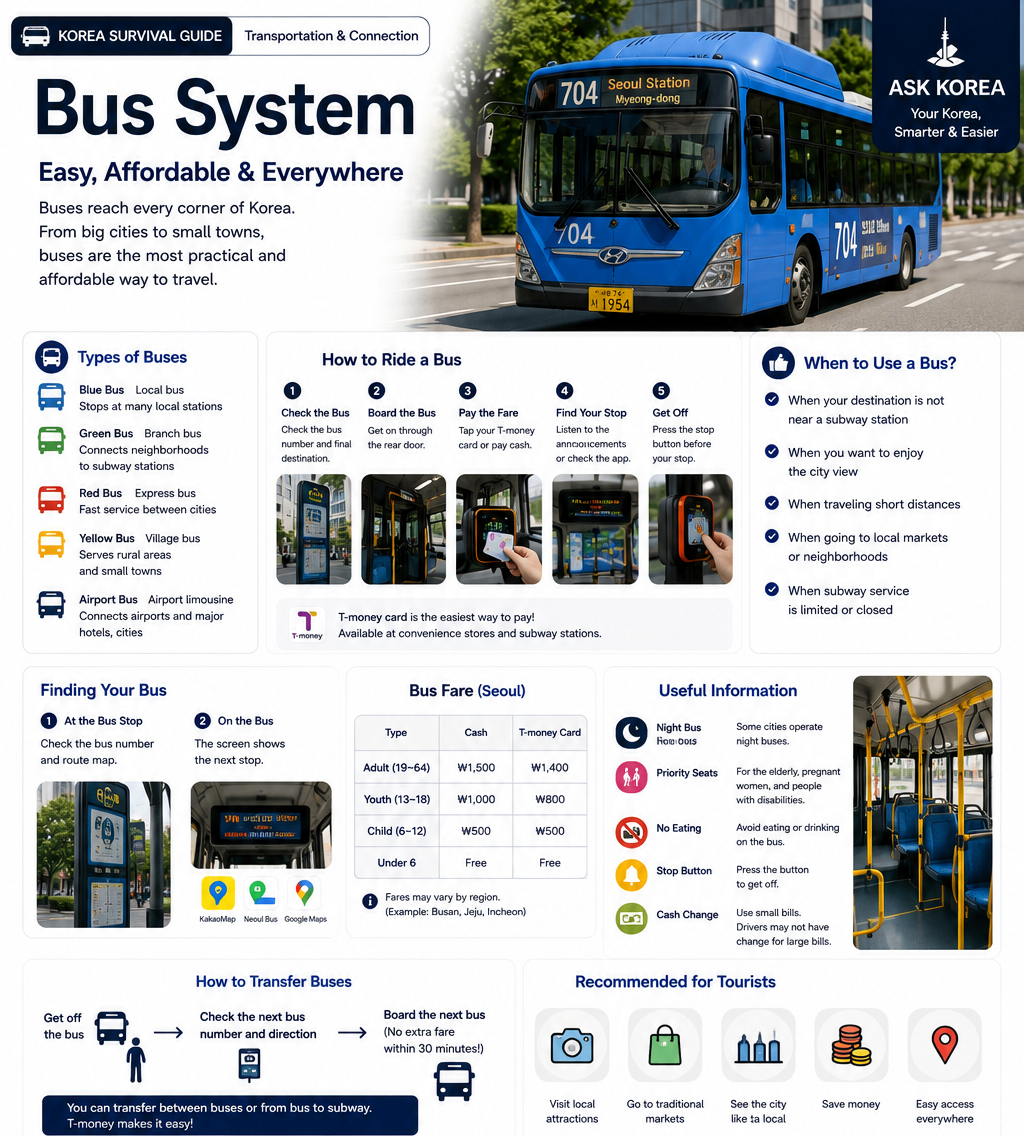
Korean buses are one of the main public transportation systems, commonly used for daily transportation, areas without subway access, short-distance travel, and airport transportation.
Key takeaways
- Buses are fast and widely connected — sometimes faster than the subway.
- Green buses run local neighborhood routes; blue buses run long-distance city routes; red buses are express/wide-area commuter buses often between cities; yellow buses run short circular routes; airport buses go directly to and from the airport.
- Board through the front door, tap your T-money card, and exit through the rear door with another tap.
- You MUST tap again when exiting, otherwise the transfer discount is lost and an extra fare may apply.
- Press the stop button before your stop — if nobody presses it, the bus may not stop.
- Korean buses can stop and depart quickly, and driving can involve sudden braking and sharp turns — hold the handrails.
- Similar-looking bus numbers (e.g. 401/402/421) can be confusing — always double-check the number, destination, and direction.
Official resources
- T-money — Official Transport Card — Official transport card issuance, top-up and usage rules.
- KOBUS — Official Express Bus Reservation — Official express bus reservation network.
- BUS TAGO — Official Intercity Bus Reservation — Official intercity bus reservation service.
- Seoul TOPIS — Real-time bus arrival information and transportation updates.
- KakaoMap — Bus routes, arrival times and navigation.
- Naver Map — Real-time bus information and route planning.
Why It Matters
Subways cannot reach everywhere. Buses help foreigners reach local areas, save time, and access difficult locations — sometimes a bus is faster than the subway.
Beyond the subway
Many foreigners use only the subway during their first visit to Korea. However, many destinations are easier to reach by bus, and a bus can sometimes save significant travel time.
Learning pays off
Learning how to use buses can make travel around Korea much easier, especially for local neighborhoods and areas without subway access.
Driving style surprises
Korean buses can feel fast, with sudden braking and sharp turns. Foreigners are often surprised. Hold handrails carefully, whether seated or standing.
Step-by-Step Guide
- 01
1. Bus types — Green Bus
Local neighborhood routes.
- 02
2. Bus types — Blue Bus
Long-distance city routes.
- 03
3. Bus types — Red Bus
Express commuter buses, often running between cities.
- 04
4. Bus types — Yellow Bus
Short circular routes.
- 05
5. Bus types — Airport Bus
Direct transportation to and from the airport.
- 06
6. What Korean buses look like
Common features: a large bus number display, a front digital screen, a card reader, a stop button, and a route display.
- 07
7. How to ride a bus
Wait at the bus stop, check the bus number, enter through the front door, tap your T-money card, and find a seat or stand.
- 08
8. Fast bus stop culture
Korean buses often stop very quickly. Be ready before the bus arrives — otherwise the bus may leave quickly without you.
- 09
9. How to get off the bus
Watch the stop display, press the stop button, exit through the rear door, and tap your card again. You MUST tap again when exiting — otherwise the transfer discount is lost and an extra fare may apply.
- 10
10. Press the stop button early
Many foreigners wait too long before pressing the stop button. It is recommended to press it one stop before your destination — if nobody presses the button, the bus may not stop.
- 11
11. How to pay
Available payment methods: T-money card, cash, and some mobile transportation payment. Most people use T-money.
- 12
12. Bus stop system
Bus stops usually show bus numbers, arrival times, route maps, and real-time information, often via digital screens.
- 13
13. Korean bus stop confusion
Korean bus stops can feel confusing at first: many bus numbers, multiple buses arriving at once, and complex stop names. Foreigners often miss the correct bus, confuse similar bus numbers, or panic when buses arrive quickly.
- 14
14. Bus etiquette in Korea
Enter through the front door, exit through the rear door, be mindful of priority seats, do not block doors, and keep phone calls quiet.
- 15
15. Similar bus number problem
Some Korean bus numbers look very similar, for example 401 / 402 / 421 or 720 / 721 / 722. Always double-check the bus number, destination, and route direction.
- 16
16. Common foreigner mistakes
Forgetting to tap when exiting, entering through the rear door, missing the stop button, riding the wrong bus number, not preparing to exit, and panicking when the bus moves fast.
- 17
17. Missing your stop
Foreigners often miss stops because Korean announcements are fast, they are watching their phone too much, or stop names are confusing. Prepare before your stop arrives.
- 18
18. Korean bus driving style
Korean buses can feel fast, with sudden braking and sharp turns. Foreigners are often surprised — hold handrails carefully.
- 19
19. Standing passenger survival tip
Korean buses can accelerate or brake suddenly. If you are standing, hold handrails firmly, keep your balance, and be careful when the bus turns. Many foreigners are surprised by this.
- 20
20. Airport bus system
Airport buses are popular for heavy luggage, direct airport routes, and comfortable seating. Important: airport buses cost more than regular buses.
Important Tips
Use KakaoMap or Naver Map
These apps show accurate bus routes and real-time arrival times.
Always check the bus number carefully
Similar numbers like 401/402/421 can easily be confused.
Press the stop button early
Press it one stop before your destination — otherwise the bus may not stop.
Prepare before your stop
Watch the display and get ready to move toward the rear door in advance.
Hold something while standing
Korean buses can accelerate, brake, and turn suddenly.
Tap in and tap out every time
You MUST tap again when exiting, or you lose the transfer discount and may be charged extra.
Buses can beat the subway
For some routes, especially local ones, a bus can be faster than taking the subway.
Learn a key phrase
"이 버스 강남 가나요?" means "Does this bus go to Gangnam?" — useful when unsure.
Common Mistakes
Don't
Forgetting to tap when exiting.
Do
Always tap your T-money card again at the rear door when exiting, or the transfer discount is lost and extra fare may apply.
Don't
Entering through the rear door.
Do
Always board through the front door and tap your card there.
Don't
Missing the stop button.
Do
Press the stop button one stop before your destination — otherwise the bus may not stop.
Don't
Riding the wrong bus number.
Do
Double-check the number carefully; similar numbers like 401/402/421 are easy to confuse.
Don't
Not preparing to exit in advance.
Do
Watch the stop display and move toward the rear door before your stop arrives.
Don't
Panicking when the bus moves fast.
Do
Korean buses can brake and turn suddenly — hold the handrails firmly at all times.
Frequently Asked Questions
Can foreigners use buses easily?+
Yes, but bus numbers can be confusing at first.
Do buses accept cards?+
Yes. T-money is the most common payment method.
Why do I need to tap again when exiting?+
For transfer discount calculation and correct fare calculation.
Do I need to press the stop button?+
Yes. Press the stop button before your stop — otherwise the bus may continue without stopping.
Are Korean buses faster than the subway?+
Sometimes. Depending on the route, a bus can save significant travel time compared to the subway.
What color bus should I look for?+
It depends on your route: green (local), blue (long-distance city), red (express/wide-area), yellow (short circular), or airport buses (direct to/from the airport).
Official Resources
Ask AI About This Topic
Have a question about Bus System — How to Ride Korean City Buses.?
Get instant, locally-checked answers from the ASK KOREA AI. Ask anything from specific edge cases to itinerary decisions.
"How do I ride a bus in Korea, and why do I need to tap my T-money card both when boarding and when exiting?"