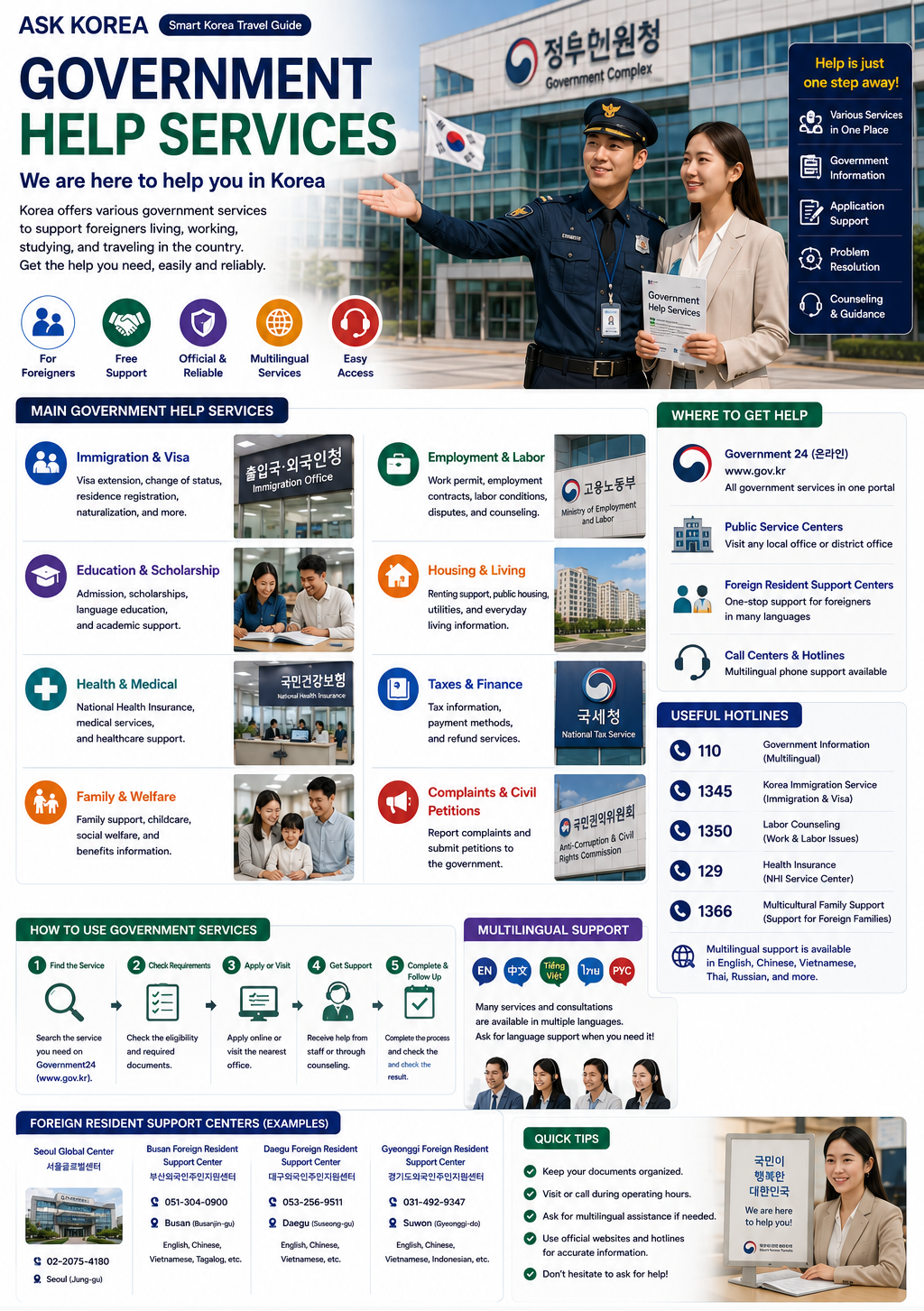
Quick Summary
Korea is generally considered very safe, but travelers should still check their embassy information before arriving and stay alert to basic safety practices.
Key takeaways
- Every traveler should check their own country's embassy information before arriving in Korea.
- If you lose your passport, contact the police and your embassy to request an emergency travel document.
- Korea is generally considered very safe, but stay aware, protect your valuables and use common sense.
- Korean police are generally helpful to foreigners.
- The 1330 Korea Travel Hotline can help with translation and general tourist assistance.
Official resources
- HiKorea — Official Immigration Services Portal — Visa applications, residence reporting and immigration appointments.
- Korea Immigration Service — Official Website — Immigration policy, entry requirements and foreigner registration.
- Ministry of Foreign Affairs — Official Website — Consular services, travel advisories and embassy information.
Why It Matters
Knowing where to turn for official help — your embassy or Korean authorities — makes a difficult situation far less stressful.
Embassy support
Your embassy can help with a lost passport, emergency travel documents and other official matters.
Korean police support
Korean police are generally helpful to foreigners and can assist with lost items, safety concerns and passport issues.
General safety
Korea is generally considered a very safe country, but basic precautions — staying aware, protecting valuables, using common sense — are still recommended.
Step-by-Step Guide
- 01
1. Check your embassy information before you arrive
Every traveler should know their own country's embassy details before arriving in Korea.
- 02
2. Save the embassy contact in your phone
Keep this alongside 112, 119 and 1330 for quick access.
- 03
3. If your passport is lost, contact police first
Report the loss to Korean police.
- 04
4. Then contact your embassy
Your embassy can guide you and issue an emergency travel document.
- 05
5. Follow basic safety practices
Stay aware, protect your valuables, and use common sense — Korea is generally very safe but not risk-free.
Important Tips
Save embassy contact information
Check your embassy's information before arriving in Korea.
Keep 112, 119 and 1330 saved too
Official help often starts with these numbers.
Use 1330 for general guidance
The Korea Travel Hotline can direct you to the right resource.
Korea is generally very safe
Still, use common sense and stay aware of your surroundings.
Protect your valuables
Basic precautions reduce the chance you'll need official help at all.
Don't hesitate to ask for help
Korean police are generally helpful to foreigners.
Common Mistakes
Don't
Not knowing your embassy's contact information.
Do
Check your embassy information before arriving in Korea.
Don't
Assuming Korea has no safety concerns at all.
Do
Korea is generally very safe, but basic precautions are still recommended.
Don't
Not asking Korean police for help when needed.
Do
Korean police are generally helpful to foreigners — don't hesitate to ask.
Frequently Asked Questions
Should I check my embassy information before traveling to Korea?+
Yes — every traveler should check their own country's embassy information before arriving.
What should I do if I lose my passport?+
Contact the police and your embassy immediately, and request an emergency travel document.
Is Korea safe for tourists?+
Generally yes, but basic precautions such as staying aware and protecting valuables are still recommended.
Are Korean police helpful to foreigners?+
Yes, Korean police are generally helpful to foreigners.
Official Resources
Ask AI About This Topic
Have a question about Government Help Services — Embassies & Official Support.?
Get instant, locally-checked answers from the ASK KOREA AI. Ask anything from specific edge cases to itinerary decisions.
"What embassy information should I save before traveling to Korea, and what do I do if I lose my passport?"