Korea Temple Travel Guide
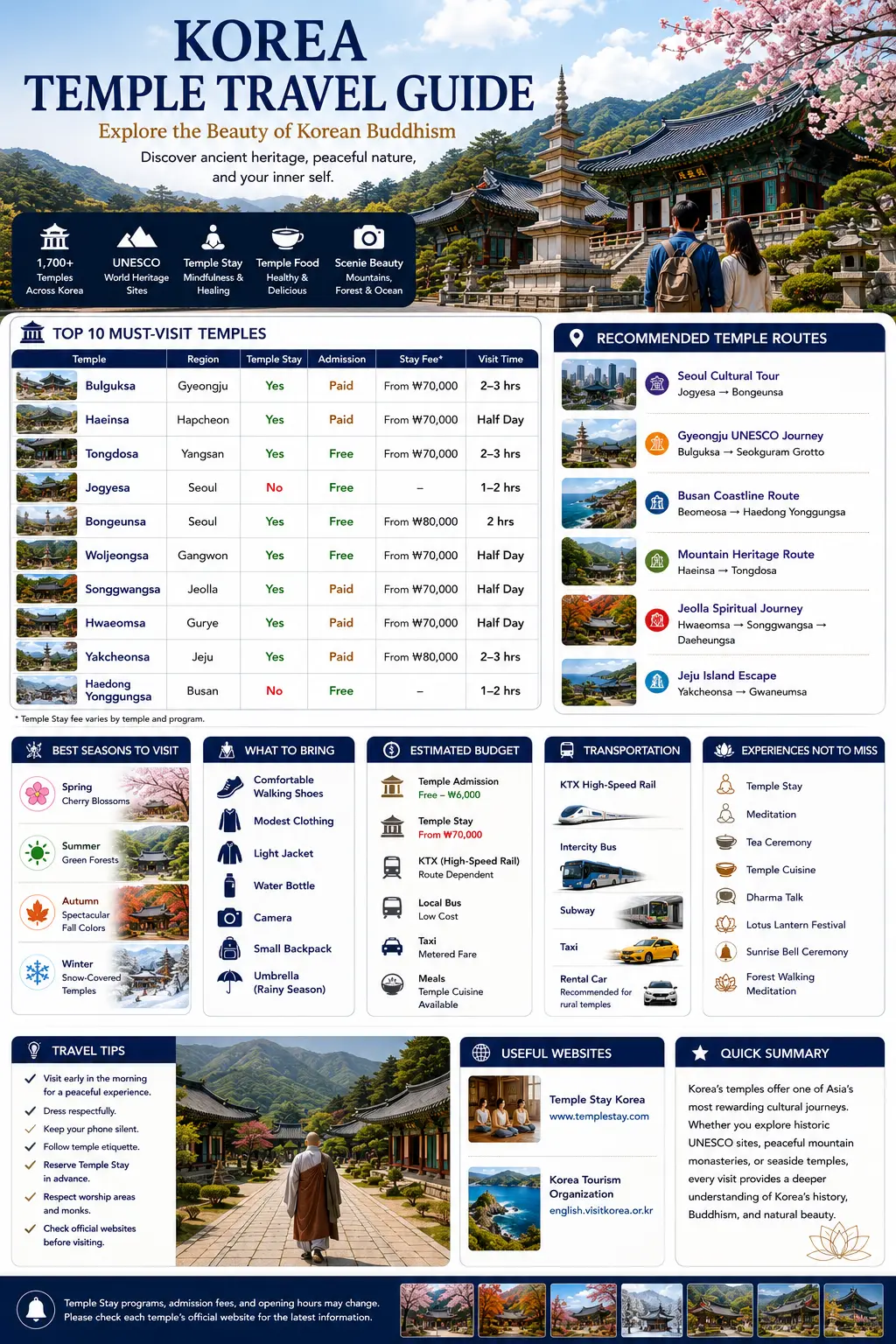
Korea's temples offer one of Asia's most rewarding cultural journeys — historic UNESCO sites, peaceful mountain monasteries and seaside temples.
Quick Summary
Key takeaways
The Complete Guide
South Korea's Buddhist temples provide some of the country's most meaningful cultural experiences. From UNESCO World Heritage Sites and mountain monasteries to peaceful urban temples and Temple Stay programs, visitors can discover Korea's spiritual traditions while enjoying beautiful natural surroundings.
Choosing the Right Temple
For First-Time Visitors
Jogyesa Temple
Bongeunsa Temple
Bulguksa Temple
For UNESCO Heritage
Bulguksa Temple
Seokguram Grotto
Haeinsa Temple
Sansa, Buddhist Mountain Monasteries
For Mountain Scenery
Woljeongsa Temple
Baekdamsa Temple
Hwaeomsa Temple
Gwaneumsa Temple
For Temple Stay
Hwagyesa Temple
Beopjusa Temple
Haeinsa Temple
Magoksa Temple
For Cultural Experiences
Jogyesa Temple
Bongeunsa Temple
Yakcheonsa Temple
What to Bring
Comfortable walking shoes
Modest clothing
Light jacket
Reusable water bottle
Camera
Small backpack
Notebook (optional)
Umbrella during the rainy season
Best Seasons
Spring
Cherry blossoms and colorful lotus lantern festivals create spectacular temple scenery.
Summer
Lush forests and cool mountain air make temple visits especially comfortable.
Autumn
Colorful foliage transforms mountain temples into some of Korea's most beautiful destinations.
Winter
Snow-covered temples offer peaceful landscapes and excellent photography opportunities.
Travel Tips
Visit early in the morning for a quieter atmosphere.
Respect religious ceremonies.
Consider joining a Temple Stay program.
Check opening hours before visiting.
Follow photography rules.
Combine temple visits with nearby national parks and cultural attractions.
Quick Summary
Korea's Buddhist temples combine history, spirituality, architecture, and nature into unforgettable travel experiences. Whether exploring UNESCO World Heritage Sites, participating in a Temple Stay, or simply enjoying peaceful mountain scenery, visitors will gain a deeper appreciation of Korea's rich Buddhist heritage.
4. Hanok Villages
Traditional Hanok villages preserve Korea's architectural heritage, community traditions, and centuries-old way of life. A Hanok is a traditional Korean house designed to harmonize with nature, using natural materials such as wood, stone, clay, and paper.
Unlike open-air museums, many Hanok villages remain living communities where residents continue to live alongside historic homes, cultural workshops, cafés, guesthouses, and local businesses. Visitors can walk through narrow stone alleys, stay overnight in traditional accommodations, wear Hanbok, enjoy Korean cuisine, and experience Korea's rich cultural heritage in an authentic setting.
Each Hanok village has its own unique character. Some reflect royal and aristocratic life, while others preserve traditional farming communities or Confucian culture. Together, they offer visitors one of the best ways to experience Korea's architectural and cultural history.
Highlights
Traditional Korean architecture
Historic villages
Hanok Stay experiences
Cultural workshops
Traditional tea houses
Korean cuisine
Hanbok experiences
Stone alleyways
Living cultural heritage
Excellent photography locations
Why Visit Hanok Villages?
Experience traditional Korean architecture.
Stay in authentic Hanok accommodations.
Learn about Korean history and culture.
Enjoy traditional food and tea.
Wear Hanbok in historic surroundings.
Explore beautifully preserved neighborhoods.
Best Time to Visit
Spring (March–May)
Cherry blossoms and comfortable weather create beautiful village scenery.
Summer (June–August)
Green landscapes and cultural festivals bring villages to life.
Autumn (September–November)
Colorful foliage makes Hanok villages especially picturesque.
Winter (December–February)
Snow-covered rooftops create peaceful and unforgettable landscapes.
Popular Experiences
Hanok Stay
Hanbok rental
Tea ceremonies
Traditional cuisine
Cultural workshops
Photography
Walking tours
Craft experiences
Traditional performances
Local markets
Quick Summary
Hanok villages preserve Korea's architectural heritage while allowing visitors to experience traditional culture through historic homes, local communities, cuisine, and cultural activities.
Ask AI About This Topic
Have a question about Korea Temple Travel Guide?
Get instant, locally-checked answers from the ASK KOREA AI. Ask anything from specific edge cases to itinerary decisions.
"Plan a week-long Korea temple trip covering the top must-visit temples."
ASK KOREA Transit