Gyeongsang Region
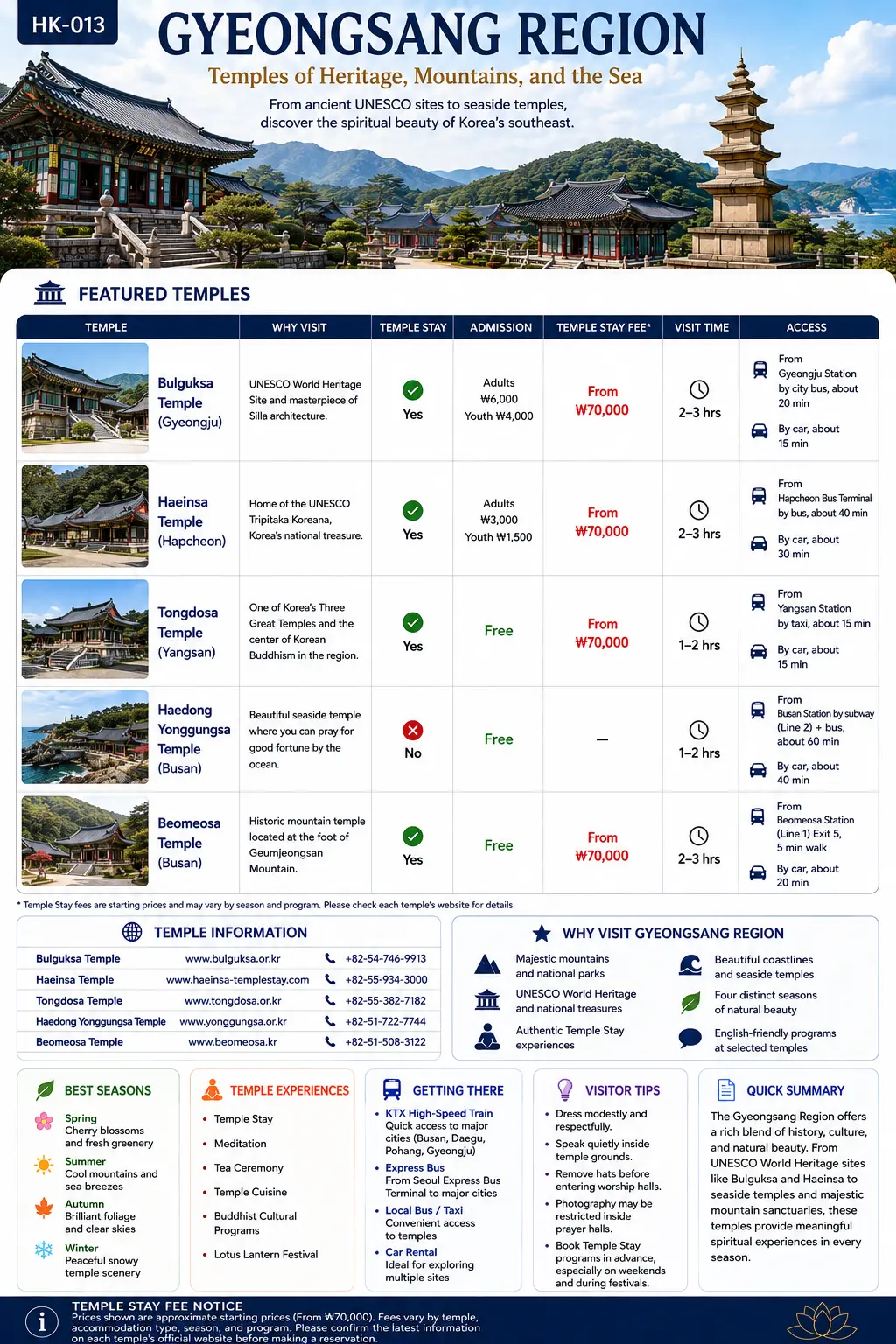
The Gyeongsang Region offers a rich blend of history, culture and natural beauty, from UNESCO World Heritage temples to seaside sanctuaries.
Quick Summary
Key takeaways
The Complete Guide
The Gyeongsang Region is often regarded as the birthplace of Korean Buddhist culture. Home to several UNESCO World Heritage Sites and some of Korea's most celebrated temples, this region preserves extraordinary examples of Buddhist architecture, sculpture, and religious tradition.
Temples in the Gyeongsang Region
Bulguksa Temple
Bulguksa Temple is Korea's most famous Buddhist temple and a UNESCO World Heritage Site. Built during the Unified Silla Period, it is renowned for its elegant stone pagodas, historic bridges, and exceptional architectural beauty.
Seokguram Grotto
Located on Mount Tohamsan, Seokguram Grotto houses one of the world's finest stone Buddha statues. This UNESCO World Heritage Site is considered a masterpiece of Buddhist art and engineering.
Haeinsa Temple
Situated in Gayasan National Park, Haeinsa Temple is internationally famous for housing the Tripitaka Koreana, the world's most complete collection of Buddhist scriptures carved onto more than 80,000 wooden printing blocks.
Tongdosa Temple
Tongdosa Temple is one of Korea's Three Jewel Temples and is unique because it enshrines sacred relics of the Buddha rather than a large Buddha statue inside its main hall.
Highlights
UNESCO World Heritage Sites
Korea's most famous temples
Tripitaka Koreana
Ancient Buddhist architecture
Sacred relics
Mountain monasteries
Outstanding cultural heritage
Temple Stay programs
Quick Summary
The Gyeongsang Region represents the heart of Korean Buddhism, offering visitors world-renowned temples, UNESCO heritage sites, and some of the country's most important religious treasures.
Ask AI About This Topic
Have a question about Gyeongsang Region?
Get instant, locally-checked answers from the ASK KOREA AI. Ask anything from specific edge cases to itinerary decisions.
"Build a Gyeongju and Busan temple itinerary including Bulguksa and Haedong Yonggungsa."
ASK KOREA Transit